LexTalk World San Francisco 2026 brings corporate legal leaders, legal operations professionals, law firm professionals, and legal technology providers together for two days on AI, IP, enterprise risk, and the changing business of law. Those themes touch the questions corporate legal teams, legal operations, and law departments are working through now: where AI fits, how teams govern it, and what work should stay with a lawyer.
LexTalk World San Francisco 2026 Overview
Detail | San Francisco Edition |
|---|---|
Dates | November 19 to 20, 2026 |
Venue | South San Francisco Conference Center; exact venue details are sent to registered delegates |
Organizer | LexTalk World |
Format | Two-day conference and exhibition |
Audience | Corporate legal leaders, legal operations professionals, law firm professionals, and industry participants |
Essential Access | $399 early rate through September 30; listed standard price $598 |
Full Access | $599 early rate through September 30; listed standard price $1,198 |
Vendor Pass | $999 early rate through September 30; listed standard price $1,998 |
Executive Roundtables | Private, peer-level discussions; Full Access includes a roundtable seat |
California CLE | Included with every paid delegate pass |
Selected LexTalk Agenda Themes
The two-day program moves from AI and the new legal business model to IP, risk, and enterprise decision-making, with separate LexTalk Executive Roundtables for senior legal leaders.
Day One: AI, IP, and the New Legal Business Model
On November 19, “From Protection to Connection: Turning Your Practice Inside Out with AI” looks at how AI changes legal work, while “Orchestration over Automation: Integrating AI Agents into Corporate Workflows” turns to AI agents in corporate processes.
Sessions on cross-border investigations, regulatory exposure, and the rise of the judgment expert lead into “The Legal Function in 2030.”
Day Two: IP, Risk, and Enterprise Decision-Making
On November 20, “IP as a Business Asset,” “The AI IPO Wave,” “The Speed of Modern Legal Decision-Making,” and “The Weaponization of Information” put IP, market pressure, and enterprise risk in view before the Legal Honor Awards ceremony.
Executive Roundtables
Executive Roundtables are private, invitation-only discussions for senior legal leaders. Each is limited to 8 to 10 participants and follows the Chatham House Rule. Some detailed titles and speakers may still change, so recheck the agenda when planning a pass.
GC AI at LexTalk World San Francisco
Come talk legal AI with the GC AI team in San Francisco. The program’s focus on AI agents, cross-border investigations, IP, and enterprise risk gives in-house counsel a useful way to ask where AI belongs in the work, what a team should automate, and what a lawyer still needs to review. GC AI is an enterprise legal AI platform built for in-house teams.
As of October 2026, 2,200+ legal teams, including 300+ public companies, use GC AI. Legal teams at TIME, Nestlé, SKIMS, and Columbia Sportswear use GC AI.
Columbia Sportswear’s legal team supports a global business and uses GC AI for research, meeting preparation, and issues outside an attorney's immediate specialty.
Bring a recurring workflow or review question to a conversation with the team. We can walk through the instructions, what the platform would prepare, what the lawyer would check, and how you would judge the result.
When you compare options, test the same use case against citations, Word support, security, and team fit, the questions at the center of legal AI tools.
When that comparison becomes a governance decision, AI governance intake starts with the use case, information involved, reviewer, and escalation path. The risk discussion also raises the lawyer’s responsibility for verifying output and protecting privilege.
GC AI’s legal AI courses, including Legal AI Ethics for In-House Legal, make that part practical: the 60-minute live class connects ABA Formal Opinion 512 to privilege, confidentiality, verification, and supervision.
The agenda’s discussion of AI agents is also a useful way to think about agentic workflows. A workflow can gather the relevant files, apply the team’s instructions, prepare a first pass, and route the result to a lawyer for review. The lawyer still decides what is safe to use, what needs escalation, and what goes to the business. GC AI’s AI agents for lawyers article shows how those boundaries work across recurring in-house tasks.
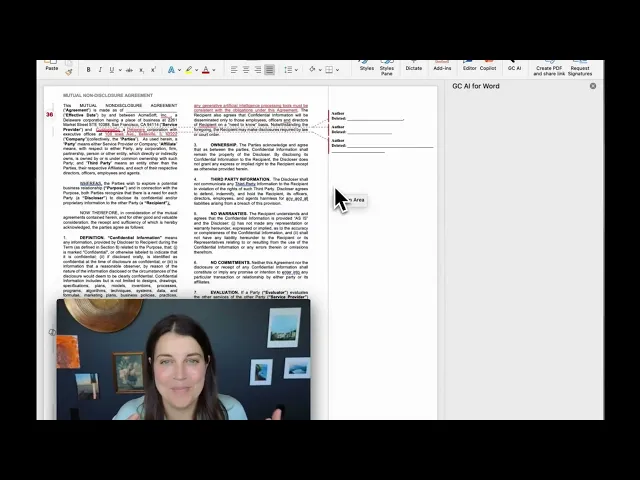
Watch the demo before November 19, then come by to ask questions and see how the workflow maps to your team.