

Dive Deeper
Transcript
Episode Overview
Gagan Biyani keeps lawyers on retainer across corporate, employment, trademark, and tax matters. He still asks ChatGPT first.
He built that instinct at Udemy, the online learning marketplace he co-founded in 2009, and sharpened it building Maven, the live cohort-based learning platform he has run as CEO since 2020.
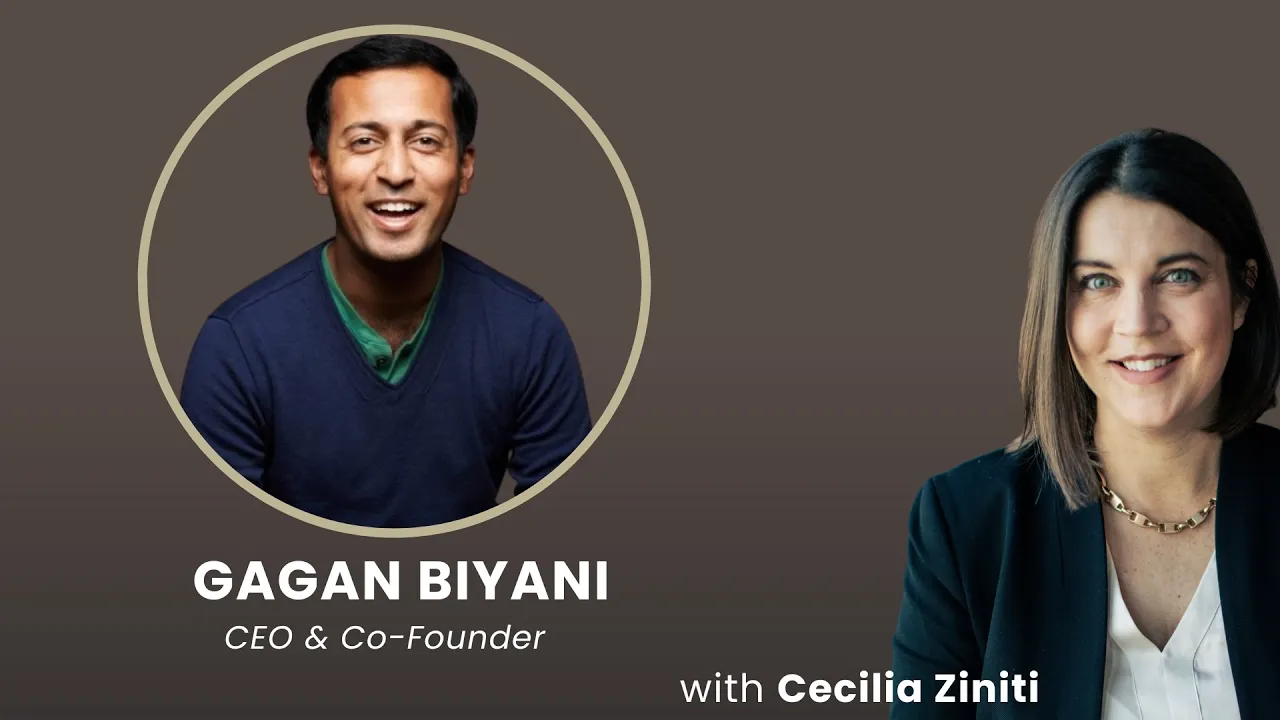
In this episode of CZ and Friends, the Udemy co-founder and Maven CEO tells GC AI co-founder and CEO Cecilia Ziniti why motivation, more than access, now limits what professionals learn, why training an existing employee on AI beats hiring a replacement, and why what he still pays lawyers for, once AI has done the research, comes down to judgment and an actual decision.
About Gagan Biyani
Gagan Biyani is the co-founder and CEO of Maven, a platform for live, cohort-based courses taught by working experts, which he launched in 2020 after several years traveling. In 2009 he co-founded Udemy, one of the largest online learning marketplaces in the world.
He left Lyft in 2013 to co-found Sprig, a food delivery startup, and earlier covered mobile technology as a writer at TechCrunch. He holds an economics degree from UC Berkeley.
Cecilia met him as an instructor, teaching GC AI Classes on Maven, where the live cohort format changed how lawyers in her courses adopted AI.
Key Takeaways
Motivation, not access, is what limits learning in 2026. Knowledge on any subject is a search away, but deep learning takes hours a week over weeks, the opposite of what feeds and algorithms are built to reward.
Cohort-based learning beats access problems with accountability. Putting a class on the calendar with money paid and peers watching is what gets people through hours of study that a free video library never could.
Training existing employees on AI beats hiring replacements. Biyani says making an employee AI-enabled can double or triple their productivity, a return large enough to justify pulling them off work for a month, even if that employee leaves within a year.
Business leaders now consult AI before calling their lawyer. Biyani asks ChatGPT first on legal, HR, trademark, and tax questions, then pays his lawyers for judgment, the creative options and the strategic conversation that turns information into an actual decision.
Size the upside before you weigh the odds. Biyani treats "if this works, how big can it possibly be" as a binary question, not a percentage, because expected-value math breaks down against exponential outcomes.
From Udemy to Maven: Why Live Learning Failed in 2009 and Works Now
Udemy's original product was live online learning, and instructors rejected it for a year. Biyani and his co-founders pivoted to recorded video, a decision that shaped a generation of EdTech companies.
When he started Maven in 2020, the conditions that killed live learning had reversed. Credentialed experts were findable, buyers paid for depth, and social platforms gave instructors distribution.
Biyani recalled the pivot:
"Our original idea was live learning online. Most people did not want to teach online at all. About a year in, I told my co-founder: I don't think this is going to work. We ended up switching to recorded online learning. That was probably one of the biggest decisions we made."
His co-founder Eren Bali grew up in a small village in Turkey with a one-room schoolhouse and taught himself computer science on the internet. Udemy's bet was that the internet would democratize access to learning, and it did.
A decade later, Biyani rebuilt from a clean sheet because the market had changed in the ways that mattered.
"In 2020, I could look someone up. Every single person who is a successful professional basically has a LinkedIn presence. There are thousands of people who have built online followings via podcasting, Substack, LinkedIn, who are now deemed to be experts... Your average instructor is a bona fide expert in the space they're in, and they've been in it for ten years. That's completely new."
Why Motivation is the Barrier to Learning in 2026
Knowledge is everywhere now, and sustained focus is what is scarce. Biyani's diagnosis is that the internet solved access and created a second problem in its place.
Learning a subject takes hours a week over weeks, and the platforms where professionals spend their time are built to interrupt exactly that kind of effort. Live cohorts counter it by putting learning on the calendar, with money and peers attached.
Biyani put it directly:
"Learning is something that doesn't happen by scrolling TikTok. You have to sit down for an hour, two hours, four hours over many weeks to really learn something. The internet has both improved access and dramatically increased the amount of distraction that prevents you from learning."
His fix for the motivation problem starts small. His own first sustained AI habit was pairing with a chatbot while playing Zelda, sending it screenshots from his TV.
The model was wrong constantly, and the habit stuck anyway. His advice for anyone stalled on AI adoption is to pick a use where it helps you personally, build the habit, and let the serious use cases follow.
What Is the Business Case for AI Training?
Replacing an employee costs more than training one. Biyani argues that making an existing employee AI-enabled multiplies their output enough to justify pulling them off work entirely for a month. His recommended format is much lighter, just two to four hours a week for six weeks, repeated two or three times a year.
Biyani made the case in plain math:
"Taking an existing employee and making them AI enabled will two to three X their productivity. So let's just say you need to stop that employee's work for a month. It would still be worth it."
He also had a message for executives burned by learning and development programs that never showed results:
"This is the moment for L&D to step up and show that it's valuable. You might have been burned in the past by investing in training that didn't really work. This is not that moment."
For legal teams, the payoff shows up in the daily workflows AI already runs, without waiting for an annual review. A lawyer who completes serious AI training demonstrates the return in their own throughput, and Biyani expects the leaders who treat AI enablement as an investment to compound that advantage over the next several years.
How Does a Tech CEO Handle Legal Questions in 2026?
Biyani asks AI first, then brings his lawyer a sharper question. He has incorporated six or seven businesses, negotiated hundreds of contracts, and been deposed, so his default was never to call counsel for information.
AI extended that default. At \$500 to \$2,000 an hour, what he still buys is judgment. Lawyers surface the creative options AI does not, and turn information into an actual decision.
Biyani described his workflow:
"Every time we have a legal or HR issue or a trademark issue or a tax issue, I will first ChatGPT it. But you know what? I still have a lawyer in every single one of those fields... I come into those meetings far more informed about what the law says, but I still need the advice of a lawyer and really the partnership of a lawyer to determine what the next steps should be."
He sees the demand side holding up too. His corporate counsel at Wilson Sonsini struggle to staff enough attorneys to cover his work, and he expects at least a decade or two in which lawyers do a similar set of things with better leverage, the same trajectory in-house counsel are already riding faster than outside firms.
For lawyers who want to stay on the right side of that shift, he offered three moves:
1. Learn the new tools and stay at the cutting edge. The AI-fluent GC is the one bringing him the deposition trainer, reviewing the transcripts, and holding him accountable.
2. Become more business forward, because the more you understand the business, the more ways you can add value beyond the legal question.
3. Keep the underlying skill of staying fresh, since whatever changes come next, the habit of learning transfers.
"If This Works, How Big Can It Possibly Be?"
Biyani's career advice inverts the usual risk framing. People underestimate how big things can get more than they overestimate the odds of failure.
Before any major decision, he sizes the ceiling first and treats the odds as a yes-or-no judgment.
Biyani explained the math error to avoid:
"You want to be shooting for top decile outcomes at least... And that should be a binary question, not a percent question. If you try to create an expected value, you will get the math wrong because of the exponential curve."
For in-house lawyers shy of founding anything, his advice is to ride the wave rather than create it. Evaluate the ambition of the company behind your safe job and the people around you, because an early legal hire at a company with genuine trajectory can see outcomes that exceed what founders achieve.
And the risk is smaller than it looks:
"Most of my friends who started companies in 2008, they all pretty much failed... As far as I know, they all had amazing careers and are financially quite successful and happy. That tells everything. Startups are really not that risky anymore."
In the lightning round, Biyani named Ben Horowitz's What You Do Is Who You Are as the book shaping his thinking on culture, and retold the Amazon lore of Jeff Bezos giving employees doors for desks to make frugality a daily action rather than a poster. His closing advice on AI carried the same spirit: go do something about it, bank an early win, and let it snowball.
Recommended Reading
AI in the Legal Field: How In-House Teams Use It in 2026. The five workflows in-house teams run through AI today, the theme Biyani frames from the business side.
In-House Lawyers Are Already Winning the AI Transition. Cecilia's 2026 GC AI Summit keynote, the counsel-side answer to the shift Biyani describes.


