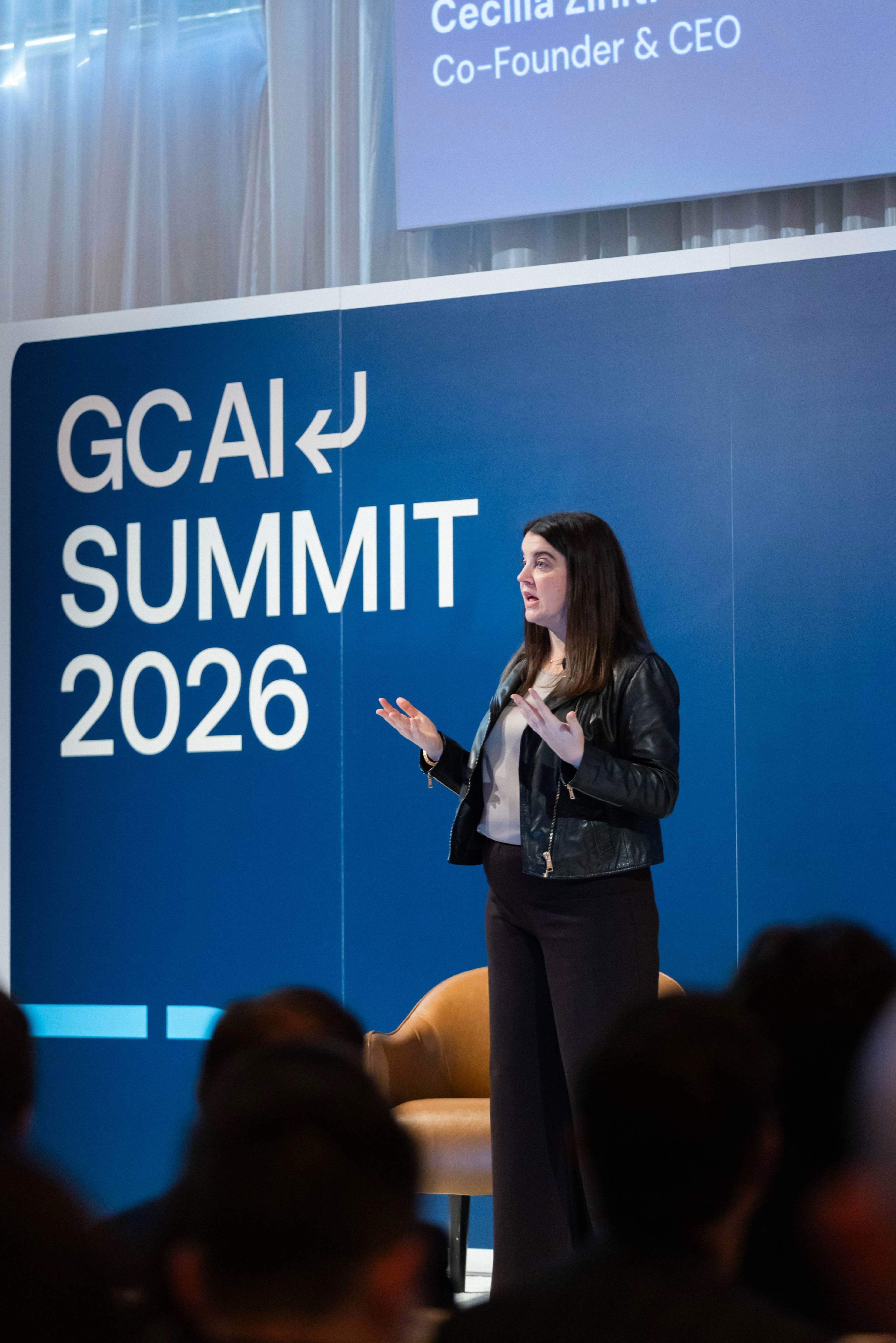
Founder and CEO, Cecilia Ziniti, opened her keynote with a simple observation. Artificial intelligence is no longer a future concept or a side experiment. Venture capitalists see it. CEOs see it. Investors see it. More than half of public company earnings calls last year mentioned AI. Courts across the United States are receiving AI-generated filings. Mediators are reading briefs written with AI assistance. Stakeholders are sending emails drafted by ChatGPT. Legal advice is no longer paywalled, and anyone can upload a document and get a baseline answer.
That shift creates an obvious tension for the profession. If access to legal information is now universal, what does it mean to be a lawyer? More specifically, what does it mean to be a great in-house lawyer and a strategic business partner when the tools have changed so quickly?
Cecilia’s answer: In-house lawyers are already ahead of the curve. She pointed to data from GC AI classes, where participants are routinely asked how often they use AI for legal work. When the survey first launched roughly a year and a half ago, more than half of attendees said they had never used AI in their work. Today, that number has dropped to 6 percent. 94 percent of in-house lawyers now report using AI for legal work at least weekly. Outside lawyers report usage below 50 percent. Agentic AI usage, meaning workflows and systems that actively perform tasks, is 50 percent higher in-house than at law firms.
“You are way ahead of the curve,” Cecilia told the audience. “It’s as if it's the first day of school and you’re already an honor student.”
That lead matters because AI is changing the competitive dynamics of legal work. Cecilia was unambiguous about the direction of that change. “I can tell you with zero equivocation that AI increases the value of lawyers. It does not decrease it.”
She explained this through a basketball analogy. In the mid-1980s, it was uncommon for NBA players to lift weights. Michael Jordan’s coach pushed him to train differently, and by the time of the 1996 Bulls, weightlifting had become standard. Today, the idea of a professional basketball player not lifting weights is unheard of. The result was that the level of play rose across the entire league. Law, Cecilia argued, operates in a similar way. It is an adversarial system. When one side uses better tools and the other does not, outcomes follow. “Your opponent is lifting weights and you’re not,” she said. “You’re going to lose.”
From there, Cecilia moved into concrete examples of how AI is already changing in-house practice. She talked about a situation involving Acorns, where the legal team was supporting a highly regulated fintech product touching COPPA, lending laws in all 50 states, and consumer protection requirements. Cecilia described how the General Counsel received a late-afternoon call from business development about a potential airline partnership that raised complex IRS issues around frequent flyer miles. Traditionally, this would have triggered a call to outside tax counsel and a turnaround measured in days. Instead, the legal team used GC AI to analyze the relevant IRS guidance, including Revenue Ruling 2002-76 and related announcements, and produced a practical memo outlining several viable structuring options. The analysis was delivered within an hour, and the business was able to move forward on that timeline.
Cecilia then described a similar shift at Love’s Travel Stops, one of the largest private companies in the United States. During an acquisition, the legal team needed to refresh a 50-state analysis. A previous version of the same work, completed by outside counsel, had cost $150,000. This time, the in-house team completed the analysis internally using AI. The result was faster execution, lower cost, and tighter alignment with the business.
Across these examples, Cecilia emphasized that AI enables in-house lawyers to operate where the business actually needs them, at the moment decisions are made. The value is not just speed, but relevance.
She also described a broader change in how lawyers express judgment, a concept she referred to as “vibe-lawyering.” Engineers using tools like Cursor can now build complex systems by describing intent in natural language. Lawyers are entering a similar phase. The programming language is English, and lawyers can manifest their advice directly into drafts, workflows, and structured outputs. “There will be people that AI tells what to do, and people who tell AI what to do,” Cecilia said. “You’re going to be in the group that tells AI what to do.”
She closed with a story that captured both the professional and personal impact of this shift. Cecilia shared an example from a General Counsel who received a request from a business leader while commuting home. Using GC AI on her phone, she drafted an agreement, made a few edits later using a Word add-in, and sent it out for signature. The document was signed just over an hour after the request came in. The part that mattered most was not the turnaround time, but what it enabled. She was able to put her daughter to bed instead of staying up late to finish the work.
In-house lawyers already have structural advantages. They understand the business and sit close to decision-making, and AI amplifies those strengths. The work now is execution, building workflows, deciding where judgment matters most, and using AI to handle the rest.
Follow Founder and CEO Cecilia Ziniti on LinkedIn for more insights on in-house legal, legal AI, and more.