

Dive Deeper
Transcript
Episode Overview
Managing high-stakes litigation, in Michael Jacobs's telling, is a management discipline in-house counsel can learn: treat the case like opening a new line of business, understand the economics before the fees ramp, build a genuine partnership with lead counsel, and hear both the advocate's voice and the advisor's voice.
Jacobs has argued the case list that reads like a history of the technology industry: Fujitsu v. IBM on mainframe software, SCO v. Novell on Linux, Oracle v. Google on APIs, Apple v. Samsung on the smartphone.
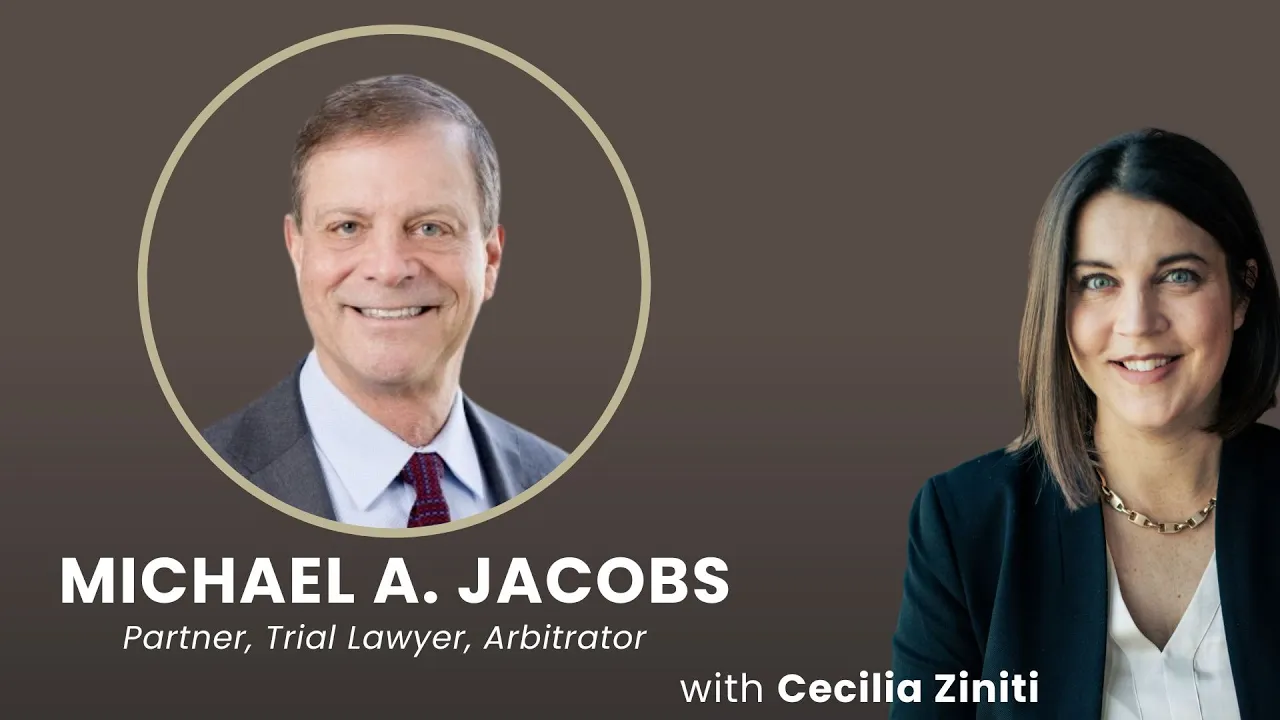
In this conversation with GC AI co-founder and CEO Cecilia Ziniti, who met him as a summer associate at Morrison Foerster, he explains what legal AI changes about law firm value and what four decades of trials taught him about translating technology for the humans who decide.
About Michael Jacobs
Michael A. Jacobs is a mediator, arbitrator, special master, and neutral evaluator at JAMS, based in the San Francisco Resolution Center, handling business, intellectual property, international, and life sciences disputes. He joined JAMS in April 2024 after four decades as a trial lawyer at Morrison Foerster (1984 to 2024), where he co-founded and led the firm's intellectual property litigation group.
His case list spans landmark technology disputes from Fujitsu v. IBM to Apple v. Samsung, plus about a year on Morrison Foerster's team representing OpenAI in the copyright litigation brought by The New York Times. Before Yale Law School, he served four years as a U.S. Foreign Service officer, with postings in Jamaica and Washington, D.C.
He is a three-time California Lawyer of the Year and received the ABA Litigation Section's 2024 John Minor Wisdom Public Service and Professionalism Award.
Key Takeaways
Arm your client contact with the exact words to relay internally. Behind the GC or head of litigation sit the executive team and the board, so advice has to travel further than the person being briefed.
Treat a big case like opening a new line of business. Run a SWOT analysis on outcomes, risks, and opportunities, and settle upfront who the decider is on the client side.
Master two distinct voices with the client. The advocacy voice shows you are their warrior, while the advisory voice delivers the unvarnished appraisal the GC has to carry to the board.
A great law firm will tell a client to walk away from a weak case. Jacobs's team talked a major U.S. industrial company out of an Apple v. Samsung replay after finding warts in the record, and the client came back for other matters.
Law firms now have to prove their work beats the AI product. Jacobs rates a good legal AI output as comparable to a second- or third-year associate's, so the senior lawyer's job is to check it and demonstrably improve it.
What Does It Take to Lead Billion-Dollar Litigation?
Think as far down the road as you can from day one, and understand the corporate dynamics behind your immediate contact. Jacobs's first moves in a billion-dollar case start at the complaint: which causes of action to plead, and what each choice implies years later.
From there, the work is as much organizational as legal, because the lawyer sees only the interface, while the decisions unfold behind it.
Jacobs explains:
"You're dealing maybe with the head of litigation, sometimes with the general counsel, but behind that person are all these discussions with the executive team... I was trying to give that person the right words to say to their internal audience... you have to look behind what you're seeing right in front of you and understand the dynamics of a corporation."
In software terms, he calls it information hiding. The GC is an intermediary, translating what outside counsel reports into something the executive team and board can act on, and the most useful thing lead counsel can do is arm that intermediary well.
How Should General Counsel Manage High-Stakes Litigation?
Build a genuine partnership with lead counsel, stay fully informed without micromanaging, and know the economics cold. Jacobs describes the best client-side leaders, whether the GC, the head of litigation, or an executive tasked with running the case, as heavily invested, aware of the staffing, clear on who the day-to-day contact is, and deliberate about when to ask for involvement in key decisions.
He tried to match that from the law firm side by staying involved as lead counsel from the beginning of a case through the end, a style point he says in-house counsel should look for when choosing trial counsel.
The economics deserve the same attention as the merits. In one of his biggest cases, the fee bill submitted at the end, after winning, came to approximately \$50 million for the life of the case.
Numbers like that are why disciplined teams audit the cost of getting to trial before it arrives; GC AI's guide on how to reduce outside counsel spend with AI walks through the same audit-first playbook.
Treat a Big Case Like Opening a New Line of Business
"I used to describe the launch of a big case on either the defense or plaintiff's side as opening a new line of business... There are certain risks. There are certain opportunities. You do a SWOT analysis... Where do decisions reside? Who is the decider?"
The same management errors that sink new ventures sink litigation. Jacobs saw it from the other side of a major trial: opposing counsel who, in his reading, were kept at a distance from the client, never encouraged to learn the facts early or pick out the most important documents.
The result was scrambling on a timed trial, discovery missteps that led to evidence exclusions, and a hamster wheel of activity for activity's sake. He attributes those strategic failures to a weak partnership between law firm and client rather than to the lawyers' ability.
When Should a Company Decide Not to File Suit?
When the record does not support the boom the client wants to create. After Apple v. Samsung, a major U.S. industrial company came to Jacobs's team wanting a replay.
The lawyers examined the record, found warts that would shape how the case unfolded, and delivered a pessimistic assessment.
"This was a law firm basically saying to a client, don't spend a lot, a lot of money on us, because we don't think this is going to go as well as you want it to go... And sure enough, the company decided not to go forward, which I think also was probably the right decision."
Jacobs frames the call as fiduciary duty in action. The client's interests come before the firm's financial interests, and the client came back for other matters.
He places the decision in a longer Morrison Foerster tradition that included declining tobacco industry litigation. He applied the same test to similar calls later, asking whether the team would enjoy coming to work every day if it took the case on.
How Do You Deliver Bad News to a Client?
Separate your two voices, then give it to them straight, with a strategy attached. Jacobs treats voice discipline as one of the specific challenges of being a trial lawyer.
Voice one is advocacy. It reflects the client's position so they know you are their warrior. Voice two is advisory. It delivers the honest appraisal, without sugarcoating.
"If you're talking to the GC, you want her to know exactly what she should be communicating internally... This is going to be a long and difficult road. I don't want you, my GC client, to get caught up in sugarcoating it for your audience, because they're going to remember that. So let's give it to them straight."
He sees errors in both directions: lawyers who pour cold water on a revved-up client before demonstrating they are on the client's side, and lawyers who never leave the warrior register long enough to advise. Cost estimates are where the temptation bites hardest, because a high estimate feels like losing the engagement, and a low one becomes the number the GC puts in a board deck.
The mentor who shaped Jacobs's answer here was Harold McElhinny, the Morrison Foerster trial lawyer with what Jacobs calls an instinct for strategy.
"If you can deliver really bad news, but you say, here's our strategy, the client retains their confidence in you, because you've thought through to the next step. It's like a doctor giving you bad news and saying, but here's your treatment plan."
What Has Changed in Big Tech Litigation, and What Stays the Same?
Two things stay constant across forty years: translating technology for lay decision makers, and applying traditional legal principles to brand-new technology. What has changed is the pace, and the youth of the companies being sued.
"Number one thing that remains the same is the challenge of interpreting this foreign language to a lay audience, to lay decision makers. It is the principal task, I think, of a great IP litigator, to be able to analogize things in a way that makes sense."
His favorite illustration is Bob Van Nest of Keker Van Nest, Google's trial counsel in Oracle v. Google, wheeling a file cabinet into the courtroom on day one and telling the jury that APIs are like a file cabinet. Jacobs judges the analogy technically imperfect and strategically excellent: Van Nest owned the physical space of the courtroom.
The second constant is doctrine catching up to hardware. In Fujitsu v. IBM, the country had only just decided copyright applied to computer software, and each new appellate decision changed the complexion of the case mid-stream.
The OpenAI copyright litigation runs the same exercise on an LLM: traditional copyright principles applied to a system that ingests, processes, and outputs information, with a potential claim to evaluate at each stage.
What is new is organizational. Fujitsu and IBM were mature institutions with decades-long counsel relationships; IBM had converted the Cravath lawyers who defended it against the government's antitrust case into IP litigators before pursuing Hitachi and Fujitsu.
In the Fujitsu case, one engineer had owned a given line of code for a decade and would own it for two more, so the facts were findable. Today's AI defendants are brand-new companies doing brand-new things, with employee bases that may have tripled between the alleged conduct and the first deposition, and brand-new relationships with their lawyers.
Finding out who did what has become the hard part.
Can Law Firms Deliver More Value Than Legal AI?
Yes, if they can demonstrate it. Jacobs credits a former Morrison Foerster colleague for the framing that he thinks defines the moment: the job of the law firm now is to deliver a product that is better than the AI product, and to be demonstrable about that.
"If I were in a law firm and my associates were, as they should, starting out with GC AI or one of the other tools, I would say, I'd like to see what you got, and then I'd like to see how you improved it."
His working benchmark holds that a good legal AI output today is comparable to a second- or third-year associate's. That means the partner treats it the way they would treat that associate's draft, with extra attention to hallucination risk. What survives above that line is quality control, strategy, and voice, the same line GC AI's guide to where legal AI is heading in 2026 draws between what the tools can do today and what still needs a human.
Ziniti brings the buyer's side of the equation from GC AI, the legal AI platform built for in-house counsel: teams report an outside firm quoting \$110,000 for a 50-state regulatory research project that the in-house team then completed in the platform in two hours.
The floor under all of it, for Jacobs, is that legal remains humans talking to humans.
"Ultimately a human is dealing with a human... Thinking strategically about what you want your human voice to be to that human audience is, I think, the deep layer of what humans add to artificial intelligence. And it's an ineluctable layer as long as we're humans talking to humans... But in court right now, it's still, I'm going to say it again, humans talking to humans."
What Makes a Good Mediator or Arbitrator?
A neutral who evaluates, keeps one consistent message for both sides, and reads the contract with care. Now on the other side of the table at JAMS, Jacobs is deliberate about being the neutral he wanted when he was in practice.
He chose to be an evaluative mediator because sophisticated parties have usually exhausted go-between diplomacy before they arrive.
"Why are you hiring me just to be a go-between? I think you're hiring a human because you want a human reaction. You want a little mock jury in front of you, or mock judge."
His internal rule holds that he will tell the defendant the risks and the plaintiff the weaknesses, but he keeps his evaluations to the two sides consistent, and sometimes says so jointly. Telling the plaintiff their case is weak while telling the defendant it is strong is a style of mediation he refuses to practice.
As an arbitrator, he sees his job as a careful reading of the contract, because in his experience the space between what contracts say and what companies do is wide. Drafting gets outsourced to specialists while the managers who must live with a 60-day reporting obligation never hear about it.
How Should You Draft Contracts to Survive a Dispute?
Draft for the reader who decides the dispute. A typical judge, juror, or arbitrator is a human being who has never drafted contracts for a living, and a chain of nested definitions makes the decision longer and the outcome less predictable.
"Are you really going to send them from the definition section to another definition, to another definition, and then have an embedded definition in the substantive clause itself?... How long does the decision have to be to explain how you get to the relevant question under the contract?"
Recommended Reading
Turning Legal Into a Growth Engine: Chuck Kable on Leading Legal in Private Equity: an outside-counsel-spend and legal-leadership companion to Jacobs's litigation-management playbook.
How Great GCs Think About Growth, Risk, and Crisis Management: the in-house-counsel view of the high-pressure decision making Jacobs describes.
AI in the Legal Field: where legal AI is heading, the backdrop to Jacobs's "better than the AI product" test.


