

Dive Deeper
Transcript
Episode Overview
Elana Freeman needed a meeting with the Chicago Teachers' Pension Fund, and the fund was not returning her calls. So she showed up at the building and walked out an hour later with everything she needed.
Running a lean in-house legal team comes down to three moves: triage so the highest risks get full attention, translate legal risk into dollar figures, and use AI to absorb volume a two-person team could not otherwise cover.
About Elana Freeman
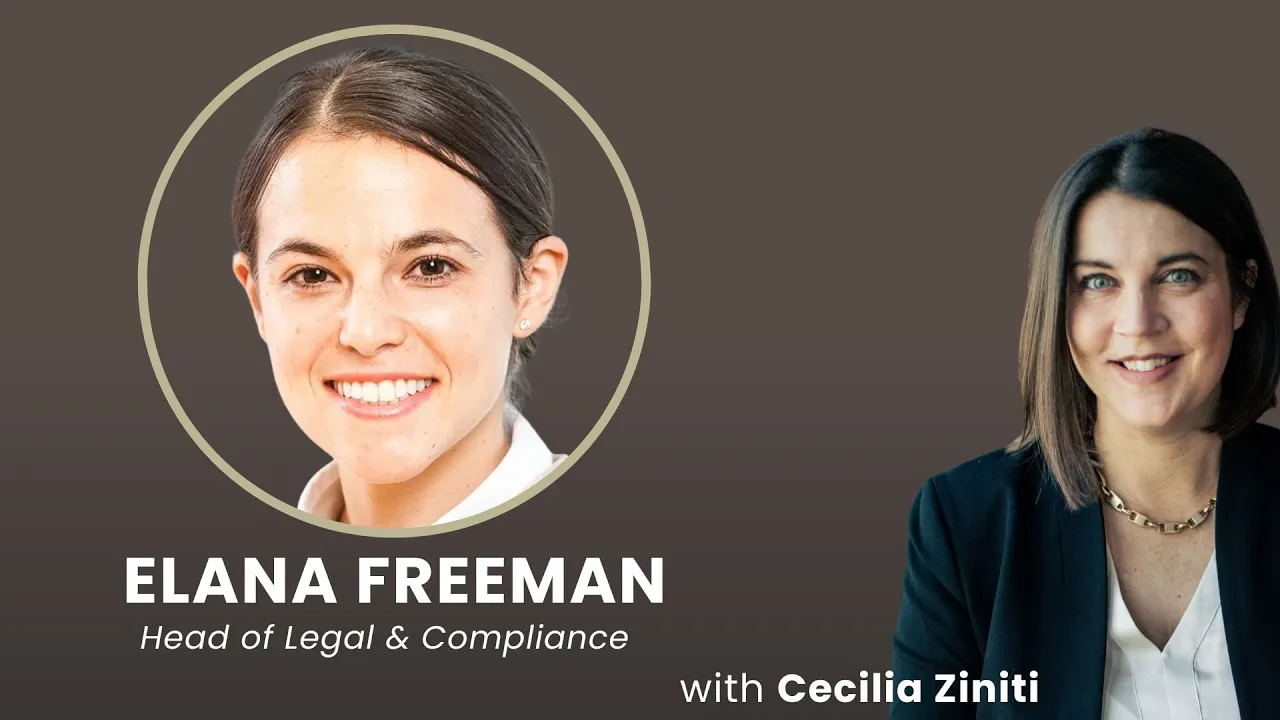
Elana Freeman is Head of Legal and Compliance at Swing Education, an ed tech company connecting schools with substitute teachers across seven states. She joined in 2019 as a compliance manager when Swing had 40 employees and built the legal function from scratch.
Key Takeaways
Rebuilding trust after going remote takes a system, not luck. Freeman built a legal presentation for each team explaining who legal is, the specific risks that team faces, and how legal helps, turning trust from an accident of office proximity into something every new hire could count on.
Put a dollar figure on legal risk and let the business decide. When Swing considered switching California employees from weekly to daily pay, Freeman calculated the change would raise potential liability by 7x, then let the business weigh that number against the reward.
Efficiency for a lean team means triage, not speed. Freeman sorts every issue into full, partial, or not-worth-it attention using three questions on every project: what is the goal, what is the outcome, what is the impact.
Legal can drive AI adoption instead of blocking it. Freeman brought proposed AI policies to leadership to align on risk tolerance before championing the technology company-wide, a move that has since saved her more than 40 hours a week.
A usable AI policy fits in two rules. Freeman's guidelines boil down to using AI freely on information that is already public or that would not matter if a bad actor got it, and routing everything else through legal, a distinction that maps directly to how trade secret law works.
How Do You Rebuild Trust Between Legal and the Business After Going Remote?
Go to the business before it comes to you.
When Swing scaled and went fully remote, Freeman built a legal presentation for each team in the company covering who legal is, the specific risks that team faces, and how legal helps them succeed. The presentations turned trust from an accident of office proximity into a system, and they taught the business to issue-spot on its own.
When Swing was a 40-person company and everyone worked in-office, trust between Legal and the rest of the business was organic. Everyone knew each other.
Then, the company scaled and went fully remote. New employees arrived with preconceived notions about lawyers, and the trust Freeman had earned in person did not transfer automatically.
Freeman described the message behind those presentations:
"We are not telling you yes or no. We are working together. We know the risk. You know the business outcome, you know what your team does best. We need to work together to make sure we're mitigating appropriate risk. And some risk is really okay to let go."
The presentations also help with issue spotting. When each team understands what legal watches and why, they flag things earlier.
Problems that used to arrive on Freeman's desk fully formed, already expensive, and already complicated, started arriving while there was still time to shape them.
How Does a Two-Person Legal Team Manage Compliance in Seven States?
Swing Education runs two business models across seven states: a gig-economy platform where substitute teachers work as independent contractors in some states, and a full employment model in California, with its wage and hour law, non-exempt employee requirements, and penalty exposure. Freeman manages it by going straight to the source, knowing the requirements well enough to spot a wrong answer, and building infrastructure that makes the next state easier.
Substitute teacher certifications and background check requirements vary by state, and sometimes by school district. Schools can add their own requirements on top.
Each new market brings new compliance obligations and new exposure. That is the environment behind the Chicago Teachers' Pension Fund story. While opening Illinois as Swing's seventh state, Freeman needed to verify whether Swing had to contribute to the fund, and the fund went silent.
Freeman told Ziniti what she did next:
"I just showed up at the building and I was like, hey, can I talk to... And they were like, yeah, sure. So I just got a meeting when they were just completely not answering our questions. It was great."
It turned out Swing did not have to contribute. The hour-long impromptu meeting settled a question weeks of unanswered calls could not.
The infrastructure side matters as much as the gumption. Swing's product team had already built back-end modules that walk substitutes through certifications and background checks for California.
When Illinois opened, Freeman mapped the state's requirements and handed them to product to productize. Systemized compliance lets a two-person team flag issues in the moment instead of catching them after they become liabilities.
How Do You Communicate Legal Risk So Executives Act on It?
Put a dollar value on it. Freeman positions her department as the team that makes sure the business knows exactly what it is signing up for before a risky move, then lets the business decide.
The sharpest example from the episode involved a proposal to switch Swing's hourly, non-exempt California employees from weekly to daily pay, a seemingly employee-friendly change.
Freeman came back with a number:
"In California, if we switch from weekly pay to daily pay for hourly non-exempt employees, our potential liability goes up by 7x."
She did not say no. She explained the exposure and asked the business to price the other side of the scale.
As of the recording, Swing's chief product officer was working out the reward side so the two could be weighed against each other.
Freeman explained the framework behind that answer:
"I consistently message everything as risk reward benefit, weighing risk and reward. If the reward outweighs the risk, we do it. I understand risk, you understand reward... I can put a dollar value to risk and we can literally just weigh them."
What Does Efficiency Mean for a Lean In-House Legal Team?
Freeman describes herself as obsessed with efficiency. For her, that means being clear on which risks deserve the team's full attention, which deserve partial attention, and which are not worth the effort.
Each issue brought to Legal gets triaged before it gets worked. The triage is the work.
Her management technique is three questions, asked whenever her direct report brings her a project: What is the goal? What is the outcome? What is the impact?
Freeman put it this way:
"Understanding what are our highest risks that we really do need to dot our I's and cross our T's on, what are the ones that are medium that we want to mitigate, and what are the ones that are just not super risky and aren't worth the effort, and being thoughtful and getting really clear on that."
Asking the same three questions consistently changed her team's culture. Her colleague now arrives with the analysis already done, which keeps the two of them focused on business priorities instead of absorbing each new problem by default.
For a deeper look at how small legal teams scale workload without headcount, see AI for Startup Legal Operations: How Lean Legal Teams Scale.
How Did Swing Education Go From No AI to Saving 40 Hours a Week?
Legal led the adoption. Two years ago, Freeman walked into a product team presentation and asked who in the room was using AI.
Nobody raised a hand. She advised them, as their lawyer, that they needed to be.
She brought proposed AI policies to the leadership team first, aligned on risk tolerance, then became the company's advocate for the technology. Today the whole company uses AI extensively.
On the legal side, the change is measurable in hours. Freeman told Ziniti:
"I have saved 40-plus hours a week, first of all, with AI. I'm definitely a power user... I use it to summarize documents, I use it to rework my communications, I use it to sanity check my initial gut on employment law stuff."
Her team's platform of choice came up on air: "We have, of course, our own legal AI tool, GC AI," Freeman said. She and her direct report Jacob both took GC AI's prompting classes, then traded experiments on what worked.
She offers one caveat. On genuinely in-the-weeds employment law questions, AI gives a useful gut check but sometimes gets things wrong in ways only visible to someone who already knows the area.
The technology speeds up a lawyer who already knows the area, and that underlying knowledge is what catches the misses.
What Makes an AI Use Policy Employees Follow?
Simplicity, plus a risk explanation each team can feel. Freeman assumes nobody reads the formal policy document, so she works the guidelines into her per-team legal presentations and all-hands refreshers, and she keeps the rules short enough to remember.
Freeman's guidelines, in her words:
"Our guidelines are: if it is already publicly accessible or you don't care if it gets in the hands of a bad actor, go wild... If those things are not true, it needs to go through legal... I've tried to make it really simple for the team."
Ziniti pointed out on the episode that the policy maps to how trade secret law works. Publicly accessible information is not a trade secret. Matching the policy to the underlying legal principle makes it easier to follow.
The second half is making risk concrete per team. Presenting to product, design, and engineering, Freeman frames the stake in terms they care about. If the team mishandles AI inputs, the company's intellectual property may no longer be its own.
For a full treatment of the professional-responsibility side, see our guide on AI Legal Ethics.
Recommended Reading
AI for Startup Legal Operations: How Lean Legal Teams Scale. Closest topical match: lean legal teams doing more without headcount.
AI in Legal Operations: The 2026 Five-Layer Playbook. How in-house teams layer AI across intake, knowledge, and compliance.
How Great GCs Think About Growth, Risk, and Crisis Management. Pairs with Freeman's risk-reward framing and crisis-nimbleness lessons.


