

Dive Deeper
Transcript
Episode Overview
What makes an in-house lawyer commercial? Ben Jacobs defines it as risk acceptance, informed by understanding of the law, the business, and the goals.
It is the ability to frame and calibrate a risk well enough to say, yes, this is a risk our business can accept.
When internal clients ask for a "commercial lawyer," they sometimes mean one who says yes to everything, and Jacobs will tell you that lawyer is dangerous.
He earned the definition the hard way. Jacobs started at Allen & Overy in London believing that going in-house was, in his words, an expression of failure, what you did if you couldn't make partner.
Then the global financial crisis put him inside Royal Bank of Scotland, selling off businesses from Argentina to Kazakhstan for a bank majority-owned by the UK government. He noticed that the work he found fulfilling was contributing to the direction of an organization and living with the outcomes.
He has been an in-house lawyer since, and now leads the legal side of Xero's acquisition strategy, including the US\$2.5 billion acquisition of US payments company Melio.
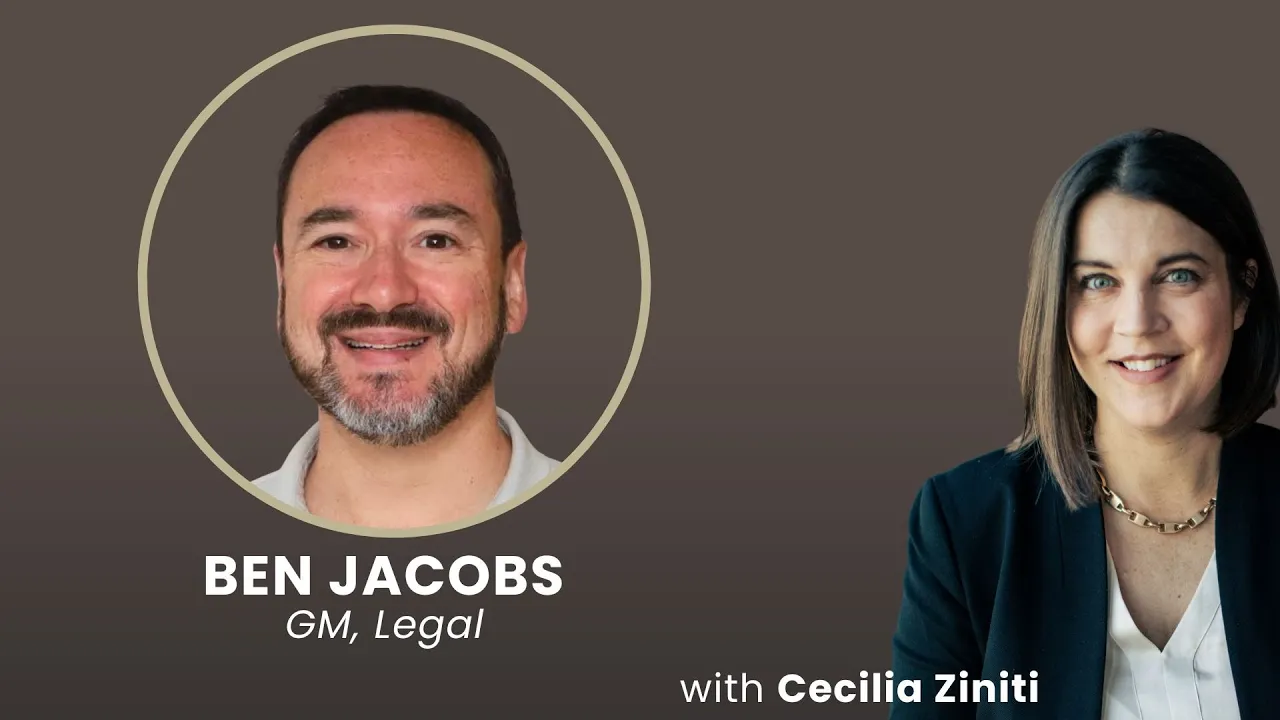
In this episode with CZ and Friends host Cecilia Ziniti, co-founder and CEO of GC AI, Jacobs covers the two mindset shifts lawyers make when they move in-house, how buying founder-led companies changes M&A legal work, why his legal team led Xero's AI adoption, and a leadership philosophy built on psychological safety, social capital, and kindness.
About Ben Jacobs
Ben Jacobs is General Manager of Legal for Strategic Growth and Development at Xero, the New Zealand-born cloud accounting platform serving 4.5 million small business customers worldwide. At Xero he is responsible for the M&A, product and technology, and partnerships legal teams.
He joined Xero in 2019 to build its M&A legal function from scratch, and the company has completed seven acquisitions since, ranging from South African reporting platform Syft Analytics to Melio, a US payments company acquired for US\$2.5 billion upfront.
Before Xero, Jacobs spent six years leading M&A legal work around the world at Barclays, following a secondment inside Royal Bank of Scotland during the global financial crisis and M&A training at Allen & Overy in London.
He is also President of the In-house Lawyers Association of New Zealand (ILANZ) and sits on the New Zealand Law Society council.
Key Takeaways
Commerciality is risk acceptance, not saying yes to everything. It means understanding the law, the business, and the goals well enough to calibrate risk; a lawyer who says yes to everything is dangerous, one who calibrates earns the business's trust.
Going in-house requires two mindset shifts. Move from advising on risk to owning it, and from eliminating risk entirely to calibrating how much the business can accept.
What looks like excessive caution is often just unexplained risk. Lawyers who articulate a risk clearly enough for the business to make an informed decision get trusted with bigger ones.
In founder-led acquisitions, culture outranks product. Xero assesses culture and people first, product second, and financials third, because what it is really acquiring is the people who will keep building.
Legal teams should be early AI adopters. At one point, Xero's legal team was the biggest user of the company's Gemini enterprise trial before it rolled out company-wide.
Is Going In-House a Step Down From Big Law?
No, and Jacobs is embarrassed he once believed it was. As a junior lawyer at Allen & Overy, he saw in-house as the path for people who couldn't make partner.
A secondment changed that. Royal Bank of Scotland, majority-owned by the UK government after the financial crisis and unwinding its disastrous acquisition of Dutch bank ABN AMRO, needed M&A lawyers in-house to sell off businesses in Argentina, Chile, Colombia, and Kazakhstan.
Jacobs moved to Scotland for a year and did the selling.
Jacobs described the realization:
"What I found fulfilling about being at the Royal Bank of Scotland was contributing to the direction of the organization, living with the outcomes of what I'm doing and contributing to that success, as scary as it is."
The partner track, he realized, offered him status, a nice title, and a decent paycheck, and none of those were the things he looked forward to. When he finished the secondment and returned to London, he knew.
An in-house role at Barclays came up, he jumped, and apart from one brief return to private practice when he moved to New Zealand, he has been in-house ever since.
What Makes an In-House Lawyer Commercial?
A commercial in-house lawyer accepts risk on an informed basis. That means understanding the law, the business, and the goals well enough to frame a risk, calibrate it against the company's risk appetite, and say yes with conviction.
Experience helps, but Jacobs is clear that younger lawyers can be commercial too, because the job runs on understanding, and a younger lawyer can build that early.
Jacobs, on the definition he opens the episode with:
"For me, commerciality is risk acceptance. That's the saying yes bit, but informed by understanding. And that can be understanding of the law, understanding of the business, understanding of the goals... It's that understanding and being able to frame and calibrate the risk appropriately to say, yes, I believe this is a risk that our business can accept."
The corollary matters as much as the definition. When lawyers get labeled uncommercial, Jacobs sees two causes: sometimes fear, and sometimes a failure to explain the risk well enough for the business to make an informed decision about accepting it.
An unexplained risk looks like obstruction to the business. Explained clearly, the same risk reads as counsel. That same instinct, sizing risk against the business's real objectives rather than eliminating it outright, is the discipline GC AI's guide to how great GCs think about growth, risk, and crisis management covers in more depth.
What Are the Two Mindset Shifts When Lawyers Move In-House?
Jacobs names two: from advising on risk to owning risk, and from risk elimination to risk calibration. In private practice, you lay out the opportunity, the options, and the risks, and the client decides; if the risk manifests, you advised, they chose.
In-house, your organization lives with the outcome of the decisions you helped make. Give up a warranty on a deal and the company carries that concession when the thing it covered goes wrong.
The second shift confronts the perfectionism law firm training instills. The world is gray, and a lawyer who pursues the elimination of all risk signals that they don't understand what the business needs.
Calibration, informed by the company's strategy and risk appetite, is the job. Cecilia and Jacobs land on the same point from opposite hemispheres. Saying yes to everything and saying no to everything are both failures of calibration.
What Skills Make a Great M&A Lawyer?
Extreme flexibility, comfort with irreversible decisions, and empathy. Jacobs frames deal work through a distinction his chief executive uses. Two-way doors are decisions you can reverse, and M&A is typically a one-way door.
Knowing which positions are the big rocks to hold and where you can pivot, and moving quickly when the situation changes, is the craft.
Jacobs explained the empathy requirement with a maxim:
"There's a maxim of M&A that says that the right deals are the ones where everybody walks away equally unhappy."
He operationalizes empathy at two levels. The macro level is structural. It means understanding what the other side needs from the deal.
A VC seller has a fund to return, so significant long-tail liability is a nonstarter, and proactively offering reps and warranties insurance solves their problem before it becomes your standoff.
The micro level is tactical. Don't drop disclosure schedules at the last minute, don't manufacture surprises, and surface the hard things up front.
Deals get done because both sides reach agreement, which is the part of the job Jacobs prefers to litigation. You have to find your way to yes together.
How Does Acquiring Founder-Led Companies Change M&A Legal Work?
It moves relationships ahead of legals. At Barclays, Jacobs negotiated with other banks' sophisticated corp dev teams, where both sides pushed hard and nobody took it personally.
At Xero, the acquisitions to date have been founder-led businesses, and the deal only works if the founder arrives still loving the company that bought them. Xero's assessment sheet reflects that order. Culture and people come first, product second, financials third.
Jacobs, on the Syft Analytics deal, a South African insights and reporting business built by university friends:
"The real focus for us, early and ongoing, was in building the relationships with them... Then you can put the legals to one side, and the legals go through so much more easily where you're in a position of trust with each other."
The scale varies enormously. Syft was a deal in the tens of millions of US dollars, while Melio, the US payments company Xero acquired in 2025, cost US\$2.5 billion upfront.
Melio's cap table held founders, staff, VCs, and strategic partners, each needing a different case for why the deal was right. The tell that both deals were right, in Jacobs's telling, came during in-person diligence, when the teams started brainstorming together and would not stop.
For the mechanics of compressing that diligence work with a legal AI platform, see how GCs run AI due diligence for M&A and vendor reviews.
Discipline is the other half of the founder-led playbook. Xero raised US\$300 million through a convertible note on the Singapore exchange before Jacobs joined, and one of his questions on the way in was how the company would avoid a shopping spree.
The answer shows in the record. Seven acquisitions in six years, each with a strategic thesis and an integration plan. Investors responded with their wallets, funding Melio in part through an A\$1.85 billion institutional placement, and Jacobs notes the conviction behind it.
"There's two kinds of expressions of investor feedback: there's what they say to you, and there's where they're prepared to put their money."
How Should Legal Teams Lead AI Adoption?
By using it first. When Xero rolled out an enterprise Gemini trial, the legal team became, at one point, the biggest users in the company before it went wide.
Jacobs is extraordinarily proud of that, and it changed how the business saw legal. Legal became the team that helps the company adopt a transformative technology safely.
Xero's AI journey predates the LLM era, and the company was building its own AI tools before ChatGPT launched. Its CEO, Sukhinder Singh Cassidy, who was the first general manager of Google Local and Maps and later ran Google's Asia Pacific business, has pushed adoption from the top.
The flagship customer-facing product is JAX, short for Just Ask Xero, which lets a small business owner query their own accounts or generate an invoice by forwarding a WhatsApp thread.
Legal's role ran on three tracks: guardrails so people could experiment safely in the early days, an internal tool for assessing the risk of new AI use cases as the company contracted with more vendors, and a formal responsible AI use policy, pulled together by Xero's heads of IP and privacy, that the team updates as the technology changes.
In-house lawyers who build that fluency before it is required show up as genuine business partners when it counts, and free legal AI classes are the fastest way to start.
How Do Psychological Safety, Social Capital, and Kindness Build Strong Legal Teams?
Jacobs's leadership philosophy stacks three research traditions. Psychological safety, from Harvard Business School professor Amy Edmondson, he recognized first by its absence. At RBS, a departed CEO's culture of fear outlived him, and Jacobs watched blame paralyze decisions.
Not making a decision is making a decision, a point Xero's board echoes when it asks about M&A. What are the risks of doing the deal, and what are the risks of not doing it?
Social capital, from Dr. Thomas H. Lee, chief medical officer of PG Forsta and a Harvard professor, supplies the second layer. Financial capital and human capital express an organization's potential; social capital, the trust and reciprocity among its people, determines how much of that potential gets executed.
The third layer came from close to home. Dr. Nicki Macklin, a University of Auckland researcher, presented her work on kindness to the New Zealand Law Society council where Jacobs sits.
Her framework has since been picked up by both Edmondson and Lee, and the three co-authored "Why Kindness Isn't a Nice to Have" in Harvard Business Review in July 2025. Jacobs is precise about what the word means:
"The principle of kindness is not a soft principle. The definition that Dr. Macklin has is the proactive effort to support someone else's growth, wellbeing or success as a set of observable, intentional actions. And she differentiates it very carefully from niceness. Niceness is avoiding tough conversations."
Asked what he is proudest of at Xero, Jacobs skips the flashy deals. He names the people. He points to hires who get described as "a real Xero," and team members who leave for bigger seats, including one who departed to become GC of an AI company.
Building teams of good people and watching them go on to good things is, for him, the point.
Why Should In-House Lawyers Learn the Business?
Understanding the business is what makes everything else work. It sharpens risk calibration, deepens relationships, and earns the standing to operate as a business person. Jacobs dislikes the "department of no" label, and he wants to retire the deeper idea underneath it, the perception that lawyers aren't business people.
At Xero, legal frames its work as strategic business partnering, embedded in product teams and their leadership and building alongside them.
His final takeaway doubles as an interview question. When a lawyer wants to join his team from private practice, Jacobs asks why they want to be in-house.
The common answer is "to be closer to the business," and his follow-up is the filter:
"My question back to that is: what does that mean to you? What does it mean to be closer to the business?"
Lawyers with a real answer, who want to learn the strategy, the revenue sources, the metrics, and the competitors and partners around their company, get the most out of the seat.
Jacobs takes visible pride in working for a cloud accounting company whose customers light up when he names his employer in their shops. Understanding the business makes the job fun, and it makes you a better lawyer, in that order, by his telling.
Recommended Reading
How Great GCs Think About Growth, Risk, and Crisis Management: the leadership companion to Jacobs's risk-calibration philosophy.
AI for General Counsel: One Operating Layer for Solo GCs to Full Departments: how in-house teams put AI to work across the department, the way Jacobs describes legal leading adoption at Xero.
AI Due Diligence: How GCs Run M&A and Vendor Reviews: the mechanics of compressing the M&A and vendor diligence Jacobs runs deal to deal.


