7 AI Legal Cases That Should Shape Your AI Policy
Josh Bertini, Head of GrowthPublished
Michele Murray, Associate General Counsel at ARKO Corp, joined Cecilia Ziniti on CZ and Friends, the GC AI podcast, and described the moment AI risk turned concrete for her:
You do have to verify the results. I heard today an attorney got slapped with a $25,000 sanction for preparing a response to a motion with AI and didn't verify the facts.
Murray is describing a category of event that barely existed three years ago and now fills a database of more than 1,400 entries. AI legal cases, meaning the court rulings, sanctions, and settlements where an AI system itself became the subject of the proceeding, have become the fastest-growing reference point for in-house counsel deciding how their teams can use AI. Every general counsel will eventually write the policy that governs AI use at their company. These cases are the raw material for that policy.
Here are the seven AI legal cases this guide covers:
-
Mata v. Avianca: ChatGPT invented six fake decisions in a federal court brief.
-
Concord Music Group v. Anthropic: a court struck a Claude-generated citation from an expert declaration.
-
Getty Images v. Stability AI: the first major UK ruling on AI training data and copyright.
-
The New York Times v. OpenAI: the landmark copyright case still heading toward trial.
-
Louis v. SafeRent Solutions: a $2.275 million settlement over a biased tenant-screening algorithm.
-
United States v. Heppner: the first ruling that a defendant's chats with an AI are not privileged.
-
FTC v. DoNotPay: the federal action against a self-described “robot lawyer.”
Each case below has a real citation, a court, a year, and an outcome you can put in a memo. Read together, they show in-house teams where generic AI breaks under legal pressure and what a defensible AI workflow looks like today.
A quick word on who put this together. GC AI is legal AI software and a legal AI platform built specifically for in-house counsel. It exists because of the gap these cases expose. Our CEO and co-founder, Cecilia Ziniti, was a general counsel three times over, at Anki, Bloomtech, and Replit, and an in-house lawyer at Amazon and Cruise before that.
She built GC AI to fix the problems she ran into firsthand, including the one at the heart of this piece: general-purpose AI that cannot reliably cite real authority or protect privileged work. More than 2,100 legal teams including 80+ public and enterprise companies use it today.
Why You Should Be Tracking AI Legal Cases
AI legal cases matter for in-house counsel because the general counsel is almost always the person who writes the company's AI policy, signs off on the vendor, and answers for the decision when something goes wrong. A case roundup is a source document for the policy a GC is already expected to own.
The volume is the story. Legal researcher Damien Charlotin maintains a public database of AI hallucination cases that passed 1,400 entries in early 2026, after starting from a handful in 2023. Copyright suits, discrimination claims, privacy disputes, and consumer-protection actions involving AI have followed the same curve.
The professional-responsibility backdrop is already settled. ABA Formal Opinion 512, issued in July 2024, tells lawyers that the duties of competence and confidentiality apply in full when they use generative AI, including a duty to verify AI output before relying on it. The cases below are what happens when that duty is skipped. For teams that want to train against these patterns directly, GC AI's Legal AI Ethics class walks through the rulings and the obligations they create.
Mata v. Avianca: The AI Hallucination Case That Started It All
An AI hallucination is what happens when a generative AI model produces a citation, quotation, or holding that does not exist. Mata v. Avianca is the case that turned that abstract risk into a sanctions order and put AI hallucination on every general counsel's radar. Citation: Mata v. Avianca, Inc., 678 F. Supp. 3d 443 (S.D.N.Y. 2023).
Roberto Mata sued the airline Avianca over an injury on a 2019 flight. To oppose Avianca's motion to dismiss, his lawyer, Steven Schwartz of Levidow, Levidow and Oberman, used ChatGPT to research the brief. ChatGPT produced six judicial decisions that do not exist, including Varghese v. China Southern Airlines and Martinez v. Delta Airlines. Schwartz even asked ChatGPT whether the cases were real, and the model assured him they were available on Westlaw and LexisNexis.
In June 2023, Judge P. Kevin Castel imposed a $5,000 sanction jointly on Schwartz, the attorney of record Peter LoDuca, and their firm. The opinion found the lawyers acted with “subjective bad faith” and described the reasoning in one fabricated decision as “gibberish.”
Put plainly, this was a verification failure. One line in an AI policy prevents a repeat: anything an AI helps draft gets checked against primary law before it is filed.
Concord Music Group v. Anthropic: When an AI Company's Own Filing Hallucinated
The reassuring read on Mata was that this only happens to lawyers who do not understand the technology. The Anthropic case closes that argument. Citation: Concord Music Group, Inc. v. Anthropic PBC, No. 5:24-cv-03811 (N.D. Cal.).
In this copyright dispute brought by music publishers, Anthropic's own outside counsel at Latham and Watkins filed an expert declaration from an Anthropic data scientist. A footnote citation had the correct journal, volume, and year, but Claude, used to format the reference, fabricated the article title and the authors' names. Latham's manual citation check missed it.
In May 2025, Magistrate Judge Susan van Keulen struck the affected paragraph of the declaration, finding the error “undermines the overall credibility” of the witness's written testimony. No one was sanctioned, and the mistake was a single citation.
The lesson is in who made it: a leading AI company, an elite firm, a case about AI, and a hallucinated citation still reached the record. Verification stays a required step no matter how fluent your team becomes with AI.
Getty Images v. Stability AI: The Landmark UK Ruling on AI and Copyright
AI copyright cases ask a question no statute was written for: does training a model on copyrighted work, and generating output from it, infringe the original creators' rights? Getty Images v. Stability AI is the first major UK answer. Citation: Getty Images (US), Inc. and Others v. Stability AI Ltd, [2025] EWHC 2863 (Ch).
Getty alleged that Stability AI trained its Stable Diffusion image generator on millions of Getty photographs without a license. By the close of trial, Getty had abandoned its primary copyright and database-right claims, because it could not establish that the training happened in the UK. In November 2025, Mrs Justice Joanna Smith ruled largely for Stability AI, holding that the Stable Diffusion model is not an “infringing copy” and that AI model weights are not a “copy” of the training images. Getty secured only a narrow trademark finding on a small number of examples.
The US version of the dispute followed its own path. Getty voluntarily dismissed its Delaware case in August 2025 and refiled in the Northern District of California, where the matter is ongoing.
For in-house teams, the practical move is a diligence one. Ask a prospective AI vendor where its models were trained and on what, because that answer now carries real litigation exposure.
The New York Times v. OpenAI: The Biggest AI Copyright Case Still in Court
If Getty is the first answer, the New York Times suit is the one that could set the rule. It is the highest-stakes AI copyright case in active litigation. Citation: The New York Times Company v. Microsoft Corporation, No. 1:23-cv-11195 (S.D.N.Y.).
The Times, which filed in December 2023, alleges that OpenAI and Microsoft copied millions of its articles to train GPT models and that those models reproduce Times content close to verbatim. OpenAI moved to dismiss. On April 4, 2025, Judge Sidney Stein allowed the core of the case to proceed, denying dismissal of the direct copyright infringement claims and the contributory infringement claims, while dismissing some secondary claims.
The case is now in discovery with no trial date set. Its outcome will shape how every AI vendor sources training data, which makes it worth tracking even though the ruling is years away.
The takeaway here is timing. The copyright rules for AI are still being written, so any vendor contract you sign this year should leave room for them to shift.
Louis v. SafeRent Solutions: When a Biased Algorithm Became a Lawsuit
AI bias cases involve automated systems that produce discriminatory outcomes in decisions about housing, employment, or law enforcement. They reach in-house teams through one channel above all, vendor selection, because the company that deploys the algorithm carries the exposure. Louis v. SafeRent Solutions put a dollar figure on it. Citation: Louis, et al. v. SafeRent Solutions, LLC, U.S. District Court, District of Massachusetts.
Tenant applicants alleged that SafeRent's tenant-screening algorithm produced scores that disproportionately disadvantaged Black and Hispanic applicants and housing-voucher holders, in part because the score did not properly account for the value of a housing voucher. In November 2024, the court approved a $2.275 million settlement. Under its terms, SafeRent may not include its score on tenant-screening reports for voucher applicants for five years, and any future screening score must be validated by an independent third party. SafeRent admitted no fault.
One related case is worth watching alongside it. In Williams v. City of Detroit, the City of Detroit paid $300,000 in 2024 to a man wrongfully arrested after facial-recognition software misidentified him, and agreed to sharp limits on how police use the technology. The same disparate-impact exposure reaches hiring, lending, and screening algorithms across the private sector.
The point for in-house counsel is ownership. License an algorithm that screens people and your company owns the discrimination risk it creates. Vendor diligence is how you keep that risk in view.
United States v. Heppner: When Your AI Chats Are Not Privileged
This group of AI legal cases asks whether what people tell an AI platform stays private. United States v. Heppner gave the first answer, and for in-house counsel it is a sharp one. Citation: United States v. Heppner (S.D.N.Y. 2026, Rakoff, J.).
After his indictment, and after retaining counsel, defendant Bradley Heppner used Claude to prepare written analysis of his own defense strategy. The government moved to compel those exchanges, and in February 2026 Judge Jed Rakoff ordered them produced. His reasoning ran in three parts: an AI platform is not an attorney; the AI vendor's privacy policy at the time allowed user prompts to be used for training and potentially shared with third parties, which defeated any expectation of confidentiality; and the defendant used the platform on his own, without direction from his lawyers.
Rakoff noted that counsel-directed use of AI could, under existing privilege doctrine, produce a different result. That distinction is the practical guidance for in-house teams.
Where AI conversations touch legal strategy, the platform's data terms become a privilege question, and self-directed use outside counsel's direction is the most exposed position you can take. GC AI's full breakdown of the ruling, including where it leaves AI use that a lawyer directs, is in Legal AI Tools and Attorney-Client Privilege. Because Heppner turned on Claude specifically, it is also worth reading where Claude fits in-house legal work.
FTC v. DoNotPay: The “Robot Lawyer” the FTC Shut Down
AI misrepresentation cases hold a company responsible when its AI makes a false or unsupported claim, whether the system oversells what it can do or gives a customer the wrong answer. The DoNotPay action is the federal government's clearest word on the first kind.
DoNotPay marketed itself as “the world's first robot lawyer” and a service that could replace human attorneys. As part of its September 2024 Operation AI Comply sweep, the FTC alleged that the company never tested whether its AI output matched the work of a human lawyer and employed no attorneys to verify it. In February 2025, the Commission finalized an order, on a 5 to 0 vote, requiring DoNotPay to pay $193,000, notify affected subscribers, and stop claiming its service equals a human lawyer without evidence to back it.
A second case shows the same principle in a customer-service setting. In Moffatt v. Air Canada (2024 BCCRT 149), a Canadian tribunal held the airline liable after its website chatbot gave a passenger incorrect information about bereavement fares. Air Canada argued the chatbot was a separate legal entity responsible for its own statements. The tribunal rejected that and ordered the airline to pay.
The principle is simple, and it belongs to you to manage. Your company stands behind what its AI says, whether that is a marketing claim about the AI or an answer a chatbot gives a customer at midnight.
AI Legal Cases in the UK and EU
Outside the US, the long-tail searches for AI legal cases cluster around UK questions on negligence, accuracy, privacy, and discrimination. The enforcement mix differs by region.
The UK has no AI-specific statute and applies existing law. That is why Getty v. Stability AI was argued as a copyright and trademark case under statutes written long before generative AI existed.
The EU has moved the other way. The EU AI Act entered into force in 2024 and phases in through 2026 and 2027. It sorts AI systems by risk level and places direct obligations on the providers and deployers of high-risk systems, a category that covers many hiring and credit-scoring tools.
For any in-house team with UK or EU operations, the practical point is the same: AI accountability already exists in both places, through old doctrines and new ones alike.
The Pattern Across Every AI Legal Case
Read the seven cases together and one pattern dominates: in nearly every hallucination and privilege case, the AI in question was a general-purpose model used for legal work without a legal verification step. Mata involved ChatGPT. The Anthropic declaration and the Heppner exchanges involved Claude. These are capable models built for general use, and they were not designed to meet a court's standard for a citation or a lawyer's standard for confidentiality.
GC AI's R&D attorneys measured that gap directly. In the In-House Legal Bench, a May 2026 head-to-head benchmark of 100 in-house legal tasks scored against more than 1,200 attorney-developed criteria, graded by an LLM judge validated against human expert review, the pass rates were:
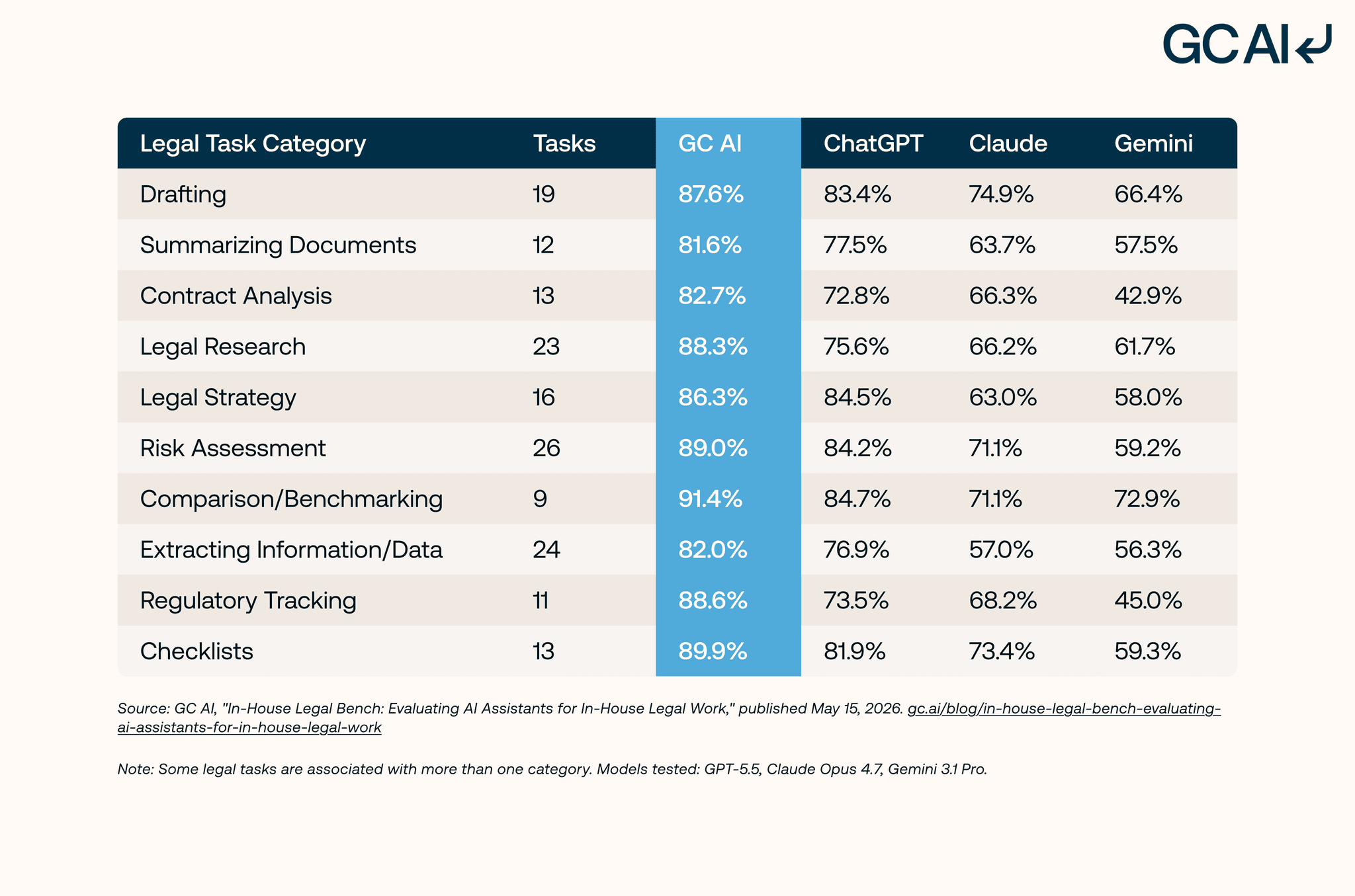
The widest gaps showed up in research-intensive work: regulatory tracking, legal research, and checklists, the exact tasks where a fabricated citation does the most damage.
This is where purpose-built design matters.
GC AI, the enterprise-grade legal AI platform built for in-house counsel, was created to close the verification gap these cases expose. It connects your company's contracts, policies, and data sources with the intelligence of modern LLMs, delivering precise, contextual answers that help legal teams accelerate business decisions. Unlike generic AI, GC AI understands contracts, compliance, and company context, so every answer aligns with how your business and legal team operate.
Our Exact Quote feature returns character-level citations tied to the source document, so a quote can be checked against the original in one click.
Our Research capability biases toward authoritative primary law and government sources. And on the confidentiality question that decided Heppner, GC AI is SOC 2 Type II and SOC 3 certified, GDPR compliant, and AES-256 encryption. We maintain zero-data-retention agreements with our LLM providers wherever feasible. A zero-data-retention agreement means the model provider does not store the prompts GC AI sends to it.
Cameron Clark, Head of Legal at Arc'teryx, put the practical value plainly:
We couldn't do our job without GC AI.
The lawyer still owns the duty to verify. GC AI builds that verification step into the workflow, so the check happens as part of the process. For a closer look at how general-purpose models perform on legal work, see GC AI vs ChatGPT, GC AI vs Claude, and the deep dives on whether ChatGPT is private and where Claude works for lawyers.
How to Keep Your Team Out of the Next AI Legal Case
Across the seven cases, the same handful of controls keep showing up. A defensible AI workflow has four parts:
-
Write a verification rule. Every AI-assisted filing, memo, or client answer gets checked against primary sources before it leaves the building. Mata happened because that step was skipped.
-
Run diligence on vendor data practices. Ask where a model was trained, whether your prompts are retained or used for training, and what certifications the vendor holds. Getty and Heppner both turned on facts a buyer can confirm up front.
-
Choose a platform built for legal work. The In-House Legal Bench shows the accuracy gap between legal AI and general-purpose models is wide on exactly the research tasks that generate sanctions.
-
Train the team on the rulings. A policy nobody reads changes nothing. Walk the team through the cases and the obligations under ABA Formal Opinion 512.
Start this quarter by writing the one-page verification rule, sending your current AI vendors a short diligence questionnaire on training data and retention, and booking one team training session on AI ethics. Those three steps move a legal department from exposed to defensible in about 90 days.
For help choosing the platform layer, the legal AI tools field guide and the guide to the best legal AI tools for in-house counsel compare the options against in-house requirements. You can also estimate your team's ROI before you commit.