We've had more than 40 conversations on CZ and Friends, the GC AI podcast where CEO Cecilia Ziniti interviews legal leaders about how they run their departments, and employment work comes up again and again. The scene repeats: a separation in a country where the team has no local counsel, and a first hour that used to go to reading labor law before anyone could draft.
Joys Choi, Senior Director, Legal at Tipalti:
“Instead of spending hours translating Colombian labor law, I ask GC AI questions and it provides me with links and summaries in English. Then I cross-reference to confirm, and it doesn’t hallucinate.”
Now, with legal AI, employment contract review starts with a structured first pass. The employment lawyer still makes the judgment calls.
How AI Employment Contract Review Works
AI employment contract review is the use of legal AI, generative AI trained on legal language, to read employment documents and surface risks, missing clauses, jurisdictional issues, and deviations from a company's standard positions. The output is a structured analysis tied to source language: a list of clauses present, clauses missing, terms that fall outside market, and language that may conflict with state or federal law.
In-house teams lean on it most for incoming third-party contracts: the offer letters from a target acquisition, the consulting agreement a business partner signed without involving legal, the severance proposed by outside counsel that needs to be checked against the company's template.
The platform reads the document, compares it to the company's playbook, and returns a redline plus a written summary in minutes. The first pass covers these provisions and the law that governs each. Here are some examples:
Provision AI Checks | What the First Pass Verifies | The Authority That Governs |
At-will and wage-hour language | Exempt classification and the salary floor, bonus and commission precision | FLSA, 29 C.F.R. Part 541 |
Equity and vesting | Cliffs and acceleration triggers match the equity plan | The company's equity plan |
IP assignment | Statutory notice present, assignment scope fits the role | Cal. Lab. Code § 2870 and state parallels |
Restrictive covenants | Scope, duration, geography, and consideration per state | Cal. B&P §§ 16600-16600.5, Minn. Stat. § 181.988, state thresholds |
Severance and release | OWBPA clocks, NLRA-safe confidentiality, consideration tied to the release | OWBPA, NLRA (McLaren Macomb) |
Contractor classification | Agreement language against ABC and economic-realities indicia | AB 5, PAGA |
GC AI is an enterprise-grade legal AI platform built for in-house legal teams, used by over 2,000 legal departments including 300+ public companies.
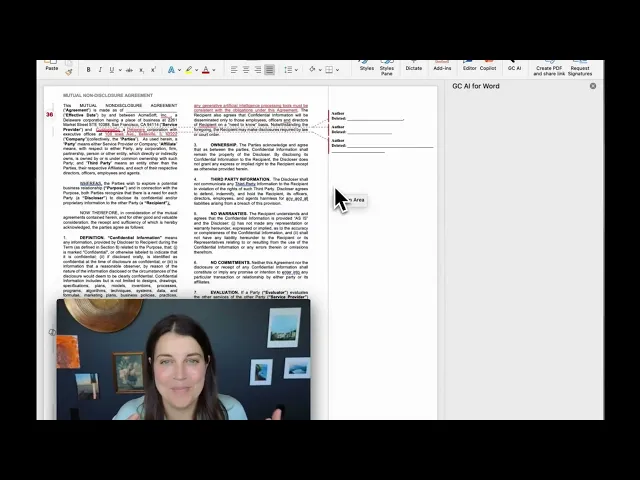
The platform reads employment documents directly inside Microsoft Word, ties each finding to the exact source language with Exact Quote, and runs against Playbooks the team has built for offer letters, separation agreements, and other recurring employment paper.
CEO and co-founder Cecilia Ziniti built it to solve the problems she hit firsthand as a three-time general counsel at Anki, Bloomtech, and Replit, and as in-house counsel at Amazon and Cruise. For a wider view of the category, see the guide to the best legal AI tools for in-house counsel.
GC AI's December 2025 ROI study found in-house teams save an average of 14 hours per week per lawyer and reduce outside counsel spend by 14% (GC AI customer survey of more than 100 active customers, January 2026).
The platform is SOC 2 Type II and SOC 3 certified, GDPR compliant, and AES-256 encrypted, and none of its AI providers train on your data, with zero-data-retention agreements maintained with its LLM providers wherever feasible; see the current subprocessor list. Employment documents stay confidential throughout the review.
What AI Flags in an Employment Contract
The flags every employment lawyer has caught at some point:
A non-compete or non-solicit clause carried over from last year's template, unchanged even though the employee's role, state, or salary no longer supports it.
A start date, title, or reporting line in the offer letter that doesn't match what recruiting or the hiring manager actually told the candidate.
A signing bonus with a clawback provision that never states the repayment amount or the window it applies to.
A vesting schedule that doesn't line up with the cliff and acceleration terms in the actual equity plan.
A severance number that doesn't match what was verbally offered in the separation conversation.
An independent contractor agreement that requires set hours, company equipment, or a direct reporting line, the kind of language that undercuts the classification the company is claiming.
A defined term or party name carried over from a different agreement entirely, the copy-paste leftover every reviewer has caught at least once.
Documents Employment Lawyers Already Review With AI
Each of these documents carry their own risks, market terms, and enforceability questions, so the review looks different for each:
Offer letters and equity grants
IP assignment and invention disclosure
Restrictive covenants: non-compete, non-solicit, and confidentiality
Severance and separation agreements
Independent contractor and consulting agreements
Offer Letters and Equity Grants
Offer letters are the highest-volume employment document a legal team reviews, and small mistakes repeat at that volume: a misstated vesting schedule, a missing at-will clause, an ambiguous start date, a bonus structure that raises a wage and hour question.
AI reads the offer letter against the company's template, flags each deviation, and pulls each defined term into a side-by-side comparison: vesting cliffs and acceleration triggers against the equity plan, at-will language against state requirements, bonus and commission structures against the precision wage and hour compliance requires, and any reference to a non-compete or non-solicit that needs its own review.
The conversation about whether the equity is competitive for the role stays with the recruiting partner.
IP Assignment and Invention Disclosure
IP assignment agreements vary by state more than they look.
California's Labor Code section 2870 carves out inventions developed entirely on the employee's own time, without company resources, that do not relate to the employer's business. Other states have parallel statutes with slightly different scope. An assignment that omits the statutory notice is unenforceable as to those inventions in California, and the unenforceability can spread to the rest of the clause depending on the court.
AI reads the assignment language, flags whether the 2870 notice or its state equivalent is present, and checks the scope of the assignment against the role description. For roles that involve open source contributions or moonlighting, AI surfaces the language a court will look at first. The intellectual property clause page covers the standard forms.
Restrictive Covenants: Non-Compete, Non-Solicit, and Confidentiality
The law on restrictive covenants changed in 2024 and is still changing.
The FTC's April 2024 rule banning non-competes was vacated in August 2024.
The agency has since moved to targeted enforcement, ordering Rollins, one of the largest pest-control companies in the country, to stop enforcing non-compete agreements against more than 18,000 employees, and sending warning letters to 13 other companies in the same industry.
The current federal posture, confirmed at a January 2026 FTC workshop, is case-by-case enforcement under a common law reasonableness standard.
At the state level, California, Minnesota, North Dakota, and Oklahoma effectively ban non-competes for employees.
Colorado, Illinois, and Maryland enforce them only above compensation thresholds. Some states require advance notice of non-compete terms before the employee accepts the offer. Texas allows non-competes but requires consideration beyond continued employment.
Filed paper shows what a reasonableness-state covenant looks like. American Integrity Insurance Group's executive employment agreement, filed with the SEC in April 2026, bars the executive for twelve months after termination from joining "any Competing Business within the Restricted Area," defined as the State of Florida plus any territory the executive served. The same clause signed by a California employee would be void, whatever the governing law provision says.
The rules differ by state and keep changing, so the same clause has to be checked state by state, and AI does that in one pass. The platform reads the non-compete or non-solicitation clause, identifies the governing law clause, and flags whether the scope, duration, geographic reach, and consideration meet the requirements of that jurisdiction. The litigation judgment about whether to enforce a covenant in a given case stays with the employment lawyer.
Severance and Separation Agreements
Ambiguity in a severance agreement costs money.
A poorly drafted release fails to cover the claims it was meant to cover. A confidentiality provision that conflicts with the NLRA's protected concerted activity rules, the line the NLRB drew in McLaren Macomb, invalidates that portion of the release. An age release that does not comply with the OWBPA timing requirements is unenforceable as to ADEA claims, which means the company has paid severance for a release that did not release anything.
AI reads the severance against the company's template, confirms the OWBPA disclosures are present for separations that include them, flags any release language that may conflict with NLRA or state-specific rules on confidentiality and non-disparagement, and checks that the consideration described in the agreement matches what was offered. For multi-jurisdictional separations, AI flags the differences between the state-specific addenda.
Independent Contractor and Consulting Agreements
Misclassification exposure multiplies, because the same agreement covers all the contracts.
The economic realities test, the ABC test in California and the states that followed it, and the classification questions that come up after AB 5 all turn on the language of the agreement and the facts of the engagement. In California the exposure has a statute attached: the [Private Attorneys General Act](https://leginfo.legislature.ca.gov/faces/codes_displaySection.xhtml?lawCode=LAB§ionNum=2698.) lets one worker pursue civil penalties on behalf of others, so a misclassified contractor population multiplies the predicate violations.
AI reads the contractor agreement, flags terms that contradict independent contractor status, surfaces the indicia a court will look at first, and checks the indemnification and IP assignment language against the relevant state's rules.
The output is a structured map of the language that supports each side of the classification question, so the in-house lawyer can have an informed conversation with the business partner about whether the engagement meets the test.
How to Review Employment Contracts With GC AI
Five steps move an employment contract from incoming to redlined on GC AI:
Run the document through the team's employment playbook
Verify each flagged clause against Exact Quote
Run the jurisdictional check
Redline directly in Word
Document the decisions
Run the Document Through the Team's Employment Playbook
The team's employment playbook captures the company's standard positions on each clause that matters: at-will language, equity vesting, restrictive covenant scope, severance terms, IP assignment, indemnification.
GC AI reads the incoming document against the playbook and returns a structured comparison. The same step scales to a batch. An employment lawyer at a multinational travel company loaded 350 documents into one GC AI project for a labor and employment matter and worked through them in a week, on a review she had scoped at more than a month.
Verify Each Flagged Clause Against Exact Quote
For each finding, confirm the source language. Exact Quote ties the flag to the exact words in the contract, so verification is one click. This is the step that separates legal AI from generic AI, and it is what makes the redline ready to send.
Run the Jurisdictional Check
Employment law moves fast.
A general-purpose assistant such as ChatGPT or Claude applies the law as it stood on its training date.
That's fine for commercial contract review, where the law barely moves. Employment review is different: the salary floor and the FTC's posture both changed within the year.
For multi-state or international employment, GC AI's Research function deploys agents to search primary law and current regulatory guidance at the moment of the question, so each material clause is checked against current authority.
Kacie Zanassi, Director of Employment, Litigation, and Legal Ops at Eventbrite, on that first pass:
"When facing litigation in unfamiliar jurisdictions, I use GC AI as my first step to quickly understand procedural requirements, causes of action, and local court rules. GC AI is my first step for research and initial drafting, accelerating my work so I can focus on complex legal analysis and strategic counsel that drive informed business decisions."
This is where to test any AI platform before relying on it. An M&A lawyer at a multinational travel company cut her team's list of fifteen AI vendors to four using one rule: if a tool only matches 80 to 90 percent of what public ChatGPT already does, it's off the list.
Redline Directly in Word
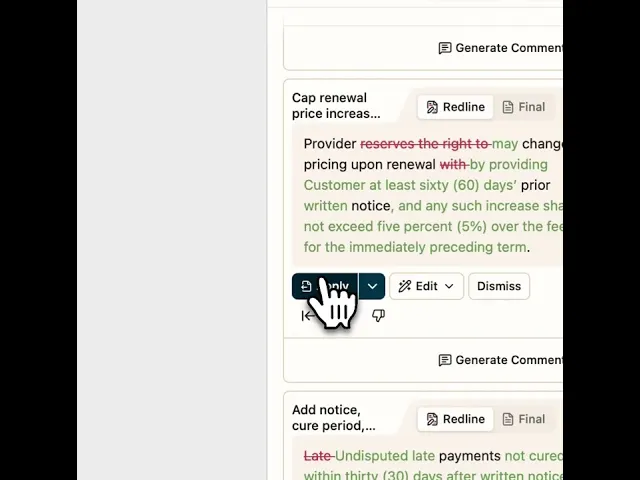
GC AI's Word integration applies the redlines as tracked changes inside Microsoft Word, where the documents already live.
The redlining is tracked, the comments export cleanly, and the revision history stays intact. Each suggested change is a normal tracked change, so the lawyer accepts, rejects, or edits it directly in Word before anything goes out, no separate tool or export step required. The redline goes back to the recruiting partner or business partner in the format they already work with.
Document the Decisions
Save the analysis to the matter file. For employment work, the documentation matters because the same questions come up again, and the team's future answer should match the past answer unless something has changed.
Start With Your Next Employment Contract
To start, pick the team's highest-volume document type, build a playbook that captures the company's positions on it, and run the next three incoming documents of that type through Steps One and Two. Add the jurisdictional check for any multi-state paper once the playbook holds.
Frequently Asked Questions
Can AI review a non-compete agreement?
Yes, for state-specific reasonableness analysis. AI reads the restrictive covenant, identifies the governing law, and checks scope, duration, geography, and consideration against the requirements of the relevant jurisdiction. For multi-state employers, the same covenant runs through each relevant state's rules in one pass. The litigation judgment about whether to enforce a covenant in a given case stays with the employment lawyer.
Is AI accurate enough to review severance agreements?
Yes, when the AI is built for legal work and tied to current authority. Severance review involves OWBPA timing for age releases, NLRA compliance for confidentiality and non-disparagement, and state-specific rules on consideration and release scope. Legal AI flags each of these and ties the finding to the source language. The lawyer makes the final call on close questions.
Does AI replace an employment lawyer?
No. AI removes the reading time, the structured comparison, and the jurisdictional checking. The employment lawyer still makes the judgment calls: whether to enforce a covenant, whether to offer additional severance, whether equity terms are competitive, how to structure a separation. The platform makes the lawyer faster on the routine work and more focused on the strategic work.
Can ChatGPT review an employment contract?
ChatGPT can summarize an employment contract and flag obvious issues, and it is the world's best general-purpose AI. It does not run the document against your company's playbook, tie each finding to the exact source language, or check the clause against current state law unless prompted to search, and consumer ChatGPT plans do not carry the enterprise security controls in-house teams require for employee data. The GC AI vs ChatGPT comparison walks through the differences on legal work.
Is AI safe to use with confidential employee data?
Yes, when the platform meets enterprise security standards. GC AI is SOC 2 Type II and SOC 3 certified, GDPR compliant, and AES-256 encrypted, and none of its AI providers train on your data, with zero-data-retention agreements maintained with its LLM providers wherever feasible. Consumer AI plans without those controls should not be used with confidential employee data.
What is the best AI for employment contract review?
For in-house counsel, GC AI is built for the in-house employment workflow, with playbooks for recurring paper, Exact Quote verification, jurisdictional research, and a Word integration that meets lawyers where they work. Legal AI platforms designed primarily for law-firm employment practices serve that audience well. The right platform depends on the team's structure and the document mix.