

Dive Deeper
Transcript
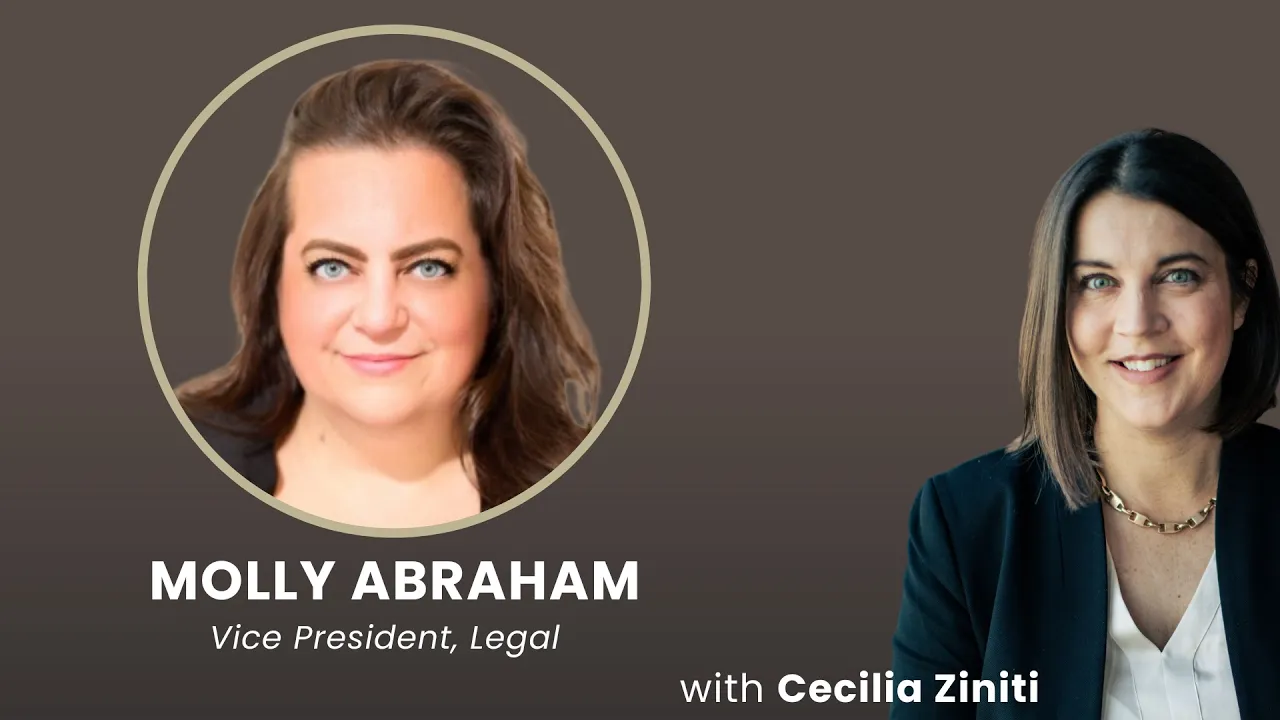
Episode Overview
AI leadership splits into three roles: the Enabler who unblocks safe adoption company-wide, the Protector who keeps confidential data out of model training sets, and the Super User who puts AI to work in daily practice.
Abraham has road-tested that framework in one of the harshest legal environments in tech. She built Coinbase’s legal team through an SEC lawsuit that threatened the company’s existence, and in July 2026 Coinbase named her General Counsel, succeeding Paul Grewal.
In this episode of CZ and Friends, Abraham and GC AI co-founder and CEO Cecilia Ziniti trace the through line from Pampers patents to flying cars to crypto’s defining legal battle, and why the most effective GCs are business people who happen to have a legal toolkit.
About Molly Abraham
Molly Abraham is General Counsel at Coinbase, promoted from VP of Legal in July 2026 to succeed Paul Grewal. She started as a product development engineer at Procter and Gamble, working on Pampers and contributing to a patent while teaching LSAT courses at night to save for law school.
After earning her JD from the University of Chicago Law School, she spent six years at Wachtell Lipton on multi-billion dollar litigations and SEC and DOJ investigations, then went in-house at Kitty Hawk, the flying car company backed by Larry Page, where she saw a carve-out and joint venture with Boeing through to completion. She joined Coinbase in March 2021 and has grown its legal team from two to 90 through the SEC's regulation-by-enforcement era and the case's February 2025 dismissal.
Key Takeaways
The best CLOs and GCs are business people first with a legal toolkit second. Abraham hires for that same instinct, prioritizing business judgment over legal pedigree alone.
Legal's highest-leverage role is dot connector. Abraham's team works in shared Slack channels instead of DMs, so one product team's work can surface a connection another team needs.
Question the traditional framework before accepting it. When a Kitty Hawk vehicle fit no FAA category, Abraham's team asked whether the Coast Guard was the right regulator instead, and took that case directly to both agencies.
Transparency compounds under regulatory pressure. Coinbase published its Wells notice, made its case docket public, and covered the SEC suit in shareholder letters through to the case's February 2025 dismissal.
Legal leaders need three AI hats: Enabler, Protector, and Super User. Abraham predicts in-house lawyers who skip all three roles will become extinct as AI reshapes the profession.
How Does an Engineering Background Make a Better Lawyer?
An engineering background taught Abraham to read the legal record as market intelligence. As a product development engineer at Procter and Gamble, she contributed to a patent, then proposed analyzing competitors' patent filings as clues to what was coming next, mapping white space for both new filings and business strategy. She has carried that habit into two decades of practice.
Abraham studied chemical engineering with a concentration in applied math, always intending to become a lawyer. She worked on Pampers, a business in the middle of long-running IP battles between Procter and Gamble and Kimberly-Clark, and took the LSAT while running a materials-science upgrade to the toilet training product. Rather than keeping her head down until law school, she went to the GC of the baby division and asked how a junior engineer could help.
Abraham, VP of Legal at Coinbase at the time, said:
"I still today love using all things legal as market clues: tracking dockets, you name it. By just getting involved both with the legal team at P&G, but also doing my day-to-day work as an engineer getting a patent ... I was able to see what the power of those two things together can be."
She tried to replicate that pairing, technical fluency plus legal leverage, through the rest of her career: Wachtell Lipton for six years of multi-billion dollar litigation and government investigations, then in-house at Kitty Hawk, then Coinbase.
What Does It Mean for Legal to Be the Dot Connector?
Dot connecting is Abraham's name for the product counsel's highest-leverage role, using legal's cross-company vantage point to link work happening in product, policy, compliance, and the business before anyone else sees the connection. Her team's operating rule makes it possible. They work in Slack channels, share FYIs constantly, and serve the product organization as a whole rather than individual PMs.
Abraham said:
"One of the most important roles that we serve as product counsel is to be the dot connector across not only the legal organization, but policy, and compliance, and the business."
You never know, she explains, when someone will notice that one product team is doing X while another does Y, and one plus one could equal three. A few episodes earlier, Mallun Yen made the case that this executive-desk function makes legal a training ground for founders. Abraham agrees, and takes it further:
"At the end of the day, they're a business leader first. ... The way that I unlock them, my set of tools or keys to unlock, happen to be legal ones, but I view myself as a business person first and a lawyer very much second."
How Do You Advise When No Regulator Fits Your Product?
The foundational question is which regulator is the right one, and why. At Kitty Hawk, one vehicle had wings, flew, and operated close to the water, but fit no FAA category cleanly. Instead of forcing it into the traditional framework, Abraham's team asked whether the Coast Guard, not the FAA, was the right regulator, and took that conversation to both agencies directly.
The approach worked because the company had already built trust, bringing FAA officials to its test facilities, showing its safety practices, and being candid about where the vehicle did or did not fit. That vehicle never reached commercialization, but the mindset became permanent.
Abraham said:
"Never take the traditional assumptions as a given. Question absolutely everything ... Don't be afraid to ask the foundational questions."
The other half of the lesson was candor with her own executives. Type A lawyers want to know the answer, she says, but the job is embracing the gray. That means telling the exec team what she knew, what she did not, and what she would dig into next.
"The reality is the most important part of the job is embracing the gray. ... Just being open about not having the answers ... was really important in giving this advice."
She now hires against that trait. The person who will not fit on her team is the one who says they have done X at a public company for ten years and know the way it is done. Coinbase is questioning how the financial system was built; its lawyers have to be willing to question anything, and to articulate the policy rationale behind a rule before accepting that the rule applies.
How Do You Choose Where to Work In-House?
Choose for the people, and choose the messy problem. Abraham evaluates offers on one question: will these colleagues make me a better lawyer and leader than I would become anywhere else? She picked Wachtell knowing nothing about corporate law, Kitty Hawk knowing nothing about the FAA, and Coinbase after buying Crypto for Dummies the day before she started.
Abraham said:
"I want to be surrounded by people that I respect and who are smarter than me. I never want to be the smartest person in the room."
The second filter surfaced when someone asked why she left Kitty Hawk after closing the Boeing carve-out and joint venture. The suggestion that it was her time to tend the garden clarified everything.
"I am not a garden tender. I am a bring me the messier, the better, the wartime, the better. I love the intensity. ... I knew that it was going to be the biggest and hardest, most fought legal battles of all time. I don't know that I fully grokked all of that at the time, but gosh, if I had known it all, it would have made me sign on the dotted line faster."
It's a pattern other guests describe too, including the CLO who left Southwest Airlines for challenger carrier JSX. The lawyers who thrive in scrutinized industries seek the fight on purpose.
What Did the SEC Suit Teach Coinbase's Legal Team About Transparency?
Transparency, at moments when convention said to go dark, defined how Coinbase's legal team fought and won. The company published a video about its Wells notice. It made its case docket accessible to the public and featured litigation developments in its shareholder letters. CLO Paul Grewal, a former federal magistrate judge, learned the SEC had filed suit while walking in to testify in Washington, DC, and testified anyway.
The SEC sued Coinbase in June 2023, at the height of what Abraham calls the regulation-by-enforcement era, with much of the fight turning on whether crypto assets are securities under the Howey test, the framework from a 1946 Supreme Court case about a Florida orange grove. Abraham played a support role and credits Grewal and the litigation team. What she took from it was how they led.
Abraham said:
"People were just direct and transparent with what was going on, whether it was with clients, whether it was with business partners, whether it was with other regulators, and even just the public. ... It was a different approach to transparency in a case that I hadn't witnessed before, and I just feel like I learned so much from it."
She remembers the morning it started. She saw the text on the way to get coffee and decided to get the coffee anyway, knowing it was going to be a long day. The case was dismissed in February 2025, with prejudice, as Abraham notes in the episode. Through the same period she kept building. She started with a team of two the day she joined; the team is 90 now. The thing she brags to her boss about is the meeting she did not attend because someone on her team covered it and crushed it.
How Do You Build Credibility With Business Teams? Give Them the Cite
When Abraham explains an unwelcome rule to a business team, she hands over the citation and a link to the source alongside her TLDR, even though perhaps one in ten people ever clicks through. Some lawyers find the practice borderline offensive, as if clients were checking their homework. Abraham sees persuasion.
Abraham said:
"People want to understand. If they're skeptical, show them why they don't need to be, and don't be defensive about it. Welcome the curiosity."
Non-lawyers are curious about the law and find it befuddling, she says. A willingness to show the source builds the credibility that makes the next hard answer land.
What Are the Three AI Hats Legal Leaders Need to Wear?
Abraham's framework for legal leaders approaching AI has three hats: the AI Enabler, the AI Protector, and the AI Super User. A leader wearing all three unblocks safe adoption for the company, guards its confidential information, and models daily use for the team. Her warning for leaders wearing none of them is blunt.
Abraham said:
"I don't think law is going to become extinct. I don't think in-house legal is going to become extinct. I think in-house lawyers who do not embrace AI will become extinct."
The AI Enabler Unblocks Safe Adoption
Legal is the function best positioned to speed AI adoption safely. Employees will experiment either way, Abraham says, so the choice is between getting ahead of it safely or letting people find their own workarounds. Her team treats accelerating AI tools for other departments as part of its mission, rethinking vendor contracts for AI products, unblocking the tools engineers want to onboard, and answering the confidentiality, privilege, and MNPI questions that stall adoption at public companies.
The AI Protector Guards Confidential Data and Privilege
The protector hat starts with vendor agreements. When a major software company notified customers that data flowing through its product was training its LLM, Abraham's commercial team reviewed its own agreements anywhere Coinbase data was processed, checking that nothing trained on it without permission. Coinbase now applies an AI lens to its agreements broadly, asking what happens to its data if a given vendor becomes an AI company.
Abraham said:
"If something ingests your confidential information and can spit it out, even in a transformed state, that's still your confidential information."
Privilege training belongs under the same hat. A non-lawyer asking a general-purpose chatbot for legal advice is not talking to their lawyer, and courts have now made that explicit. In United States v. Heppner, the Southern District of New York held in February 2026 that AI chat exchanges with generalist tools are not protected by attorney-client privilege. For the buyer's side of the protector checklist, see the guide to data security in legal AI.
The AI Super User Applies AI to Their Own Work
The third hat is the one Abraham confesses she is still earning. Her team already runs AI-first workflows, taking the first pass at redlines with playbooks the team developed, and using scale tools to hire fewer commercial lawyers than planned. Her personal practice is research, and she has a discipline worth stealing. She runs the same question through multiple AI platforms at once.
Abraham said:
"It is a helpful cold dose of reality to see the differences that come back, because the answers are so polished and thorough that it lends itself to credibility. And then you realize, wait a second, I did not get the same answer."
Her mission for the month is unlocking her own daily productivity, starting with building her first agent alongside a friendly engineer.
Why "Be Dispensable" Is the Best Career Advice Abraham Ever Got
Be dispensable. Build a team so strong the company does not need you. It sounds backwards to lawyers who equate value with being indispensable, and Abraham argues the opposite is what leaders owe their companies.
Abraham said:
"If I am doing my job, I can get hit by a bus or win the lottery tomorrow and my team will continue to function excellently and the company will not miss a beat. ... And it ends up also working out for my own career, because every time I do that, I'm able to take on more responsibility or a new or exciting challenge."
The proof arrived after this episode was recorded. In July 2026, Coinbase named Abraham General Counsel, succeeding Paul Grewal. His public sendoff echoed her own framework: Abraham "has been in the trenches with him on the company's most important legal battles for more than five years."
Recommended Reading
Why Judgment Is the New Superpower for In-House Lawyers in the Age of AI: pairs with Abraham's Super User hat, where knowing which answer to trust is the skill AI cannot replace.
AI in the Legal Field: the broader context for the three hats, from adoption to guardrails across in-house teams.
How Great GCs Think About Growth, Risk, and Crisis Management: the business-person-first mindset Abraham lives, applied to the GC seat she is stepping into.


