

Dive Deeper
Transcript
Episode Overview
Quantum computing matters for in-house counsel for three reasons: it will eventually break public key encryption, it already sits under active export control scrutiny, and the lawyers who can translate it for regulators will shape how it gets governed.
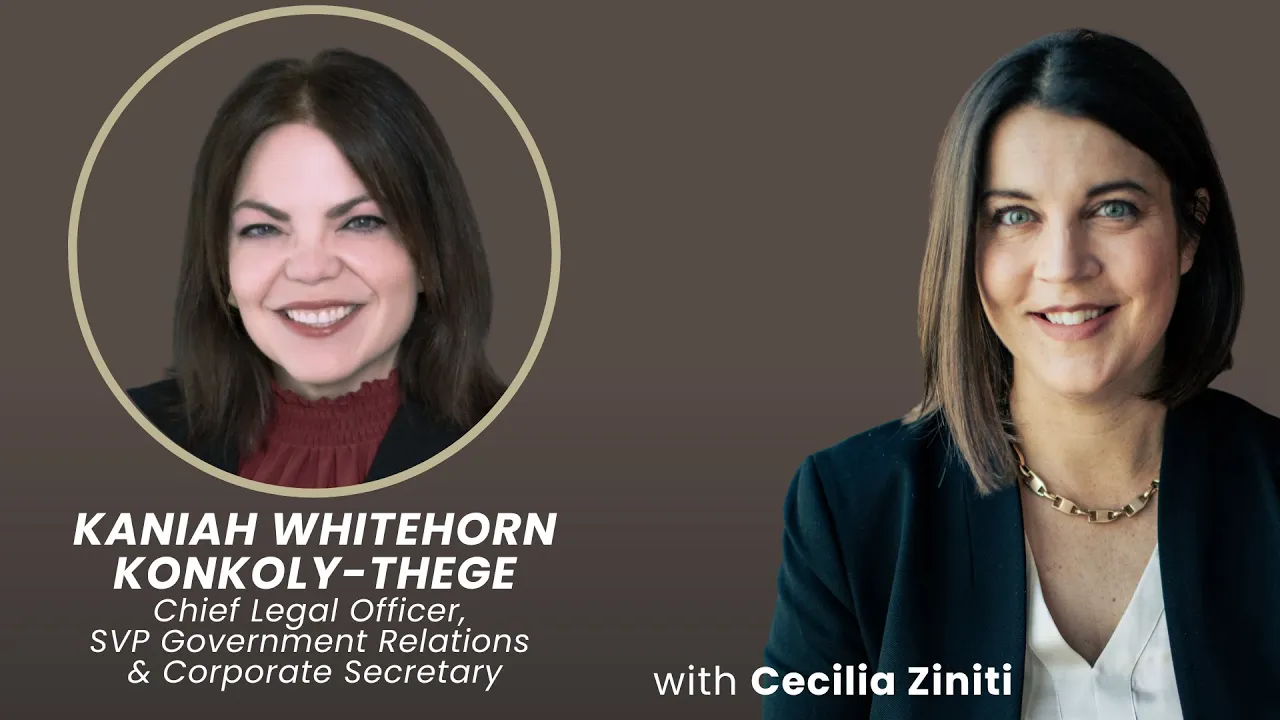
That last skill is Kaniah Konkoly-Thege's specialty. She has been Chief Legal Officer of Quantinuum since the company grew out of Honeywell's quantum program, and since 2018 she has explained quantum computing to a Capitol Hill that had never heard of it.
She built that fluency without a technical degree, the same way she built her career: by asking the experts what she calls "stupid" questions until the answer made sense.
In this conversation with GC AI co-founder and CEO Cecilia Ziniti, Konkoly-Thege breaks down what quantum computing actually does, how she talks regulators through emerging technology, and why she thinks every lawyer will be using AI within five years.
About Kaniah Konkoly-Thege
Kaniah Konkoly-Thege is Chief Legal Officer at Quantinuum, the quantum computing company that grew out of Honeywell's quantum program. She began her legal career in 2003, working on the Cobell v. Salazar litigation against the Department of the Interior.
Key Takeaways
Quantum computing will eventually break public key encryption, just not yet. Konkoly-Thege says attackers already have cheaper ways in today, hacking a system, ransomware, or social engineering, so the encryption threat is real but not the most pressing risk.
Quantum already lives inside export control regimes that can upend a supply chain overnight. The technology depends on a handful of overseas suppliers, including just two companies worldwide that build the dilution refrigerators quantum computers need to run.
Quantum will transform regulated industries starting with chemistry, not consumer tech. Quantinuum's work with Microsoft identified a catalyst and mapped a chemical reaction that classical computers can approximate but not fully solve.
Ask what problem you're solving before writing the regulation. Konkoly-Thege applies the same test to quantum and AI: a framework built without that question produces heavy-handed regimes that crush small startups instead of managing the real risk.
Every lawyer will be using AI within five years, whether their department is ready or not. Konkoly-Thege says legal AI has already reshaped her law department's hiring plans and cut how much work goes to outside counsel.
What Is Quantum Computing?
Quantum computing solves certain problems by testing every possibility at once instead of one at a time, the way a classical computer has to. Once these systems scale up, what the industry calls large-scale fault-tolerant systems, they will take on problems in chemistry, drug discovery, and financial modeling that would take a classical machine thousands of years to grind through.
Konkoly-Thege has spent years refining the analogy. Her favorite is planning a seating chart for a wedding with a hundred guests and ten tables.
Konkoly-Thege explains:
"A typical classical computer is not going to be able to solve it. It'll take 10,000 years to solve it because it's working in these ones and zeros, and every iteration of where those people could sit, it has to first figure out and then eliminate. A quantum computer is going to function a little bit more like the way your mind thinks. It's going to eliminate a lot of these probabilities at once to get to the most ideal, optimal seating arrangement."
Her second analogy is simpler. Picture a hotel with a hundred rooms and treasure behind one door.
A classical computer knocks on doors one at a time. A quantum computer opens all of them at once.
The payoff is precision at a scale nature already achieves and classical machines cannot. She points to recent work with Microsoft in which Quantinuum helped identify a catalyst and map exactly what would happen in the chemical reaction, something she says classical computers get close to but cannot finish.
Why Does Quantum Computing Matter for In-House Counsel?
Three legal consequences follow from the technology, in Konkoly-Thege's telling. First, quantum computing will eventually be able to break public key encryption, the backbone of secure digital transactions.
Second, it already lives inside export control regimes that can reshape a company's supply chain overnight. Third, it will transform regulated industries, starting with chemistry and pharmaceuticals, before most legal departments have a position on it.
She is careful not to oversell the encryption threat as tomorrow's problem:
"Will quantum break public key encryption someday? I'm sure it will. Not today, but eventually you can use it to break encryption. But guess what? You can still hack a system. You can still call somebody up, put in ransomware. There's so many other things that you can do to exfiltrate information."
The near-term legal exposure is the export control and supply chain work she has been doing since 2018.
How Do You Handle a Legal Problem You Know Nothing About?
Konkoly-Thege's answer took shape on her second day as a lawyer. Take the assignment, find the people who understand the technical framework, and ask them basic questions until you can defend the plan yourself.
Precision can come later. The first thing you need is a working model of the system you are being asked to make legal judgments about.
Her crash course was the Cobell case. The judge overseeing the litigation, Royce Lamberth, had ordered the entire Department of the Interior to disconnect from the internet after a court-ordered penetration test found trust account records exposed.
Employees came in on a Friday afternoon and physically unplugged their computers from the internet. The Secretary of the Interior had been held in contempt twice, and the senior attorneys wanted nothing to do with the case.
So the department handed it to the newest lawyer in the building.
"They asked me to figure out this crazy cybersecurity stuff and help the Department of Justice present to the Special Master a reconnection plan for each office and bureau. So I had to essentially figure out what would be considered an appropriate reconnection plan that included segregation of data and mapping out network architecture, which I had no clue about until I just started figuring it out."
She spent weeks in sessions with personnel from NIST and the NSA, asking what a WAN was, what a LAN was, how the wires flowed, until the framework clicked well enough to translate into legal terms she could defend in front of a Special Master.
The case carried personal weight. Konkoly-Thege is an enrolled member of the Osage Nation and grew up on reservations in Arizona, Florida, Mississippi, and New Mexico.
Cobell demanded an accounting of assets the government had held in trust for Native people since 1887.
"Walking into Interior and reconnecting with Native people, reconnecting with people who look like me, who had the life experience that I had, was really meaningful. Now, I will say working on this case was also a challenge because I was learning more and more about the institutional racism that had been put in place over the last few centuries that led to where the department was."
How Do In-House Lawyers Build Technical Fluency?
Ask the experts your "stupid" questions, and trade what you know for what they know. Konkoly-Thege built fluency in cybersecurity, aerospace-adjacent hardware, and quantum physics without a technical degree, by treating each new field as a set of conversations rather than a curriculum.
The lawyers who thrive in deep tech, she argues, are the ones willing to look uninformed in the room.
"I just asked a ton of questions. And what I found was everybody was happy to answer them. And things I thought were stupid questions really weren't."
At Quantinuum, the trade runs both ways. She works alongside more than 350 PhD physicists and scientists, including alumni of the NIST team whose ion-trapping work won a Nobel Prize.
They walk her through the mechanics of energy transfer over lunch; she walks them through Supreme Court cases.
The second ingredient is volunteering for the hard problems. She never worked in Big Law.
Colleagues who spent years on Big Law's rote mechanics came away with precision. Taking on the problems nobody else wanted taught her to weigh risk, the same judgment AI cannot replace for in-house counsel.
"When you take those hard problems on, over time you start to figure out what's the likelihood that these hoof prints are gonna be a zebra versus a horse. What's the likelihood that this one clause in a contract is gonna lead to some huge litigation."
The third ingredient is the smallest, and the one she repeats most. Ask for what you want.
Early in her career she watched a colleague work on two monitors and assumed a second screen was not available to her. His response, "Did you ever ask for it?", became a career rule.
How Do You Explain Emerging Technology to Regulators?
Map how sophisticated each audience is, come armed with analogies, and connect the technology to what that person cares about, whether that is jobs, national security, or the environment. Konkoly-Thege learned this in 2018, when the U.S. government was weighing strict export controls on quantum technology while Honeywell prepared to tell the world it had been building a quantum computer.
The proposed controls would have landed on a supply chain of small overseas manufacturers: specialty laser makers and the two companies in the world that built dilution refrigerators, mom and pop shops in Finland, Austria, and Germany that made a handful of units a year for academics. Licensing regimes designed for defense contractors would have crushed them, and the U.S. quantum industry with them.
"There was such a small group of people who understood the technology, and they were all scientists, and that meant they didn't really understand public policy. So I started meeting with the regulators and going up to Capitol Hill and talking to Congress members to try and just get them to understand."
The early meetings, around the time the National Quantum Initiative Act came into play, amounted to "hi, this is quantum, it exists outside of labs." Today the conversations carry specific asks: which appropriators to brief, which use cases need early funding, why a laser built for a 2,000-hour life has to be reengineered for 10,000 hours. Her test for any proposed regime, in quantum or in AI, is the same:
"What problem are you trying to solve? And does the framework you're proposing actually solve them? ... Otherwise you come up with these heavy-handed, blanketed regulatory regimes that create a lot of stress on small startups."
That same discipline, translating technical risk into terms decision-makers can act on, is what great GCs bring to how they present risk and prepare for a crisis.
How Do You Lead Legal Without Becoming the Office of No?
Be a business partner first. The advice came from Konkoly-Thege's mentor at Honeywell, and she still leads with it.
The GC's job is to get the business where it wants to go, compliantly and creatively, starting at the deal structure instead of showing up at the contract stage to say no.
What grated on her early in her GC career was the accounting. Legal sat on the books as a cost center.
"I was like, I have value. I'm not just a cost," she says. Her answer was to move upstream:
"You want to go sell something? Let me help you. I'll stand right there with the BD team, ready to sell the products and then write the contract in the manner that's the best for us. You're structuring the deal from the beginning, and you're building relationships with outside parties. You're trying to find the best solution for everybody."
Where Does Legal AI Fit in the Modern Law Department?
Konkoly-Thege predicts that within five years every lawyer will be working with legal AI, whether their department is ready or not. Hers already is.
She credits legal AI with reshaping how her team operates, from hiring plans to how the department uses outside counsel.
"I swear to you, I am not saying this because of you and GC AI, but I believe every lawyer is gonna be using, hopefully GC AI, but some AI tool. I cannot tell you how much it has revolutionized my law department, my team. I've contracted hiring, I have streamlined how we use our outside counsel."
She acknowledges the fear and uncertainty that keep some departments on the sidelines, particularly around training data and confidentiality.
Her framing mirrors her regulatory test. Name the problem first, then check whether the concern holds up against how the systems are built.
Recommended Reading
Why Judgment Is the New Superpower for In-House Lawyers in the Age of AI: former Unity CLO Anirma Gupta on the judgment layer AI cannot replace, the same instinct Konkoly-Thege calls telling a horse from a zebra.
How Great GCs Think About Growth, Risk, and Crisis Management: a companion to her "don't be the office of no" argument, on presenting risk as a business partner rather than a blocker.
AI in the Legal Field: How In-House Teams Use It in 2026: the practical version of her five-year prediction that every lawyer will work with legal AI.


