


Dive Deeper
Transcript
Episode Overview
To roll out AI across an in-house legal team, start at the top: a general counsel who uses the technology visibly, enterprise AI access for every lawyer early, a mandate that sets the destination while each person picks the route, and standing forums where wins get demoed and shared. That is the playbook Nicole Altman and Kelly Noguchi ran inside Instacart's 60-person legal department.
About Nicole Altman and Kelly Noguchi
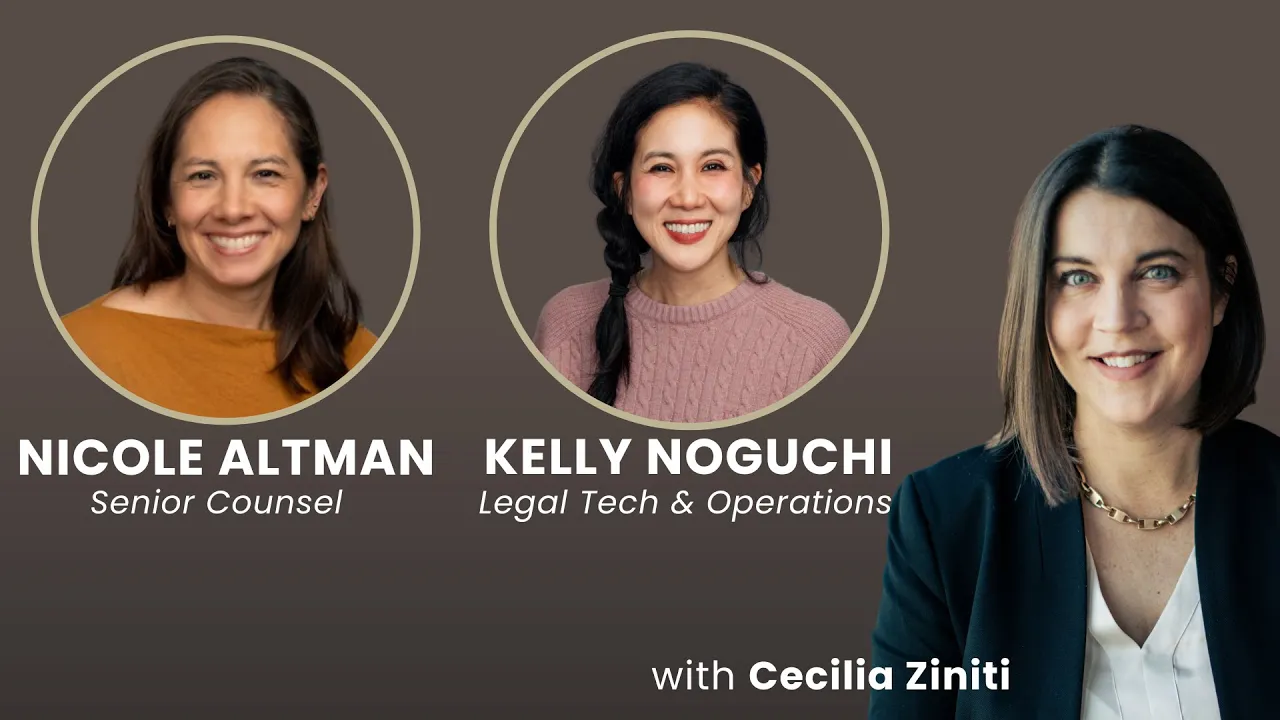
Nicole Altman is Associate General Counsel at Instacart, where she leads AI governance, privacy, security, and IP. She was Senior Counsel at the time of recording.
At a Bolt hackathon, she built Contract Compass, an AI app that stitches contract amendment chains into a single operative version.
Kelly Noguchi is Senior Legal Technology and Operations Manager at Instacart, where she drives adoption of new technologies and leads efforts to make AI accessible across the 60-person legal department.
Key Takeaways
AI-first cultures are built top-down. Instacart's GC Morgan Fong was visibly involved from day one, and AI fluency is baked into personal and team goals company-wide.
Mandate the mindset and leave the method open. Instacart set no mandatory workflows; leadership set adoption as a priority and left each lawyer free to build fluency their own way.
Personal AI wins and enterprise-ready workflows are two different projects. Altman leans on a chatbot for up to 90% of her work, but the legal team's AI inbox-triage system took two attempts a year apart before the models were ready to make it stick.
Change management runs peer-to-peer, not top-down mandate alone. Instacart drives adoption with recurring live demos, learning sessions, polls, and a Slack channel where AI wins get shared in real time.
You do not need an engineering background to build AI tools. Altman had none when she learned to vibe code at a Bolt hackathon and built Contract Compass, a tool that stitches contract amendment chains into one operative version.
How Do You Build an AI-First Culture on an In-House Legal Team?
Instacart built its AI-first legal culture from the top. General Counsel Morgan Fong championed AI from the start, the company gave legal enterprise AI access years before most peers, and AI fluency became part of personal and team goals. The mandate sets the destination and leaves the route to each lawyer. Everyone learns AI, and each person chooses how to fold it into their day-to-day.
The access came early. Years before most tech companies began introducing AI en masse, Instacart engineers built an internal chatbot called Ava on top of leading model APIs and made it available company-wide.
Nicole Altman, Associate General Counsel at Instacart, said:
"You still hear of companies that don't have enterprise AI tools, where people are using shadow AI because the company is not there yet. We're the opposite. We got enterprise AI very early on."
The autonomy mattered as much as the access. There were no mandatory workflows or one-size-fits-all rollouts. Leadership made clear that AI adoption was a priority, then gave people time and space to figure it out, which produced a department full of professionals who use AI because it works rather than out of obligation.
Kelly Noguchi, Senior Legal Technology and Operations Manager at Instacart, explained:
"AI is something that we all have to learn no matter what, and how you learn it and how you incorporate it into your day-to-day is up to you. That engages a lot more people... I feel like AI is just part of every conversation we have."
The culture shows up in the calendar. Monthly business reviews include a standing segment where people from different pillars of the legal team demo what they have been doing with AI. When the team convened in San Francisco for its annual retreat, the theme was cultivating an AI-first mindset, and the majority of working time went to exploring use cases and troubleshooting each other's blockers.
How Do You Turn Lawyers Into AI Early Adopters?
Show concrete examples of what AI can do, and walk people through them repeatedly. Altman and Noguchi run live demos, learning sessions, and polls that surface use cases from across the team, plus a Slack channel where AI wins get shared in real time. The goal is to make curiosity the driver, so early adopters pull skeptics forward rather than waiting for total consensus.
Altman describes the typical stall-out with a story: a friend tried to write a condolence card with an AI chatbot, got something too flowery, and gave up. She never thought to ask the AI to make it less flowery. The impulse to try again, tweak the prompt, or approach from another angle is what makes an early adopter.
Nicole Altman said:
"It takes a lot of investment of time and grit and patience to get the good stuff out of them... And you have to keep doing that over and over again, because the systems are so rapidly changing. What it can and cannot do today is very different from three months ago, one month ago, one year ago."
That grit compounds when the environment rewards it. Altman says she learns the most from seeing how other people on the team use AI, which is why the demos and polls repeat on a cadence, each one leveling up a little from the last.
"The best way to get people into using AI is to show concrete examples of what it can do and how to do it, and walk people through it."
How Do You Roll Out AI From Personal Wins to Enterprise Workflows?
Treat personal productivity and enterprise workflows as two different projects. The first, using a chatbot to brainstorm, draft, research, or pressure-test an argument, delivers immediate value: Altman consults AI on upwards of 90% of her work. The second, building scalable processes the whole team relies on, requires change management, patience, and a tolerance for things failing on the first try.
Noguchi is one of the most candid voices in legal ops on this distinction, and she gives the much-debated MIT study on enterprise AI adoption an honest read. She sees it as a snapshot of the transition point every legal team is in the middle of. The tools are moving faster than most organizations can absorb them, and that gap is a people problem as much as a technology problem.
Kelly Noguchi said:
"The gap between personal productivity and a scalable, business-ready, enterprise-ready process is where the huge challenge is... We can't glaze over changing excitement into execution. That's real."
She also names the pressure nobody talks about. Model releases land every few weeks, native AI ships inside platforms teams already own, and legal professionals are asked to be testers and QA people on top of their day jobs. Legacy SaaS implementation habits, long RFPs, structured roadmaps, and multi-year plans do not survive contact with that pace.
Which Legal Workflows Should You Automate First?
Start with a high-volume, manual, low-judgment process. For Instacart, that was the legal@ inbox: hundreds of emails a week, from anyone inside or outside the company, ranging from urgent matters to complete garbage. Triaging it consumed nearly a full-time job. Altman and the litigation operations team built an AI triage system that routes what needs a response to the right owner.
The rollout took two attempts. The team tried the triage system a year earlier and it did not work; the models improved, they tried again, and it stuck. Processing time dropped so far that inbox triage is no longer anyone's full-time job.
Nicole Altman said:
"Now we have this system that understands what kinds of things are coming inbound to legal. What insights and intelligence can we get from that? What predictions can we make about trends? That's something we're building out too, that would not have been possible previously."
For teams planning a rollout, the first automation pays for itself in reclaimed hours. The second-order win is the business intelligence layer that a categorized, structured intake stream unlocks.
Do You Need to Be an Engineer to Build Legal AI Tools?
No. Altman had no engineering background when she entered a Bolt hackathon, learned to vibe code, and built Contract Compass, an app that solves one of the most universally painful parts of contract management: the amendment chain. Search a counterparty in your contract database and you get back dozens of documents, the original agreement, amendment one, amendment seven, a partial restatement, with no single document showing the operative terms.
Nicole Altman said:
"It takes the various pieces of a contract, understands using AI what has been superseded, and gives a change log and a final version of the contract... it is GitHub for contracts."
The hackathon version runs standalone: upload the documents, get back a document-by-document change log, an overall summary of the changes, and a stitched-together final version.
Kelly Noguchi added:
"Nicole's a great example of a person that's baked AI into their life, and it makes her a better teammate, a better attorney, and now a vibe coder."
A GC AI user once uploaded 26 documents spanning three spinoffs and a primary agreement dating to 1995. The AI gave back exactly what Nicole described: the operative version and the amendment history, in minutes.
Today, you can do the same with GC AI Playbooks. Nicole built her version herself at a hackathon. Talk about taking matters into your own hands.
Instacart Legal rolled out AI with early access, visible leadership, and room for each lawyer to experiment. Ready to try it with your own team?
Recommended Reading
AI in Legal Operations: the same automation instinct behind Instacart's inbox-triage build, applied across a legal department's routine process work.
Legal AI Readiness Assessment: gauge where your own team stands before trying to replicate Instacart's softly mandated rollout.
AI for General Counsel Operations: the department-wide operating layer that fits a GC-led AI push like Morgan Fong's at Instacart.
Outstanding Adoption of AI: The Zscaler Legal Team: another legal department that built an AI-first culture from the top down, worth reading alongside Instacart's playbook.


