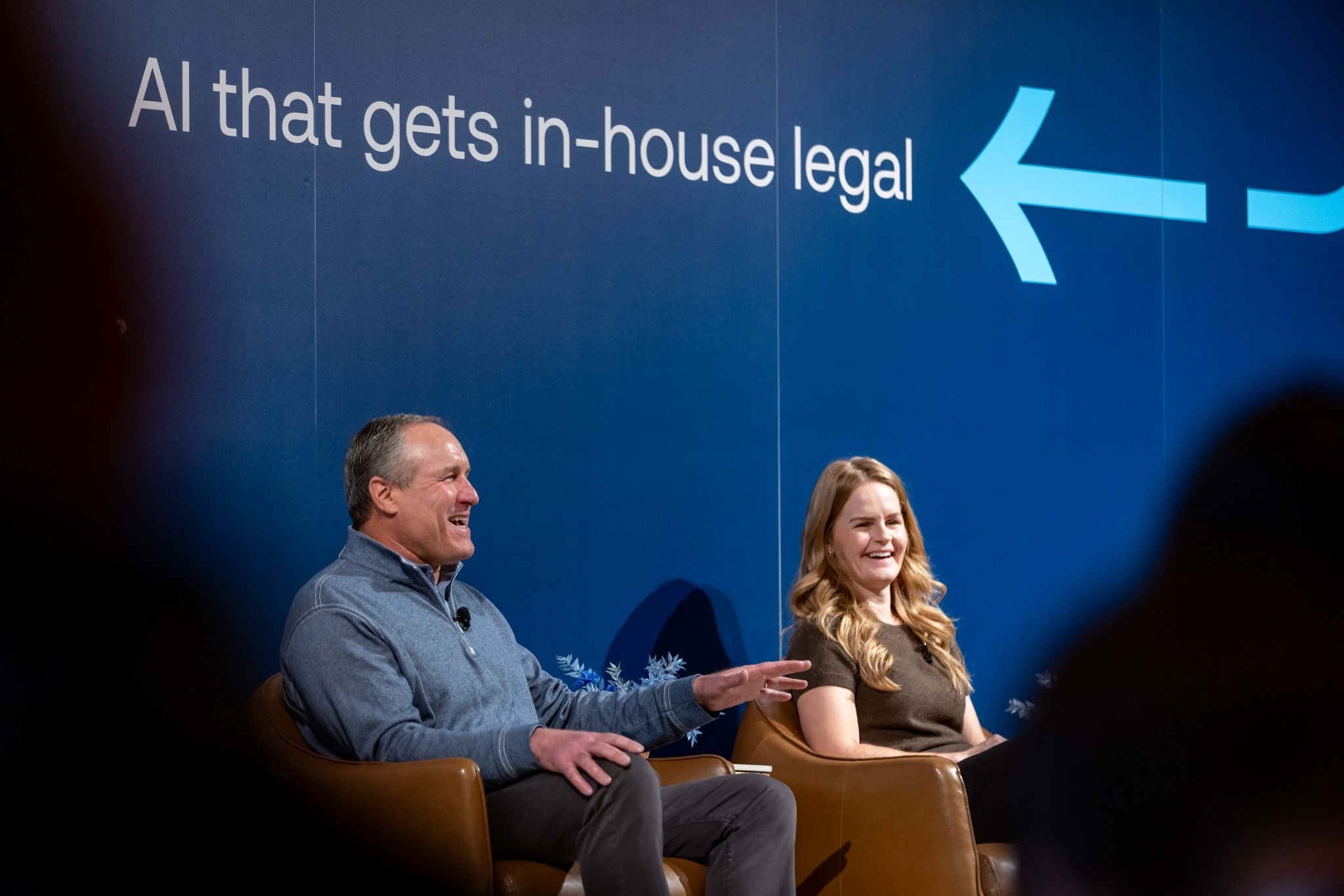
Robert Schlossman, CLO, and Amanda Cincotta, Director of Legal Ops, offered a detailed and practical look at how Zscaler’s legal team quickly and effectively adopted AI. Moderated by GC AI CRO, Andrew Conley, the conversation focused on execution rather than aspiration, including early failures, internal skepticism, training, budgeting, and how AI ultimately improved both efficiency and quality across the legal function.
Amanda began by describing the culture she encountered when she joined Zscaler eighteen months ago. She emphasized that the legal team values open participation and encourages people to speak up, even when they disagree. That openness created space for experimentation and made it easier to acknowledge when initiatives did not work as planned. According to Amanda, this culture directly contributed to the team’s willingness to try new technology and learn from missteps along the way.
Amanda explained that AI adoption required meeting people where they were. Some lawyers were excited to push the technology into sophisticated workflows, while others were concerned about job security and long-term implications. Amanda made it a priority to have those conversations directly rather than pushing adoption through mandates or fear.
Robert provided context on how the legal team evolved over time. When he joined Zscaler ten years ago, the department consisted of three people supporting a company with under one hundred million dollars in annual recurring revenue.
Today, the legal team has grown to 65 people supporting 9,000 employees. Throughout that growth, Robert focused on building processes before layering in technology. In his view, technology cannot solve legal problems if the underlying workflows are not already clear and well understood.
Before GC AI, the legal team rolled out a different AI tool for a specific use case. The tool failed quickly. Lawyers found themselves spending more time fixing errors than saving time, which created frustration rather than leverage.
Instead of forcing adoption, leadership supported removing it and starting over. Amanda explained that the decision was critical because it set a tone that experimentation was encouraged and failure was acceptable.
This early failure directly influenced how the team approached the next rollout. Expectations were reset. The team no longer believed AI would be perfect on the first attempt. Amanda noted that one of the hardest mental barriers in legal tech is the belief that if a tool is not magical, it is not useful. Experiencing failure early made the team more willing to learn prompting skills, iterate on workflows, and invest time in making the tool work well.
Amanda and Robert initially planned to identify a small group of power users and allocate licenses accordingly for a 90-day GC AI pilot. The feedback was overwhelming. Lawyers across the department reported that they could not imagine working without it.
After reviewing usage and listening to the team, Amanda made the call that adoption was their number one priority.
“We did a 90-day pilot where I was like, this is not optional anymore,” Amanda said. “This is priority number one. Our team is not going to be able to function without it.”
Training played a key role in sustaining adoption. The team ran interactive, practical prompting classes, then followed up with sessions tailored to specific legal functions, such as commercial contracting, employment, and litigation. This helped lawyers connect initial excitement to real day-to-day use and reinforced that AI was a tool to support judgment, not replace it.
Robert shared that while he expected AI to reduce time spent on friction tasks, he did not expect it to affect work product quality. Over time, the team began using AI not just to move faster, but to think more clearly and iterate more effectively.
“I expected it to help with friction tasks that take up a ton of time,” Robert said. “It has. But leading to better business outcomes was probably not what I expected.”
One example involved a forty-page business document that needed to be converted into contract language. Using GC AI, the legal team quickly transformed the document into usable contract terms. The estimated time savings were significant, but the more important result was a stronger final product.
According to Robert, AI enabled their lawyers to iterate on tone, structure, and approach while still serving as the final decision makers.
Amanda shared a separate example that demonstrated business impact. While preparing to negotiate outside counsel rates, she used GC AI to pressure test her strategy and assumptions; it suggested asking for a 20 percent discount, which exceeded her initial expectations. Amanda followed the recommendation and secured not only a higher discount going forward but also retroactive discounts that resulted in substantial savings for the company.
Securing a budget for AI required translating these outcomes into financial terms. Robert explained that legal does not control the IT budget, so he framed AI as an alternative to headcount. He offered to reduce his legal hiring request by two positions in exchange for funding AI tools through IT. That tradeoff made the return on investment concrete and unlocked approval.
The session closed with Robert’s perspective on what defines an effective legal team. He described three core responsibilities:
Ensuring compliance with the law
Protecting company assets
Supporting the business.
The first two are expected. The third is where legal teams differentiate themselves.
For Robert, GC AI expanded the legal team’s capacity to support the business.
“The future of being an effective legal department is going to be tied to how effective you are at putting on the Iron Man suit,” he said.
The metaphor, expressed earlier in the day by GC AI Investor, Ashton Kutcher, is about augmentation. “If everybody had an Iron Man suit that was available to them, but some people were like, 'No, I'm not going to wear the suit', and then you go in and try to fight with Iron Man, you're probably going to lose." - Ashton Kutcher, General Partner at Sound Ventures