Maury Bricks was skeptical about legal AI. He is General Counsel and Secretary at ARKO Corp and GPM Investments, a Fortune 500 company and the sixth largest convenience store provider in America. Then Michele Murray, ARKO’s Associate General Counsel, brought over a redline. Bricks described what happened next on the CZ and Friends podcast:
“I was not using AI, proudly staying away from ChatGPT and everything, saying, you know, not needed. I’m smart. I can do my work. And Michelle showed me… I love how I type in like ‘please redline this document’ and then press easy prompt and it’s like, did you mean you wanted to know these 40 things? And I’m like, yes, that’s exactly what I wanted to do.”
Bricks joined ARKO in 2013 as a legal department of one. Since then, he and Murray have navigated 26 acquisitions together. Many Fortune 500 and Global 1000 legal teams live some version of the same story: thousands of legal entities, dozens of jurisdictions, and a legal team that is lean relative to all of it. Outside counsel ends up handling work that should be routine, sometimes even an NDA, because there is no one in-house to hand it to.
This is where legal AI comes in. GC AI is the enterprise legal AI platform built for that kind of department.
GC AI’s CEO and co-founder, Cecilia Ziniti, was a general counsel three times (Anki, Bloomtech, and Replit), and an in-house counsel at Amazon and Cruise. Ziniti built GC AI to solve the problems she encountered firsthand as an in-house lawyer. That experience is embedded directly into GC AI’s system prompt, tone, and workflows.
More than 2,200+ legal departments across 53 countries run on GC AI, including 200+ public companies.
One Contract Standard Across Dozens of Entities
At Fortune 500 scale the expensive part of a legal question is the fortieth time it arrives wearing a different subsidiary’s name. Operating companies, dormant entities, joint ventures, and whatever paper came with the last three acquisitions all carry the same indemnity position, and the lawyer applying it on a Tuesday may be seeing that entity’s template for the first time.
Playbooks is how GC AI holds the standard. It encodes your position, your fallback, and your hard stop on each clause, then runs the review the same way for each counterparty on each entity’s paper. Pre-built playbooks ship for NDAs, DPAs, MSAs for SaaS, and MSAs for commercial purchases, and Easy Playbooks builds custom ones from your own precedent. At a global manufacturer whose commercial team spent its weeks moving contracts through intake, redline, and routing, work that used to take a week now takes 10 to 15 minutes.
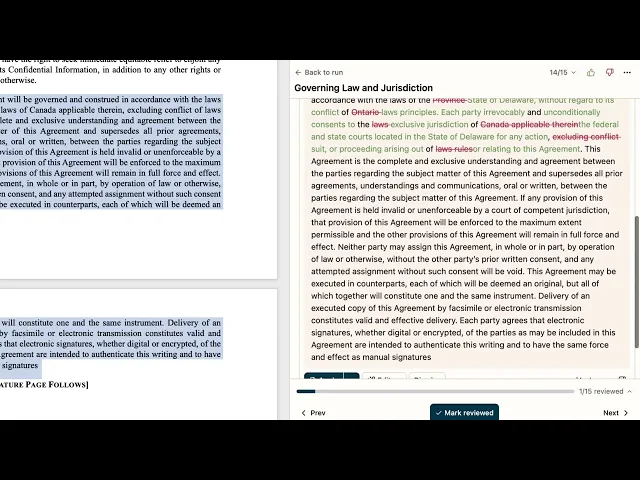
That same manufacturer had lived through a failed contract-AI rollout in 2023. The second time, what mattered was proof the team could check on its own, the same standard Bricks held before Murray’s redline changed his mind.
Underneath entity sprawl sits a portfolio question: what did we already agree to? Contract Intelligence is how GC AI answers it. GC AI brings your contracts into a Vault from Google Drive, SharePoint, OneDrive, Dropbox, or Ironclad, extracts the terms you name into sortable columns, and cites each one back to the source passage. It tells draft from fully executed without tagging, links amendments, SOWs, and renewals into a contract family, and rolls the live terms into a current-terms view.
That last part earns its keep after an acquisition, when the operative term sits in the third amendment and the original agreement says something else. An arbitration provision inherited from an acquired company’s form, with no carve-out for injunctive relief on IP, reads clean in isolation and becomes a real problem the day your litigation strategy assumes a courthouse.
Contract Intelligence covers the repository half of a CLM: storing, searching, and answering questions about signed contracts. Authoring, approval routing, and signature stay in whatever workflow system you already run.
The Same Question in Every Country You Operate
Global 1000 legal teams spend outside counsel money fastest on jurisdiction sprawl, when a routine employment, privacy, or consumer question has to land correctly somewhere nobody on the team has practiced.
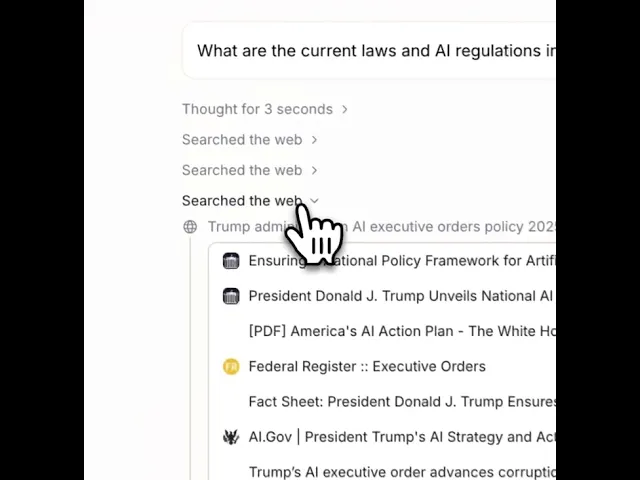
Research is how GC AI answers it: simultaneous agents against primary law and authoritative government sources, so the answer arrives with citations a local lawyer can open and check line by line. Exact Quote is how that same standard applies to documents, pinning each point to a character-level citation in the source file, which is what makes an answer safe to forward to a business leader three time zones away. The Skill Library is how that consistency travels: it holds the reusable workflows that keep the analysis the same wherever it runs.
Andrea Peters, Senior Counsel and Global Head of Compliance at Interface, described how that travels across a global team:
“I often work with colleagues in other time zones, and instead of re-doing research or writing long explanations, I can just share the prompt I used. It saves all of us time and gets us aligned quickly.”
For Peters’s team a shared prompt is a portable standard. That is the test Global 1000 legal teams run: whether a lawyer in another office can open the citation and confirm the answer for themselves.
What It Returns at Fortune 500 Scale
The number that moves a budget in a large department is outside counsel spend. During a hiring freeze, a Fortune 500 food company ran the math at $800 an hour and kept the work in-house instead: more than 111 hours in a single month, which the company projects at roughly $963,000 a year it no longer sends out the door.
There is a second way large departments fund it. At Zscaler, whose legal team grew from three people to 65 supporting 9,000 employees, Chief Legal Officer Robert Schlossman traded two forgone legal hires and routed the budget through IT, which turned an unfamiliar line item into a headcount comparison a CFO already understands
GC AI’s December 2025 ROI study of more than 100 active customers found teams saving an average of 14 hours per week and reducing outside counsel spend by 14%.
Run that percentage against your own outside counsel number. The ROI calculator takes team size, contract hours, and annual outside counsel spend and returns a figure a CFO will read, corporate legal department metrics covers what belongs in the quarterly deck, and reduce outside counsel spend covers which work to bring in first.
What Your Security Team Will Ask
At this scale the security review is also a governance review, which is what makes it slow. Privacy review, transfer impact assessments, records of processing, and AI vendor due diligence sit in four systems owned by three people, so one new AI vendor triggers all of them at once and waits on whichever assessment is slowest.
The Trust Center is how GC AI answers those questions before the RFP arrives. GC AI is SOC 2 Type II and SOC 3 certified, GDPR compliant, and AES-256 encrypted, and every AI provider in its stack processes customer content on a zero data retention basis. Those reports download directly from it, alongside the DPA, subprocessor list, and corporate policy suite, so InfoSec, privacy, and procurement can each start on day one instead of waiting on a questionnaire. A large-department security team hands the report to its own auditor and verifies the claim there.
Our enterprise legal AI buyer’s guide walks through the full evaluation, including how the platform compares on verifiable accuracy and what procurement support looks like, and our guide to reviewing a DPA against Article 28 covers the privacy half. For head-to-head detail on the platforms you are likely weighing, see GC AI vs Harvey and GC AI vs CoCounsel.
Start With the Entity That Generates the Most Paper
Bricks didn’t start with a department-wide rollout. Murray brought over one redline, on one document, and that was enough to change his mind. Do the same thing at your scale: pick the operating entity with the highest contract volume, take the agreement type your team reviews most, and build one playbook on your real positions and fallbacks. Run it against twenty agreements you have already closed and compare the output to what your lawyers concluded.
That test settles the entity question, the citation question, and the adoption question in a week, and it costs a trial instead of a procurement cycle.
Frequently Asked Questions
Which Legal AI Do Fortune 500 Legal Teams Use?
ARKO Corp and GPM Investments, a Fortune 500 company and the sixth largest convenience store provider in America, runs its legal department on GC AI, and General Counsel Maury Bricks has described the workflow publicly. ARKO sits inside a roster of more than 2,200+ legal teams across 53 countries, including 200+ public companies.
How Does GC AI Handle Dozens of Legal Entities?
Playbooks encodes your standard position, fallback, and hard stop on each clause and applies them the same way across each entity’s paper, so an acquired company’s template gets reviewed against your standard rather than its own. Contract Intelligence then answers the portfolio question, extracting terms across your signed contracts with a citation to each source passage and rolling amendments, SOWs, and renewals into a contract family with a current-terms view.
How Do We Answer a Legal Question in a Country Where We Have No Local Counsel?
GC AI Research runs against primary law and authoritative government sources and returns the analysis with citations a local lawyer can open and check line by line, which is what makes a first read usable before you decide whether to engage counsel in that jurisdiction. Legal teams in 53 countries use GC AI as of September 2026, and a shared skill in the Skill Library keeps the same framing in use wherever the question lands.
Can GC AI Replace Our Contract Lifecycle Management System?
GC AI Contract Intelligence takes over the repository function of a CLM: storing, searching, and answering questions about signed contracts, with citations back to the source passage and contract families that roll amendments into current in-force terms. Authoring, approval routing, and signature stay inside whatever workflow system your team already runs. How much of your CLM is repository versus workflow determines how much of it GC AI absorbs.
How Much Does Legal AI Cost for a Fortune 500 Legal Department?
GC AI publishes an Individual plan at 500 USD per month. Team pricing is on request and adds enterprise SSO, a team skill library, and solutions attorney support. The Enterprise tier adds custom integrations, managed procurement and onboarding, change management support, ROI forecasting, and dedicated support. The GC AI API is priced on credits, and Contract Intelligence is a capacity-based add-on. Large departments commonly price the platform against forgone headcount, the way Zscaler’s Chief Legal Officer did.