If you’re comparing Ironclad vs Wordsmith, you’ll realize quickly that these products solve different problems. Ironclad is an enterprise contract lifecycle management (CLM) platform: intake, routing, e-signature, repository, renewals. Wordsmith is a legal enablement platform that brings legal AI to non-lawyer users in Slack, Gmail, and the rest of the business stack. Both ship AI for contracts. They sell to different buyers.
“I feel like it’s a badge of honor in the legal ops community saying you had a failed CLM. I think everyone has at least one under their belt.”
Jenna Hunt, Head of Legal Operations at Tipalti, said that on the CZ and Friends Podcast about an early CLM implementation she inherited.
Anyone who has rolled out a CLM has either lived that moment or knows the person who did. Picking the next legal AI platform is partly about which layer of the stack the next investment goes into, and partly about whether the platform on the shortlist is built for the in-house lawyer or for everyone else in the business.
GC AI is a legal AI platform built for in-house counsel. In-house buyers running shortlists ask about Ironclad and Wordsmith and most of the available content on the web blurs the category lines.
Here is how the two compare on the criteria in-house teams filter on, with every claim verified against the live product and pricing pages.
The Quick Verdict on Ironclad vs Wordsmith
The three products on the table below sit at three different layers of the legal stack.
Ironclad is an enterprise AI CLM. It manages contracts across their full lifecycle: intake, drafting, redlining, e-signature, repository, renewals, and obligation tracking. Its AI ships under the Jurist brand, an agentic layer for drafting, review, research, and redlining.
Wordsmith is a legal enablement platform. It brings legal AI to non-lawyer users across the tools they already work in, so sales, procurement, and HR can self-serve on routine legal work under playbooks the lawyer sets up.
GC AI is the legal AI platform built for the in-house lawyer as the daily user. Its 20,000-line legal system prompt is tuned for that audience. 2,100+ legal teams across 53 countries use GC AI, including 200+ public companies and 25 unicorns. The legal departments at Liquid Death, Arc’teryx, Tipalti, and Vercel are among them. Cecilia Ziniti, the CEO and a 3-time former General Counsel (Anki, Bloomtech, Replit), built the product around the work in-house counsel do every day.
If you’re specifically evaluating whether Wordsmith or GC AI is the better fit for an in-house legal team, see our detailed GC AI vs Wordsmith comparison.
Ironclad vs Wordsmith vs GC AI Comparison
Every figure verified against the live product and pricing pages as of June 2026.
Ironclad | Wordsmith | GC AI | |
|---|---|---|---|
Category | Enterprise AI CLM | AI-native legal enablement platform | Legal AI platform for in-house counsel |
Founded | 2014, San Francisco | 2024, Edinburgh, Scotland | 2023, San Mateo, California |
Founder | Jason Boehmig, CEO (former Fenwick and West attorney); Cai GoGwilt, CTO | Ross McNairn, CEO (ex-Skyscanner, letgo, TravelPerk) | Cecilia Ziniti, CEO and 3x former General Counsel (Anki, Bloomtech, Replit) |
Core use case | Contract lifecycle: intake, routing, signature, repository, renewals | Cross-functional self-service inside Slack, Gmail, and existing tools | Contract review, redlining, legal research, regulatory work, employment, privacy, drafting, board prep |
AI features | Jurist agents (Drafting, Review, Research, Editing, Manager) plus Intake, Redlining, and Conversational Search (Nov 2025) | Blueprints (AI-built templates and dynamic playbooks), auto-triage, automated redlining, return-to-source delivery | Easy Prompt, Exact Quote (character-level citations), Playbooks (NDAs, DPAs, MSAs), Research with primary-law citations, Skill Library, Chat2 in Word |
Word integration | Native Word add-in for AI redlining | Word add-in for drafting and reviewing contracts inside the document | GC AI for Word: redlining, drafting, issue spotting, web research from inside Word |
Trial and pricing model | No trial. No published per-seat pricing available. | ||
Demo-available. | Trial sign-up available on pricing page. No terms disclosed. Pricing not publicly disclosed. | 14 days trial available, no credit card required. Demo available. $500 per seat per month. | |
Security | SOC 1 and SOC 2 Type II, ISO 27001/27017/27018, HIPAA capabilities, GDPR via Standard Contractual Clauses | SOC 2 Type II, GDPR, ISO 27001 (in progress), zero data retention with OpenAI, Anthropic, and Google; no training on customer data | SOC 2 Type II and SOC 3 certified, GDPR compliant, zero data retention agreements with OpenAI and Anthropic, AES-256 encryption |
How Ironclad Works
Ironclad organizes its platform around the stages of the contract lifecycle: Create, Review, Sign, Store, Analyze, and Fulfill. Workflow Designer turns a company’s intake form into a routed approval workflow, and the repository becomes the system of record after signature. Reporting surfaces renewal exposure and obligation tracking across the portfolio.
The Jurist agents handle the analytical layer inside the same platform that runs the operational workflow, so drafting, redlining, and research sit alongside intake, signature, and renewals in a single system.
Pricing is demo-only; Ironclad does not publish per-seat pricing, and buyers receive a custom quote. The buying motion is enterprise sales with annual contracts and implementation services included.
The clearest Ironclad fit is a large enterprise with mature legal operations, high contract volume, and the budget for a multi-year platform commitment. If the primary need is a contract system of record with AI woven into the workflow, Ironclad is built for that lane.
If you’re exploring competing CLM platforms before making a decision, see our Ironclad Alternatives: Which One In-House Teams Pick for a detailed comparison of the leading options and how to choose the right fit.
If you’re deciding whether your team needs an AI CLM or a purpose-built legal AI platform, our GC AI vs Ironclad comparison explains how the two differ and when each makes sense for in-house counsel.
How Wordsmith Works
Wordsmith calls its category the legal enablement platform. Legal AI lives inside the tools the business already uses, with the in-house lawyer setting the rules and non-lawyers doing the daily work. In practice, that means auto-triage of inbound legal requests, automated redlining against Blueprints (Wordsmith’s playbook system of AI-built templates and dynamic playbooks), and return-to-source delivery, so a redline lands back in the channel the request came from.
Wordsmith’s published customer base is high-growth tech and consumer brands, where a small legal function supports a much larger go-to-market organization. Wordsmith does not publish per-seat pricing. The pricing page offers a free trial sign-up.
Ironclad vs Wordsmith on Security and Data Posture
Both Ironclad and Wordsmith publish SOC 2 Type II and GDPR materials, and the table above has the specifics. Ironclad adds SOC 1, ISO 27001/27017/27018, and HIPAA capabilities. Wordsmith publishes zero data retention commitments with OpenAI, Anthropic, and Google, states customer data is never used to train models, and lists ISO 27001 as in progress. The line items that carry the most weight for in-house procurement are SOC 2 Type II, GDPR, and zero data retention with the LLM providers in use.
Confirm current certification status, ZDR scope, and the LLM provider list with each vendor directly before signing.
Is Ironclad Right for You?
Ironclad is right for you if your team is at enterprise scale, contracts are a discrete operational function with dedicated headcount, and your buying timeline supports a full CLM implementation.
The question you should ask before you sign: does the AI inside the CLM cover the broader analytical workload your lawyers carry every day (regulatory research, employment, privacy, board materials), or is its scope limited to the contract layer?
If your in-house team’s needs extend beyond contracts, try GC AI free for 14 days. For the broader category map, see the best legal AI tools for in-house counsel.
Is Wordsmith Right for You?
Wordsmith is right for you if your strategy is to push legal AI out to sales, procurement, finance, and HR so they can self-serve under playbooks the lawyer sets up. The question before you sign: is the in-house lawyer the platform’s primary user, or one user among many? If your in-house lawyer is the daily user and the output goes to the CEO or the board, try GC AI free for 14 days. For the broader category map, see the best legal AI tools for in-house counsel.
How GC AI Fits
For many in-house teams, the work that lands on the lawyer’s desk sits a layer above both products.
A general counsel running lean rarely operates the contract lifecycle as a discrete function with dedicated software; contracts pass through Word, Slack, email, and a shared drive on the way to signature.
A CLM becomes the right investment when contract volume justifies the platform spend, and cross-functional self-service helps when sales and procurement own most of the paper.
The redline that holds the line on an indemnification carve-out or a limitation of liability cap, the cover note to the CFO, and the briefing to the board are the in-house lawyer’s output, and that is the layer GC AI is built for.
GC AI’s CEO and co-founder Cecilia Ziniti built GC AI to solve the problems she encountered firsthand as an in-house lawyer. That experience is embedded directly into GC AI’s system prompt, tone, and workflows.
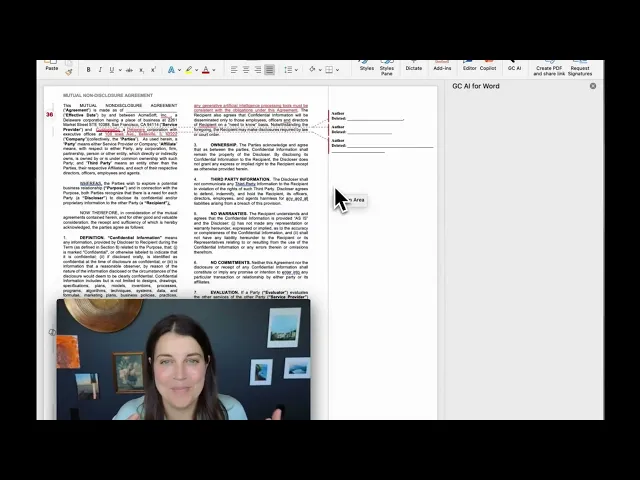
The product capability set is built for the in-house workload. The redline goes back with a cover note ready to send. The research returns with character-level citations into the primary law. The Word add-in handles the document and the follow-up question in the same window.
GC AI ships the capabilities the in-house workload runs on:
Easy Prompt rewrites plain language into structured prompts calibrated for legal work.
Exact Quote pulls verbatim text from your uploaded documents at the character level. Click the citation, see the source.
Playbooks ship pre-built for NDAs, DPAs, MSAs for SaaS, and MSAs for commercial purchases. Your team can extend them with your own positions, drawing on GC AI’s free clause library of real-world examples.
Research pulls real-time primary law from authoritative legal databases with citations.
GC AI for Word brings the full platform inside Microsoft Word: redlining, issue spotting, drafting, comment summarization, and Chat2 for web research from inside the document. Web chats pull into Word with one click. See the GC AI for Word walkthrough.
Skill Library ships ready-to-use workflows for NDAs, DPAs, regulatory summaries, and board consents.
GC AI is SOC 2 Type II and SOC 3 certified, GDPR compliant, with zero data retention agreements with OpenAI and Anthropic, and AES-256 encryption. LLM providers are OpenAI, Anthropic, Cohere, Reducto, and Google.
In GC AI’s December 2025 ROI study of more than 100 active customers, teams reported saving an average of 14 hours per lawyer per week, reducing outside counsel spend by 14% (approximately $252,000 in annual savings for the median company, based on the $1.8M median outside counsel spend per the ACC Law Department Management Benchmarking Report), achieving 21% greater perceived accuracy than generic AI, and 97.5% of teams seeing value before month one.
Pricing is $500 per seat per month with a 14-day free trial and no credit card required.
What In-House Legal Teams Say
Joys Choi, Senior Director of Corporate Legal at Tipalti, on running corporate legal lean:
“Year to date, I’ve saved 609 hours, the equivalent of 76 full working days. Because of GC AI, I can run corporate legal with a lean team. Honestly, without it, I’d probably need two more attorneys right now.”
Joys works at the same legal team Jenna Hunt described on the podcast. The team that lived through a failed CLM rollout now runs a global fintech across 200 countries with a lean function, and the legal AI platform that lets them do it is calibrated for the lawyer first.
Cameron Clark, Head of Legal at Arc’teryx, on the night before a board-level negotiation:
“The night before, I worked through the whole strategy with GC AI. What would be sensitive, what ranges to hold, what counterarguments to expect. It gave me a plan and the confidence to lead discussions with our CFO and GM of APAC.”
Andrea Peters, Senior Counsel and Global Head of Compliance at Interface, on the input layer:
“Easy Prompt is the best thing that’s happened to generative AI for lawyers.”
The numbers behind those experiences are worth seeing.
The In-House Legal Bench
GC AI’s In-House Legal Bench is a head-to-head benchmark of legal AI assistants on in-house tasks: 100 in-house legal tasks across 10 categories (drafting, summarizing documents, contract analysis, legal research, legal strategy, risk assessment, comparison and benchmarking, extracting information, regulatory tracking, checklists), scored against 1,200+ attorney-developed criteria. The published results are tested against the general-purpose models in-house teams most often use as a fallback:

GC AI’s widest margins came on regulatory tracking, legal research, and contract analysis, the workload a contract-tool shortlist is built around.
Try GC AI Free for 14 Days
Ironclad and Wordsmith both solve real problems at their layer of the stack. The question for an in-house team is whose daily work the platform is built around. GC AI is built around the lawyer’s: the redline that goes back with a cover note ready to send, the research that returns with citations into primary law, the board prep that holds up in the room. See it on your own documents with a 14-day free trial, no credit card required, or book a walkthrough with our Solutions Attorneys.
Frequently Asked Questions
What Is the Core Difference Between Ironclad and Wordsmith?
Ironclad is an enterprise contract lifecycle management (CLM) platform that governs the full contract process: creation, review, signature, storage, analytics, and renewals. Wordsmith is a legal enablement platform that pushes AI-assisted contract workflows to non-lawyers in Slack and Gmail, under playbooks the in-house lawyer defines. Ironclad manages the contract system of record; Wordsmith decentralizes routine contract tasks to business teams.
Who Is Ironclad Built For?
Ironclad is built for large enterprises with mature legal operations, high contract volume, and the budget and timeline for a multi-year platform commitment that includes implementation services. It suits teams that need a governed system of record, workflow automation across business units, e-signature, and reporting, and that are ready to invest significant time in onboarding. Enterprise CLM deployments typically require months before teams are fully in production.
Who Is Wordsmith Built For?
Wordsmith is designed for legal teams whose primary goal is enabling sales, procurement, finance, and HR to self-serve on routine contracts without pulling in a lawyer for every request. Its published customer base skews toward high-growth tech and consumer brands. A free trial is available on the pricing page, though detailed plan pricing requires contacting the team. It fits teams willing to invest in building playbooks that non-lawyers can execute independently.
Does Ironclad Publish Its Pricing?
No. Ironclad does not publish per-seat or per-tier pricing. Buyers go through an enterprise sales process and receive a custom quote. The buying motion includes annual contracts and implementation services, which means meaningful upfront time and budget commitments before teams see the platform in production. In-house teams evaluating Ironclad should budget for both licensing and implementation costs during diligence.
What AI Features Does Ironclad Include?
Ironclad ships its AI layer under the Jurist brand, with agents for drafting, review, research, editing, and contract management. The platform also includes AI-powered intake, automated redlining, and conversational search across the contract repository. A native Word add-in is included. Ironclad’s AI scope is organized around the contract lifecycle and does not extend to the broader in-house workload beyond contracts.
What Are Wordsmith’s Core AI Features?
Wordsmith’s core features include Blueprints (AI-built templates and dynamic playbooks lawyers configure for non-lawyers), auto-triage of inbound legal requests, automated redlining, and return-to-source delivery that routes redlined documents back to the originating channel, including Slack, Gmail, and Ironclad. A Word add-in is also available. All features are designed to keep business teams moving on routine contracts without waiting for legal capacity.
Do Either Ironclad or Wordsmith Cover Work Beyond Contracts?
Neither platform does. Ironclad’s AI is organized around the contract lifecycle. Wordsmith focuses on cross-functional contract self-service. Neither covers the broader in-house workload: regulatory research, employment matters, privacy compliance, or board prep. In-house lawyers who need a single platform for contract work and the full range of daily legal tasks should evaluate tools built specifically around the in-house lawyer as the primary user.
What Security Certifications Do These Platforms Hold?
Ironclad holds SOC 1 and SOC 2 Type II certifications, ISO 27001/27017/27018, HIPAA compliance capabilities, and GDPR compliance via Standard Contractual Clauses. Wordsmith holds SOC 2 Type II and GDPR compliance, with ISO 27001 in progress; it publicly discloses zero data retention commitments with OpenAI, Anthropic, and Google, and customer data is never used for model training. Confirm current certification status and review each vendor’s DPA directly before signing.
How Does GC AI Differ From Ironclad and Wordsmith?
GC AI is built around the in-house lawyer as the daily user, not the CLM administrator or business-team self-server. It covers contract review and redlining, legal research with primary-law citations, regulatory work, employment, privacy, drafting, and board prep in one platform. Pricing is $500 per seat per month with a 14-day free trial and no credit card required. Security includes SOC 2 Type II and SOC 3 certifications, GDPR compliance, and zero data retention agreements with OpenAI and Anthropic. More than 1,900 in-house legal teams across 53 countries use GC AI, with an NPS of 77 as of April 2026.
What Should In-House Teams Ask Before Signing with a CLM or Legal Enablement Platform?
Ask whether the platform’s AI covers the full analytical workload in-house lawyers carry every day, not just the contract layer. Confirm which LLM providers process your data and request written zero data retention confirmation in the DPA. Ask about implementation timeline and total cost of ownership beyond licensing. Finally, establish how long it takes to see value: some platforms require months of configuration before delivering productivity gains, while others, like GC AI, are designed so that 97.5% of teams see value before month one ends.