Joseph Schohl, founder of the Inside Counsel Academy and former Fortune 500 general counsel at DaVita, has run the same end-of-day system for 16 years. He calls it his “Big Five”: inbox zero, calendar review, task update, time entry, tomorrow’s top three priorities. The system held for more than a decade and a half.
Until a few months ago, when it became a Big Six.
On the CZ and Friends podcast, Schohl described what changed when he added an AI legal assistant to his daily workflow:
“Now I have a sixth one on there, which is talking to my AI partners, using AI after I’ve just previewed the calendar for the next day and looked at my tasks. What are the things that I can use AI as a partner for? And you know, that didn’t exist for me four months ago, but it’s hard for me even me to believe that, because now it’s become such an essential part of each day.”
A 16-year system does not grow a sixth step for a fad.
That is what a well-built AI legal assistant earns: a permanent slot in the workflow of a lawyer who has seen every productivity trend come and go.
What an AI Legal Assistant Does for In-House Lawyers
An AI legal assistant is a legal-specific AI platform that helps lawyers draft documents, review contracts, research legal questions, and manage legal workflows, with the citation accuracy and security controls that legal work requires.
The market is full of products calling themselves “AI legal assistants.” Some are general-purpose AI tools (ChatGPT, Claude, Gemini) wrapped in a legal-sounding interface. Some are CLM platforms with an AI feature bolted on. Some, like GC AI, are purpose-built legal AI platforms designed from the ground up for how in-house lawyers work.
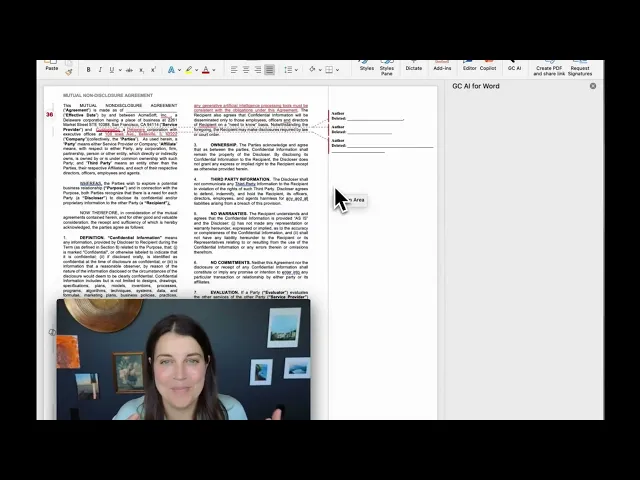
The difference shows up the moment you ask something specific. A generic AI drafts an NDA. GC AI reviews that NDA against your company’s standard positions using Playbooks, flags deviations clause by clause with Exact Quote citations you can verify verbatim, and does it inside Microsoft Word through GC AI for Word.
More capable legal AI raises a broader question beyond drafting and review: Will AI Replace Lawyers? Here’s What the Experts Say explores how legal leaders answer that question.
What a legal AI assistant typically handles:
Drafts and redlines contracts
Answers legal research questions with citations to primary sources
Reviews documents for risk against your playbook
Drafts emails, memos, and board communications
Summarizes documents across hundreds of pages
Monitors compliance and regulatory developments
What separates a legal AI assistant from general-purpose AI:
Legal-specific training and system prompt calibrated for legal outputs
Character-level citation, so you can verify every source verbatim
Security controls: SOC 2 Type II, zero data retention, GDPR compliance
Workflows built around in-house legal, not law firm billing structures
Why In-House Counsel Have Different Requirements
In-house counsel need an AI legal assistant built for the full scope of in-house work, not retrofitted from a law firm or consumer context.
Law firm AI tools center on the partner-associate dynamic: high-volume document review, billable hour tracking, matter codes, firm-wide knowledge bases. That context shapes how outputs get structured and what counts as “good.”
In-house counsel operate on a different model. Your job is to move the business forward and protect it simultaneously, on a team of one to five lawyers handling work that a BigLaw department of fifty used to touch. That creates requirements firm-side tools are not designed to meet. For a detailed comparison with Harvey, a law-firm AI platform, see GC AI vs Harvey for In-House Counsel.
Full-Spectrum Work
One morning it’s a supplier NDA; by lunch it’s an SEC comment letter; by 4pm it’s an employment question in a jurisdiction you’ve touched once. Your AI legal assistant needs to cover that range without defaulting to firm-side framing.
Business-Partner Framing
The framing of the AI matters as much as the features. Hayley McAllister, Senior Counsel at Jasper, put it plainly:
“The biggest advantage of GC AI is it understands that you are trying to be more of a business person.”
Research That Replaces Googling
When the AI cites its sources reliably, the research workflow shifts. Ritesh Patel, Chief Legal Officer at Viant Technology, described what changed:
“It’s also replaced Googling. Now my first stop is GC AI. I describe the setup, get an answer with citations, and use that to brief my team or our business partners.”
Security That Survives Your Own Vendor Review
In-house counsel review vendor security posture for their clients. Yours reviews yours. SOC 2 Type II certification, zero data retention agreements with the underlying LLM providers, and AES-256 encryption are the baseline.
GC AI’s CEO and co-founder, Cecilia Ziniti, was a general counsel three times (Anki, Bloomtech, and Replit), and an in-house counsel at Amazon and Cruise. Ziniti built GC AI to solve the problems she encountered firsthand as an in-house lawyer. That experience is embedded directly into GC AI’s system prompt, tone, and workflows.
Five Things a Great AI Legal Assistant Does for In-House Counsel
The right legal AI assistant earns its place in your workflow by delivering on five core capabilities:
Review and redline contracts against your positions
Research legal questions and cite primary sources
Draft documents in your voice and company standards
Work inside Microsoft Word, where legal work happens
Keep client and company data secure
Review and Redline Contracts Against Your Positions
Generic AI reads a contract and summarizes it. A legal AI assistant reviews it against your company’s standard positions and flags deviations, clause by clause, with citations.
GC AI’s Playbooks are agentic, pre-built review frameworks for NDAs, DPAs, MSAs for SaaS, and MSAs for commercial purchases. Your team loads a contract, runs the Playbook, and gets a redline with issue-specific commentary. Your team can also build Playbooks that encode your negotiation positions and run them automatically on every incoming contract.
Research Legal Questions and Cite Primary Sources
The risk with general-purpose AI on legal research is confidence without verifiability: the output looks authoritative whether the citation is real or not.
GC AI’s Research feature deploys simultaneous web agents biased toward authoritative legal databases, government sources, and primary law. Every result includes citations. Exact Quote, GC AI’s character-level citation feature, lets you verify that every pulled passage matches its source verbatim, so you can rely on the output in a regulatory filing or a board memo.
Draft Documents in Your Voice and Company Standards
A legal AI assistant that produces outputs requiring a full rewrite is a first-draft generator. GC AI’s Custom Company Profile encodes your team’s voice, templates, and standards so every output arrives calibrated to how your team writes.
Cameron Clark, Head of Legal at Arc’teryx:
“It’s like having a senior legal peer to think with. It helps me brainstorm and refine ideas in real time.”
Work Inside Microsoft Word
The American Bar Association’s Legal Technology Survey reports that 98% of lawyers use Microsoft Word. An AI legal assistant that requires you to leave Word adds friction at the worst possible moment: mid-document, mid-deadline.
GC AI for Word brings the full GC AI platform into your Word environment: redlining, issue spotting, drafting, and research without a context switch. Web chats pull into Word with one click. Easy Prompt and saved prompts from the Skill Library are available inside the add-in.
Keep Client and Company Data Secure
GC AI is SOC 2 Type II and SOC 3 certified, GDPR compliant, with zero data retention agreements with OpenAI and Anthropic, and AES-256 encryption.
Zero data retention means your contracts, memos, and research questions do not train the underlying models. For in-house counsel working with board communications, M&A data, and employment matters, that is a load-bearing requirement. Larger organizations can add the Enterprise tier, which includes SSO and managed procurement, giving enterprise security teams the access controls they require before vendor sign-off.
How ChatGPT, Claude, and GC AI Compare as AI Legal Assistants
The most common entry point for lawyers evaluating legal AI is a free-tier general-purpose tool. ChatGPT and Claude are genuinely strong, and many in-house lawyers start there. Here is what each delivers for legal work, and where the limits show up.
ChatGPT Free Tier
ChatGPT’s free tier gives you access to GPT-4o for general drafting, summarization, and research. For a first-pass memo or a quick contract summary, it performs. For legal-specific requirements, the gaps accumulate: no character-level citation (you cannot verify a pulled passage against its source), data stored on OpenAI systems and used to improve their models by default unless users manually opt out in settings (per OpenAI Data Controls FAQ: https://help.openai.com/en/articles/7730893-data-controls-faq), and no legal-specific training calibrated for in-house workflows. GC AI’s Exact Quote feature addresses the citation problem directly: every passage verifiable verbatim. The full breakdown is in our ChatGPT for Lawyers guide. OpenAI’s April 2026 privacy policy also confirms the Free and Go tier serves personalized ads by default, worth noting for legal teams uploading sensitive documents.
Claude (Anthropic) Free Tier
Claude is among the strongest general-purpose reasoning models available and produces high-quality drafting. The same limitations apply: no legal-specific training, no character-level citation for primary law, and data handling that does not meet the zero-retention standard in-house counsel typically require. For a full breakdown, see Claude for Legal in 2026.
GC AI: 14-Day Free Trial, No Credit Card
GC AI offers a 14-day free trial with no credit card required. That gives in-house counsel enough time to run a contract through a Playbook, send a jurisdiction research question through Research, and compare the output against free-tier tools on a real matter before committing.
The May 2026 In-House Legal Bench tested 100 attorney-verified legal tasks across the AI tools most used by in-house counsel:
GC AI: 86.8%
ChatGPT: 79.8%
Claude: 68.4%
Gemini: 57.5%
On the tasks most relevant to in-house counsel: legal research (GC AI 88.3%) and contract analysis (GC AI 82.7%). The benchmark measured general-purpose AI only and did not evaluate law-firm platforms.
How GC AI Works as Your In-House AI Legal Assistant
GC AI is a legal AI platform purpose-built for in-house counsel, used by 2,100+ legal teams across 53 countries as of September 2026, including 200+ public companies and 25 unicorns, with teams at Arc’teryx, Tipalti, Columbia Sportswear, and Liquid Death among them.
In our December 2025 ROI study, a self-reported survey of 100+ active customers, teams reported saving an average of 14 hours per person per week and reducing outside counsel spend by 14%. For the median company, that translates to approximately $252,000 in annual savings (based on 14% of the $1.8M median outside counsel spend reported in the ACC Law Department Management Benchmarking Report).
The platform covers the full range of in-house legal work:
Research: Multi-agent web research with primary-law citations. Answers market-standard questions for NDAs, DPAs, and MSAs. Delivers regulatory summaries with source links.
Files: Upload and analyze up to 1,500 pages at once. Organize documents into permanent collections accessible across all chats.
Playbooks: Agentic, multi-step contract review. Pre-built playbooks for NDAs, DPAs, MSAs for SaaS, and MSAs for commercial purchases.
GC AI for Word: Full platform capability inside Microsoft Word. Redlining, drafting, research, no context switch.
Easy Prompt: Turns plain language into optimized legal prompts, built for lawyers still calibrating how to ask precisely.
GC AI Classes: Free, California CLE-eligible courses taught by former general counsels. More than 6,000 lawyers have completed the curriculum, building legal AI skills in contract review, regulatory research, compliance monitoring, and advanced prompting. Teams adopt AI at 3 to 5 times the rate of those that skip the courses.
Joys Choi, Sr. Director of Legal at Tipalti:
“GC AI has become a daily partner for our lean legal team. It gives us fast, reliable analysis across multiple jurisdictions and keeps us ahead of regulatory change. It’s transformed how we operate.”
How to Evaluate an AI Legal Assistant
The right evaluation framework for any legal AI platform runs through five questions. Apply them to GC AI, and apply them to every legal AI tool you consider.
Who Built It and for Whom?
General-purpose AI optimized for consumers will not prioritize legal accuracy the way a platform built by and for lawyers does. Ask whether the product was designed for in-house counsel from the start, or expanded into the in-house market from a law firm or consumer base.
Can You Verify Every Output?
Every AI produces errors. The question is whether the platform gives you the tools to catch them: character-level citation, source links, verifiable passages. If you cannot trace an output to a primary source, you cannot rely on it in a board memo or a regulatory filing.
What Does the Security Architecture Look Like?
The minimum for in-house legal work: SOC 2 Type II certification, zero data retention with the underlying LLM providers, GDPR compliance, and AES-256 encryption. If a vendor cannot produce a current SOC 2 Type II report on request, that is your answer.
Does It Work Inside Microsoft Word?
If your team works in Word, a standalone web app adds a daily switching cost every time you move from drafting to research to redlining. Ask whether the platform has a native Word add-in that brings the full product into the document.
Does the Vendor Invest in Your Team’s Adoption?
The teams that get the highest ROI from legal AI are the ones that built fluency, not just access. GC AI’s free legal AI courses are California CLE-eligible, taught by former general counsels, and have accelerated adoption 3 to 5 times faster in teams that complete them.
Start With One Contract That Matters
The fastest way to evaluate an AI legal assistant is to run it against a contract your team has already reviewed. Drop it into GC AI, run a Playbook, and compare the output against your own markup. That takes 20 minutes. The 14-day free trial could give hours back to your week.
Frequently Asked Questions
What Is an AI Legal Assistant for In-House Counsel?
An AI legal assistant is a legal-specific platform that helps lawyers draft documents, review contracts, research legal questions, and manage legal workflows, with the citation accuracy and security controls that legal work requires. Platforms purpose-built for in-house counsel, like GC AI, differ from general-purpose AI tools by including legal-specific training, character-level citation, and security architecture designed for corporate legal teams.
How Does a Legal AI Assistant Differ from ChatGPT or Claude?
General-purpose tools like ChatGPT and Claude can handle first-pass drafting and summarization, but they lack character-level citation, legal-specific training, and the SOC 2-certified, zero-data-retention terms in-house counsel require. In GC AI’s May 2026 In-House Legal Bench, GC AI scored 86.8% overall accuracy on 100 attorney-verified legal tasks, compared to 79.8% for ChatGPT, 68.4% for Claude, and 57.5% for Gemini.
Can an AI Legal Assistant Review Contracts Against My Company’s Positions?
Yes. Purpose-built legal AI platforms review contracts clause by clause against your negotiation positions and flag deviations with citations. GC AI’s Playbooks are pre-built review frameworks for NDAs, DPAs, and MSAs, and you can build custom Playbooks that encode your specific standards. Snyk, Arc’teryx, and Tipalti use GC AI to manage contract workflows at scale.
How Does a Legal AI Assistant Handle Confidential Data?
The minimum security baseline for in-house legal work includes SOC 2 Type II certification, zero data retention with underlying LLM providers, GDPR compliance, and AES-256 encryption. GC AI meets all four requirements, meaning your contracts, memos, and research questions do not train the underlying models.
Does a Legal AI Assistant Work Inside Microsoft Word?
Yes. GC AI for Word brings the full platform into Microsoft Word, where the American Bar Association’s Legal Technology Survey reports 98% of lawyers already work. That means redlining, issue spotting, drafting, and research without a context switch.
How Does AI Handle Legal Research for In-House Counsel?
Legal AI platforms built for in-house work deploy research tools biased toward authoritative legal databases, government sources, and primary law, with every result citing its source. GC AI’s Exact Quote feature lets you verify that every pulled passage matches its source verbatim, so outputs can be relied on in regulatory filings or board memos.
Who Built GC AI and Why Does That Matter?
GC AI’s CEO and co-founder, Cecilia Ziniti, served as general counsel three times and worked as in-house counsel at Amazon and Cruise, and built the platform to solve problems she encountered firsthand. That background is embedded in GC AI’s system prompt, tone, and workflows, shaping outputs toward the business-partner framing in-house counsel need rather than law firm billing structures.
What Results Have In-House Teams Reported Using Legal AI?
In GC AI’s December 2025 ROI Study, a self-reported survey of 100+ active customers, teams reported saving an average of 14 hours per person per week and reducing outside counsel spend by 14%. For the median company, that translates to approximately $252,000 in annual savings. Customers rate GC AI with an NPS of 77. Read how Columbia Sportswear, Viant Technology, and Eventbrite use GC AI.
How Can My Team Build Fluency with a Legal AI Platform?
Teams that build fluency with legal AI, rather than access, consistently report higher ROI. GC AI offers free legal AI courses that are California CLE-eligible, taught by former general counsels, and teams that complete the curriculum adopt AI at significantly faster rates than those that skip them.
Which AI Legal Assistant Outputs Still Require Attorney Review Before Filing in High-Stakes Matters?
All AI legal assistant outputs require attorney review before filing in high-stakes matters, regardless of platform. AI tools generate drafts, surface research, and flag issues, but a licensed attorney is responsible for verifying citations, confirming current law, and certifying accuracy to the court. Courts have sanctioned attorneys for submitting unverified AI-generated content. GC AI is built for in-house counsel workflows, not court filings, and is designed to accelerate attorney review rather than replace it.
Which AI Legal Assistants Offer SOC 2 Compliance and End-to-End Encryption?
GC AI is SOC 2 Type II and SOC 3 certified, GDPR compliant, and uses AES-256 encryption at rest with TLS 1.2+ in transit. GC AI maintains zero data retention agreements with both OpenAI and Anthropic, meaning your legal data is never used to train underlying models. SOC 2 Type II certification requires sustained controls over time and is the appropriate baseline for enterprise legal teams handling privileged or confidential matter data.
Is Ivo or GC AI Better for Legal Research and Document Generation?
Ivo is focused primarily on playbook-driven contract review and redlining. GC AI covers a broader in-house workflow: contract review with Playbooks, agentic legal research, matter memory via Projects, and document and memo drafting in your company’s voice, all in one platform. Ivo offers its own Word add-in and research assistant but stays centered on contract work. For teams whose main need is high-volume contract review, Ivo is purpose-built for that use case. For teams that want contract review, research, and drafting in a single in-house workspace, GC AI is the stronger fit. See the full GC AI vs. Ivo comparison.
If you’re evaluating Ivo specifically, our Ivo Legal AI Review 2026: Is It Right for In-House Counsel? takes a closer look at its features, pricing, strengths, and ideal use cases.
How Do You Choose an AI Assistant for an In-House Legal Team?
Evaluate on five criteria: (1) Purpose-built for in-house work, not a generic AI with a legal layer added on. (2) Security: SOC 2 Type II certification, GDPR compliance, and zero data retention with LLM providers. (3) Workflow fit: does it live inside Microsoft Word where your team already works? (4) Verified accuracy: look for independent benchmarks, not vendor claims alone. (5) Adoption support: onboarding, playbooks, and training resources. GC AI offers a 14-day free trial with no credit card required, which lets teams evaluate fit before any commitment.
Can an AI Legal Assistant Store and Apply My Team’s Playbooks, Policies, and Precedents?
Yes. Playbooks encode your pre-negotiated positions for contract types like NDAs, DPAs, and MSAs, so every review runs against your actual standards. Projects store matter context, past documents, and team knowledge so that research and drafting build on your precedents rather than starting from scratch. This is the difference between a general AI tool and a platform built specifically for in-house legal operations.