Legora vs Harvey: Which Legal AI Fits the Way You Work?
Josh Bertini, Head of GrowthUpdated Published
If you are an in-house lawyer comparing Legora vs Harvey, you are looking at two legal AI platforms built first for a seat that is not yours.
Harvey grew up inside large law firms. Legora grew up inside global and European firms running high-volume, cross-border matter work. Both are widely used.
The more useful question is which one fits the way your team works. If your work looks more like a law firm's, the same lens still helps, because it shows what each platform is built to optimize.
Below is the comparison. We'll also share where GC AI fits as a third enterprise option, included where it is the best fit for the job. Every claim is fact-checked through June 2026.
The short answer: Harvey and Legora are both built first for law firms. Harvey suits in-house teams running firm-scale diligence and litigation. Legora suits multilingual, cross-border work. If your team is in-house and wants business-ready output on a transparent budget, GC AI is the platform built for that seat.
The Legal AI Market Is Growing Fast
Legal AI has become one of the most heavily funded categories in software, with billions flowing to the leading platforms. That tells you the category is here to stay and that the major players will keep shipping.
It does not tell you which platform fits a five-person legal team at a Series A-D company. A lean in-house buyer is shopping for something specific: a platform that thinks the way the team thinks, on a budget the team can defend, with a buying cycle that skips the procurement committee and the months-long pilot.
Treat the market's momentum as a reason to adopt now, and weight your own fit criteria above any funding headline.
Harvey: Built for the Law Firm
Harvey launched in 2022, founded by Winston Weinberg, a former O'Melveny litigator, and Gabriel Pereyra, who came from DeepMind and Meta. It targets large law firms, and the design reflects that: deep research, complex diligence, and document analysis at the scale a litigation or M&A team handles.
The core surfaces are Assistant for everyday legal work, Vault for bulk document analysis across collections up to 100,000 documents, Knowledge for grounding answers in a firm's own materials, and Workflow agents, which Harvey says clients have built more than 25,000 of. It connects to Word, Outlook, and SharePoint, runs inside Microsoft 365 Copilot and Cowork (as of June 2026), ships a mobile app, and runs Harvey Academy for training. A LexisNexis partnership feeds primary law into research.
Harvey built law-firm credibility first and added solutions aimed at in-house teams later, and it reports more than 500 in-house customers. Law firms remain its center of gravity, which shapes how the product writes: thorough, comprehensive, built for the billable analysis.
For the in-house specifics, see GC AI vs Harvey, or the wider field in Harvey alternatives for in-house counsel.
Legora: Built for Global Scale
Legora started in 2023 in Stockholm, founded by Max Junestrand and his co-founders, and went by Leya until early 2026. Its strengths are European and multilingual: legal research across 12 jurisdictions, with GDPR built into the foundation. Its customers include White and Case, Linklaters, Cleary Gottlieb, Bird and Bird, Goodwin, Deloitte, and Dentons.
Legora is built around what it calls aOS, an agentic operating system. If you have seen an older comparison mention “Walter AI” or “SmartCounsel,” that naming is out of date.
The pieces in-house buyers will hear about are Agent, Monitors for tracking changes over time, Tabular Review for bulk document analysis that arrays documents as rows and prompts as columns, Workflows, Legal Research, a Portal for delivering white-labeled work to a firm's own clients, an Editor, and Word and Outlook add-ins.
Legora serves in-house teams, and its product and flagship customers skew BigLaw. Portal, for instance, serves the firm-to-client relationship, which most in-house departments do not have.
For the in-house breakdown, see GC AI vs Legora, or compare the category in the best legal AI tools for in-house counsel.
Legora vs Harvey: The Feature Comparison
Here is Legora vs Harvey side by side, with GC AI added as the in-house option. Where pricing is not published, the table says so.
| Harvey | Legora | GC AI | |
|---|---|---|---|
| Built for | Large law firms | Global and European law firms | In-house legal teams |
| In-house focus | Added in-house solutions; law-firm focus | Serves in-house, skews BigLaw | Built for in-house from day one |
| Bulk document analysis | Vault (up to 100K docs) | Tabular Review (docs as rows, prompts as columns) | Files (analyze up to 1,500 pages at once) |
| Legal research | Assistant plus LexisNexis | Legal Research across 12 jurisdictions | Research (multi-agent, primary law with citations) |
| Microsoft Word | Yes, plus Microsoft 365 Copilot and Cowork | Yes (Word add-in) | GC AI for Word (Chat2, no context switching) |
| Citations | Source citations | Source citations | Exact Quote (character-level) |
| Education | Harvey Academy | Firm onboarding | Free CLE-eligible classes, 6,000+ lawyers taught |
| Security | SOC 2 Type II, ISO 27001, GDPR, CCPA | SOC 2 Type II, ISO 27001, ISO 42001, GDPR, HIPAA | SOC 2 Type II, SOC 3, GDPR, ZDR with our LLM providers wherever feasible, AES-256 |
| Pricing | Seat-based pricing with an option for consumption pricing; some customers are moving to consumption-based pricing. Some prospects report hearing about token-based pricing. Confirm included usage, overage rates, budget controls, and trial terms in your proposal. | Not published | $500/mo, transparent, 14-day free trial |
| NPS | Not disclosed | Not disclosed | 74 |
Legora does not publish pricing. Harvey offers seat-based pricing with an option for consumption pricing, and some customers are already moving to that model, according to a September 17, 2026, Legal IT Insider interview with Harvey COO Katie Burke. Some prospects report hearing that Harvey has begun discussing token-based pricing in sales conversations. If you are comparing proposals, ask both vendors for normal-month and peak-quarter forecasts, included usage, overage rates, and spending controls. In-house teams that want a visible price and a self-serve trial can compare against GC AI, which lists $500 per month publicly.
In-House Legal Work Is a Different Job
CZ and Friends podcast:David Schellhase, who was general counsel at Salesforce, Groupon, and Slack, named the difference on the
Almost always the decisions we're making are in a gray zone. If it were clear, they wouldn't need a lawyer to opine. When it comes to us in-house, that's when it's really gray.
A firm lawyer's product is often the analysis itself. An in-house lawyer's product is the decision the business can act on, made in that gray zone, fast, and in language a non-lawyer will read.
Danielle Sheer, Chief Trust Officer and CLO at Commvault, put the in-house priority plainly on the same podcast:
You are going to have to figure out whether you want to be right or you want to be effective. AI, for the most part, let's just assume that it can be right. What it can't be is effective. So it frees up time for humans to figure out how to be effective.
Here is where firm-grade platforms create friction for in-house teams. A platform tuned to produce the thorough firm output gives you something accurate that still needs translating before a non-lawyer can use it.
The trim, the tone shift, the “make this four sentences for the VP of Sales” pass, that work falls back on you. When you compare Legora vs Harvey, weigh how usable the output is for a business audience as heavily as how complete it is for a lawyer. The Association of Corporate Counsel has documented how the in-house role keeps shifting from legal advisor toward business partner.
Where GC AI Fits for In-House Teams
GC AI is the legal AI platform purpose-built for in-house counsel, and it is the third name worth having next to Legora and Harvey.
GC AI's CEO and co-founder, Cecilia Ziniti, was a general counsel three times (Anki, Bloomtech, and Replit), and an in-house counsel at Amazon and Cruise. Ziniti built GC AI to solve the problems she encountered firsthand as an in-house lawyer. That experience is embedded directly into GC AI's system prompt, tone, and workflows.
The result is a platform that assumes the in-house seat from the first prompt. Output arrives in the register a business partner can read, without a translation pass.
Easy Prompt turns a half-formed thought into a working legal prompt. Exact Quote pulls character-level citations for quick review. Playbooks turn your team's standard positions into repeatable contract review.
2,100+ legal teams across 53 countries use GC AI, including legal departments at Hitachi, Snyk, Liquid Death, and Columbia Sportswear, plus 200+ public companies and 25 unicorns.
The proof shows up in the numbers. In a December 2025 ROI study of more than 100 active customers, GC AI users reported saving an average of 14 hours per week, reducing outside counsel spend by 14%, and seeing 21% greater accuracy on legal tasks compared with generic AI like ChatGPT.
The outside-counsel reduction works out to roughly $252,000 in annual savings for the median company, based on 14% of the $1.8 million median outside counsel spend in the ACC Law Department Management Benchmarking Report. You can run your own numbers with the ROI calculator.
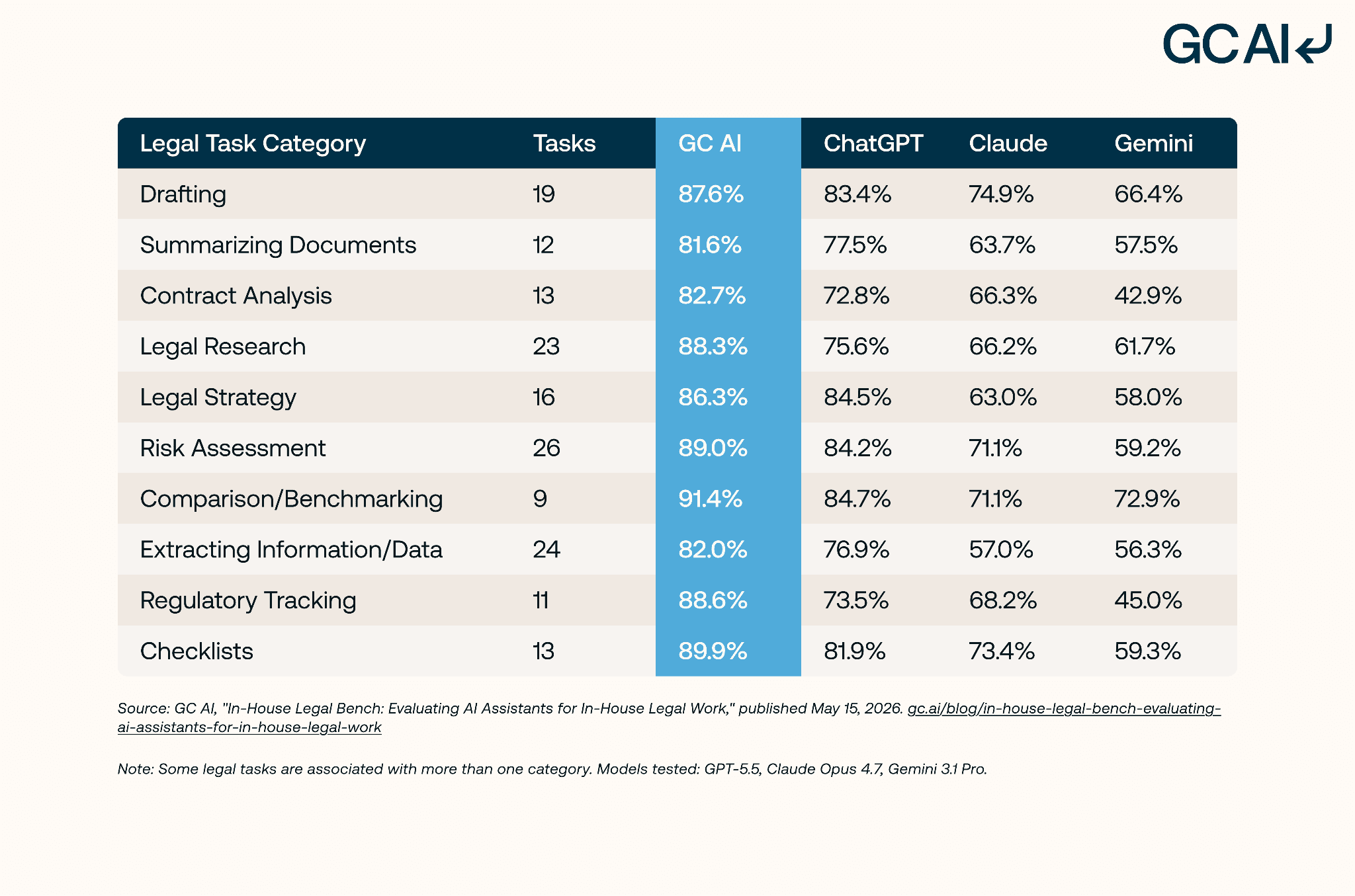
GC AI also publishes its own benchmark. In the In-House Legal Bench (May 2026), a 100-task evaluation of how AI handles in-house legal work, GC AI passed 86.8% of tasks and led all ten categories against general-purpose models like ChatGPT, Claude, and Gemini, with its widest margins on regulatory tracking (15.1 points) and legal research (12.7 points).
The classes are another tell. GC AI's free legal AI classes are California CLE-eligible and taught by former general counsels who sat in the in-house seat and lived the job.
The pricing is the final tell. We publicly share our pricing and you can try it for free for 14 days, no credit card required. An in-house buyer can see the number, start a trial, and prove value before a single sales call.
If your team is in-house and you want a platform that already speaks your language and shows you the price, GC AI belongs on the list with Legora and Harvey.
Legora vs Harvey vs GC AI: Which Is Right for You?
Here is how to choose, with the condition that makes each answer yes.
Run your decision through five questions:
-
Team type: an in-house department, or a law-firm-style practice?
-
Matter mix: high-volume contract triage, or large diligence and litigation sets?
-
Jurisdictions: mostly domestic, or multilingual and cross-border?
-
Budget visibility: do you need a price you can see and defend today?
-
Output audience: who reads the result, a lawyer or a business partner?
Harvey is the pick if your matters look like a firm's, with heavy diligence and large litigation document sets. You are buying depth at scale, and the more than 500 in-house teams on it show the expansion is working. Expect output shaped for firm-style analysis and a sales-led buying process.
Legora is the pick if your company runs multilingual, cross-border work where jurisdiction coverage earns its keep every week. You get global research range. Weigh the BigLaw center of gravity, and whether firm-oriented surfaces match how your in-house team operates day to day.
GC AI is the pick if your team sits in-house and the daily job is turning legal judgment into something the business can act on fast. You get output in the right register from the first prompt, a price you can see, and a trial that proves value before any call.
There is no wrong answer for the right team. The point is to match the platform to your seat.
The cost of a license is a couple of hours of outside counsel time. It will completely transform your outside counsel budget. -KT Farley, Chief Privacy Officer and Associate General Counsel at Helix
Move at the Speed of Your Business
Legora and Harvey are built for firm-shaped work, and either may be the right call for a team that does it. If your team is in-house and needs answers a business partner can act on, on a budget you can show your CFO, GC AI is built for exactly that.
Join the 2,100+ in-house legal teams using GC AI.