A demand letter lands at 4:40 on a Thursday. It comes from a former employee's lawyer, or a regulator, or a customer your VP of Sales swore was bluffing. You read it twice. The part of your brain that survived your litigation rotation starts a clock: the duty to preserve triggered the second you saw this, and every Slack thread, sent folder, and Salesforce record that touches the dispute is now evidence you are on the hook to keep.
The retention policy does not know that. It keeps deleting until someone tells it to stop. A litigation hold notice is how you tell it.
A litigation hold notice is the written instruction you send to everyone who might hold relevant evidence, directing them to stop deleting or altering it. The duty to preserve attaches the moment your company reasonably anticipates litigation, and a demand letter, an EEOC charge, or a credible threat can trigger it months before any complaint is filed. The hold notice is how in-house counsel discharge that duty. A defensible one names the matter, defines the scope and time frame, lists the custodians, spells out what to keep, suspends auto-delete, and asks each recipient to confirm receipt.
Send it fast, send it broad, and write down that you did. That paper trail is what stands between you and a spoliation fight eighteen months from now.
Preservation is the one move in a dispute you cannot redo. You can amend a pleading. You can swap outside counsel. You cannot un-delete the email that auto-purged on day 31 because nobody paused the retention policy.
Courts have sanctioned companies, and individual lawyers, for getting this wrong, and the sanction can be an adverse-inference instruction that tells the jury to assume the missing evidence would have hurt your side. That single instruction can decide a case.
GC AI is the enterprise-grade legal AI platform built for in-house counsel by Cecilia Ziniti, a three-time general counsel. On a hold, GC AI drafts the notice from the facts of the matter, reasons through the custodian list the way a litigator would, and helps you track who has acknowledged it, so a one-person legal department can get a defensible hold out the door the same afternoon instead of losing a Thursday night to it. First, the timing question almost everyone gets wrong.
When the Duty to Preserve Triggers
The duty to preserve attaches when litigation is reasonably anticipated, long before anyone serves you. That is the part people miss. You do not get to wait for a filed complaint, and courts judge the trigger with hindsight, asking whether a reasonable person in your position would have foreseen a dispute.
The standard traces to Zubulake v. UBS Warburg, the Southern District of New York employment case that turned "litigation hold" into a term of art. Judge Shira Scheindlin held that the duty attaches once a party reasonably anticipates litigation, and that issuing the hold is counsel's job to see through, from distribution to follow-up.
Spoliation law has developed jurisdiction by jurisdiction since, so on a close call, pull the controlling standard before you decide: GC AI researches it in chat and links every citation to the full opinion through US Case Law, GC AI's case law library of 13M+ US court opinions. Watch US Case Law work through a forum selection clause under Delaware law in the two-minute walkthrough.
In practice, the trigger is a judgment call you make on incomplete facts. The signals that should move your hand toward the keyboard:
A demand letter, a draft complaint, a demand for arbitration, or a preservation request from the other side
An EEOC charge, a regulator's civil investigative demand, or a subpoena
An internal complaint serious enough that a lawsuit would not surprise you
A high-dollar contract dispute where the other side has started quoting the indemnification or limitation of liability clause
A workplace incident, a breach of a data protection obligation, or a product issue with a real injury behind it
When the signal is ambiguous, issue the hold anyway. A hold that turns out to be unnecessary costs you a few hours and some mild eye-rolling from custodians. Waiting too long costs you evidence that no longer exists. When in doubt, preserve. You can always lift a hold later, and you can never recover what auto-delete already erased.
What Goes Into a Litigation Hold Notice
A litigation hold notice does two jobs at once. It tells people clearly what to keep, and it creates a record that you told them. A vague hold nobody can act on is almost as risky as no hold.
Every notice should contain these elements:
A plain-English description of the matter. Enough that custodians understand what is at issue, with no editorializing about the merits and nothing that waives privilege.
The relevant time frame. "All materials from January 1, 2024 to present," for example. Open-ended works when you do not yet know the bounds.
The categories of data to preserve. Email, documents, text messages, chat (Slack, Teams), voicemails, calendar entries, CRM records, financial data, and anything in the specific systems where this dispute lives.
A clear do-not-delete instruction. Recipients must stop deleting, archiving, or modifying anything in scope, including on personal devices and accounts they use for work.
An instruction to suspend auto-delete. This one goes to IT, and it is the element most holds forget.
An acknowledgment request. Ask each recipient to confirm receipt in writing. This is your proof of distribution.
A point of contact. Your name, so questions route to you instead of guessing.
Keep the tone direct and a little serious. This is one of the rare internal emails where you want people slightly nervous about hitting delete. Could someone two weeks into the job read this once and know exactly what to stop deleting? That is the send test.
The Litigation Hold Notice Template You Can Copy
Here is a clean template to adapt and copy straight from this page. Treat it as a starting point and tailor it to your matter. This is general educational information for in-house legal teams, not legal advice for your specific situation.
TO: [Custodian names / distribution list]
FROM: [Your name], [Title], Legal
DATE: [Date]
RE: Legal Hold Notice: Preserve Documents and Data (CONFIDENTIAL)
Action required: do not delete anything described below. Confirm receipt by replying to this email.
The company is involved in, or reasonably anticipates, a legal matter concerning [brief, neutral description of the dispute]. By law, we must preserve all documents and information that may be relevant. This notice requires you to take the steps below immediately.
1. Preserve everything related to this matter. Do not delete, discard, alter, or overwrite any documents, emails, text messages, chat messages (including Slack and Teams), voicemails, calendar entries, notes, files, or data relating to [subject], for the period [start date] to present. This applies to information on company systems and on any personal devices or accounts you use for work.
2. Suspend automatic deletion. Do not let any auto-archive, auto-delete, or retention setting remove information in scope. If you are unsure whether a system auto-deletes, contact me before changing anything.
3. The scope may grow. Preserve broadly. If you are unsure whether something is relevant, keep it and ask.
4. Keep this confidential. Do not discuss this notice or the matter with anyone outside the recipients listed, except me.
5. Acknowledge receipt. Reply to confirm you have read and understood this notice within [2 business days].
This hold stays in effect until I notify you in writing that it has been lifted. Questions go to me directly at [email / phone].
GC AI can draft a version of this notice tailored to your facts, scope it to the right data types, and write the matter description so it stays neutral and protects privilege.
Who Should Receive the Notice
Send the hold to two groups: the custodians who created or hold relevant evidence, and the people who control the systems that store it.
Custodians are the obvious names plus the ones you have to think to add. The deal lead and the disgruntled employee's manager, yes. Also the person who sat next to them, the sales rep who sent the email that started this, and the finance analyst who ran the numbers.
Jimmy Toy, Chief Legal Officer at Articore Group, a CZ and Friends guest who has handled 40+ IP cases across global jurisdictions, describes discovery as something that pulls in the whole company, reaching out from legal to product and engineering, marketing, even finance. Your custodian list should reflect that reach.
The second group is IT and any data owners. They are the ones who can suspend the records retention policy, pull the backup tape, and lock down a departing employee's mailbox before it gets wiped 30 days post-exit. Loop them in the same hour you send the hold. Skip IT and the retention policy keeps running right through your hold.
Reminders, Re-Issuing, and Lifting the Hold
Courts expect you to manage a hold for the life of the matter, and matters run long: a reminder roughly every 90 days, a re-issue on every scope change, and a written lift at the end. The judge grades the paper trail, so keep one: a single tracker with custodian, date sent, date acknowledged, and date of last reminder does the job.
A workable rhythm:
Re-send the notice on a regular cadence, commonly every 90 days or quarterly, so it stays top of mind. (The interval is a convention; what courts look for is a consistent, documented cadence.)
Re-issue immediately when the scope changes or a new custodian joins the matter.
Brief every new hire who steps into a custodian role, and re-confirm with anyone who changes teams.
Catch the departures. When a custodian gives notice, flag their data for preservation before offboarding runs its usual delete-and-reclaim playbook.
When the matter resolves, lift the hold in writing. Tell custodians the preservation obligation has ended and normal retention resumes. People skip this step constantly, and an indefinite zombie hold eats storage and erodes the credibility of the next hold you send. A litigation hold is a living obligation, so give it the same follow-up discipline as an open matter, including a clean close-out at the end.
The Five Mistakes That Sink a Hold
Most holds fail on the same five points. Watch for these:
Scope too narrow. Naming three custodians when the real number is twelve, or missing a data type like Slack or text messages.
No acknowledgment. Sending the notice and never confirming anyone read it, so you cannot prove distribution if anyone ever challenges it.
Forgetting auto-delete and ephemeral apps. Retention policies, disappearing-message settings, and anything on personal devices keep deleting in the background while you assume the hold is working.
Issuing once and walking away. No reminders, no re-issuing when custodians change, no record of ongoing management.
Never lifting it. Holds that linger for years past resolution, eating storage and trust.
Every one of these is a process problem, which is exactly the kind of thing the right system catches for you before it costs you.
What Courts Do When a Litigation Hold Fails
Federal Rule of Civil Procedure 37(e) governs lost electronically stored information, and it works in two tiers. Under Rule 37(e)(1), a court that finds prejudice can order measures to cure it, from reopened discovery to cost shifting. Under Rule 37(e)(2), a court that finds a party acted with intent to deprive the other side of the evidence can instruct the jury to presume the lost information was unfavorable, or enter judgment outright. Spoliation is the name for the underlying failure, and courts have sanctioned individual attorneys for it, along with their companies.
Zubulake shows what that looks like from the inside. UBS employees deleted emails after the hold went out, follow-up never happened, and Judge Scheindlin gave the jury an adverse-inference instruction. The opinion's sharpest lesson lands on the lawyer: counsel has an affirmative duty to monitor compliance for the life of the hold. The verdict came back at roughly $29 million, and it traced to a hold nobody followed up on.
How GC AI Issues a Defensible Hold in Minutes
In GC AI's December 2025 ROI study of more than 100 active customers, teams saved an average of 14 hours per week and cut outside counsel spend by 14%; the GC AI ROI calculator turns those benchmarks into your own numbers. A litigation hold is exactly where hours like those go: draft the notice, work out who the custodians are, get it out the door, prove you did. That first afternoon of a dispute belongs to the GC alone, before an ediscovery platform or outside counsel ever enters the matter.
GC AI compresses it. Describe the dispute and the platform drafts the hold notice in your voice, scoped to the data types and time frame the matter calls for. Ask it to reason through the custodian list from the facts, the way a litigator would, and it surfaces the non-obvious names you would have missed.
Drop the demand letter into Files and it works from the source document, with Exact Quote pulling character-level citations so you can check every line against the letter itself, the same way GC AI handles any legal document review. Run the sequence through Research when you want the preservation standard for your jurisdiction with citations to primary law. To see the whole workflow end to end, watch the full demo below:
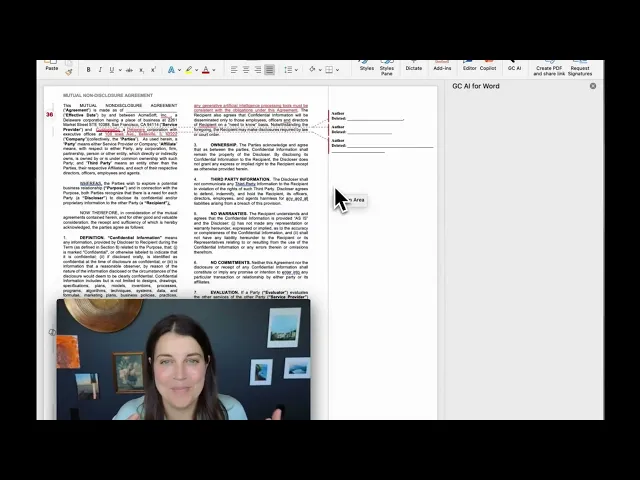
Counsel retains the legal decisions: whether the preservation duty has triggered, who to include, and when to lift the hold.
The team still needs an owner to send the notice, follow up with custodians, and track compliance.
For broader litigation-response work, Trisha Mauer, VP of Legal at Tonal, describes using GC AI for research and litigation responses:
"I go straight to GC AI for everything from research requests to litigation responses. I've compared against ChatGPT, GC AI gives more comprehensive responses appropriate for a lawyer to use. After six months of use, I'm sure I've saved hundreds of hours."
If you want the reps before the real thing, more than 6,000 in-house lawyers have completed GC AI's free, CLE-eligible legal AI courses for legal professionals. 2,100+ legal teams across 47 countries use GC AI as of September 2026, including the legal teams at Liquid Death, Arc'teryx, and Tipalti, plus 300+ public companies and 75+ unicorns.
GC AI is SOC 2 Type II and SOC 3 certified, GDPR compliant, with zero data retention agreements with its model providers wherever feasible, and AES-256 encryption, so the demand letter you upload stays yours. Full details live on GC AI's security page. The duty to preserve is unforgiving, and the whole defense fits in one afternoon: a clear notice, a full custodian list, and a tracker that proves you sent it.
Frequently Asked Questions
Is a Litigation Hold Notice Privileged?
Courts generally treat the notice itself as attorney-client privileged or attorney work product, while the surrounding facts, including that a hold went out, when, and to whom, remain discoverable. Several courts have ordered production of the notice after a preliminary showing of spoliation, so draft every hold as if a judge may one day read it.
How Long Does a Litigation Hold Last?
A litigation hold lasts for the life of the matter, including appeals, and ends when counsel lifts it in writing. Holds routinely run for years, which is why the close-out matters: telling custodians in writing that normal retention resumes keeps storage costs down and preserves the credibility of the next hold you send.
Can Routine Document Deletion Continue After a Hold Is Issued?
No. Suspend auto-archive, auto-delete, and routine document destruction immediately for anything within the scope of the hold, including on personal devices and accounts used for work. The suspension holds until counsel lifts it in writing, even when the retention schedule says otherwise.
What Is the Difference Between a Litigation Hold and a Records Retention Policy?
A records retention policy is the company's default schedule for keeping and deleting information. A litigation hold overrides that schedule for anything related to a specific matter, and it stays in force until lifted in writing. Suspending the retention policy's auto-delete settings is the step most holds miss when the two collide.
What Should an Employee Do After Receiving a Litigation Hold Notice?
Stop deleting, altering, or archiving anything the notice describes, including on personal devices and accounts used for work, and confirm receipt in writing right away. Route every question about scope to the contact named in the notice before touching the data, and keep the notice itself confidential.
Can AI Help Draft a Litigation Hold Notice?
Yes. A legal AI platform built for in-house counsel can draft a litigation hold notice tailored to your matter, reason through the custodian list from the facts, scope it to the right data types and time frame, and help you track acknowledgments. GC AI does this from a description of the dispute or an uploaded demand letter, with character-level citations through Exact Quote, so a lean legal team can issue a defensible hold in minutes.
Is a Litigation Hold the Same as a Preservation Notice or Legal Hold?
Yes, these terms are used interchangeably. "Litigation hold," "legal hold," "preservation notice," and "hold letter" all refer to the written instruction directing custodians and data owners to preserve evidence relevant to a current or anticipated dispute. Some organizations distinguish an internal hold sent to employees from a preservation letter sent to an opposing party, but the core obligation to stop deletion is the same.
This article is general educational information for in-house legal teams, not legal advice for any specific matter.