Two years ago, David Morris, General Counsel at Snyk and GC AI customer, set out to improve legal department efficiency. He introduced GC AI to his team, and the reaction was familiar: another login to remember, another tool the legal ops budget would have to absorb, and another stack of training videos before anyone could prove the thing would shorten a single deal cycle.
Then the free trial ended. He described what happened next on the CZ and Friends podcast:
“The team came to me and said, ‘so we can’t live without this’ … And the response then was, ‘so we’ll give up other stuff. What tools can we get rid of?’”
That is the conversation a legal department has when AI is doing real work. Your team begging you to cut other tools to keep one inverts every procurement cycle you have ever run.
GC AI is an enterprise-ready legal AI platform purpose-built for in-house counsel by a three-time former general counsel, Cecilia Ziniti.
Used by 2,100+ legal teams across 53 countries (including 200+ public companies and 25 unicorns), GC AI absorbs the work that bottlenecks lawyers (first-pass contract review, “what’s market” research, intake triage, regulatory monitoring, invoice analysis, matter reporting) and gives the team back the hours that belong to judgment work. According to GC AI’s December 2025 ROI study of more than 100 customers, in-house lawyers using the platform reclaim an average of 14 hours per week per lawyer, cut outside counsel spend by 14%, and 97.5% see value before month one. See it for yourself!
What “Legal Department Efficiency” Means When the CFO Walks In
Legal department efficiency is the ratio of legal output (matters resolved, contracts closed, advice rendered, risk surfaced) to legal input (lawyer hours, outside counsel dollars, decision-cycle time). The CFO has been measuring it the same way since the Association of Corporate Counsel started benchmarking it. In 2024, median in-house outside counsel spend was $1.8 million per department. The top quartile spent $11.2 million or more. Outside firms still take 87% of the outside legal budget, with alternative legal service providers taking the rest.
Three numbers tell the story to a CFO.
The first is hours per matter, meaning how long it takes the team to redline a sales-paper agreement, answer a “what’s market” question, or close an NDA from intake to signature.
The second is outside counsel spend, and what kind of work it covers.
The third is decision-cycle time, meaning how fast the team can give the business a defensible answer on a deal, a hire, or a regulatory question.
Nobody puts “reduce outside counsel spend by 14%” on the org chart. Then the QBR happens, and it is on the org chart by Friday.
Wolters Kluwer’s Future Ready Lawyer 2026 study describes legal moving from cost center to strategic business partner. Bloomberg Law’s GC x AI series frames today’s GCs as architects of AI-enabled legal functions. Both narratives meet at the same line.
The Leading Indicator Your CFO Doesn’t Track Yet
Outside counsel spend is a lagging indicator. It tells you what already happened. It is the receipt for last quarter’s “is this term standard” email, last quarter’s “can you take a quick look at this DPA,” last quarter’s “what’s market on indemnity caps for SaaS deals north of $5M.” Each of those questions left the building at $600/hr. Each one is now a line on an invoice. The CFO is reading the line.
The leading indicator is the question your team is about to send out the door. Pull a sample of last quarter’s outside counsel emails before they were sent. Categorize them. How many were “what’s market” questions a legal AI platform can answer in 30 seconds with primary-source citation? How many were a clause comparison an encoded playbook could run automatically? How many were a regulatory summary a saved prompt could draft in two minutes?
That percentage is the leading indicator. GC AI customers who compress it cut outside counsel spend by 14% on average.
The Three Workflows from GC AI’s Class 308 That Compound In-House
Former general counsels teach Class 308: AI for Legal Operations, a California-CLE-eligible course built around three examples drawn from real in-house work. Each example maps to one of the sub-questions in-house teams ask by name. The class has run for hundreds of legal ops leaders, and the examples are course-tested.
Best AI for Legal Department Expense Tracking
Your e-billing system of record sits in one place. Brightflag, SimpleLegal, Onit, or Thomson Reuters Legal Tracker holds the invoices, enforces billing guidelines, and produces variance reports for the CFO. The reasoning layer sits on top.
Run a saved prompt across every incoming invoice. Tell the AI your billing guidelines verbatim. Ask it to flag block billing, vague task descriptions (“research” with no matter reference), rate creep above approved schedules, and partner work that should have been associate work.
The AI surfaces the variances, the team approves or pushes back, and the “stupid tax” companies pay on invoices nobody reads drops to near zero.
Ritesh Patel, General Counsel at Viant, framed the underlying mechanism in plain English:
“Before, I’d call outside counsel and pay by the hour for a generic answer. Now, I can analyze it myself, see where it gets me, and call outside counsel if I’m truly out of depth.”
That swap, from outside counsel to in-house AI for the first 75% of an answer, is where the 14% reduction comes from. Apply it to the ACC 2024 median of $1.8 million per department and the math works out to roughly $252,000 a year in invoices the team never sends out the door. The e-billing system stays in place as the system of record. The AI is the reasoning layer that reads it.
Best AI for Risk Assessment in a Legal Department
The second example is the triage layer that reads inbound work, classifies it, scores risk, and routes it before a lawyer touches a billable second.
Three workflows compound. An encoded playbook scans every incoming agreement for clause-level deviations from your company’s standard positions: cap on liability, indemnity scope, IP assignment, termination triggers, governing law.
Platforms with playbook engines run this automatically, and GC AI’s Playbooks handles it for in-house teams.
Standardized workflows compound the gains, and how to build Skills in GC AI walks through turning one lawyer’s best process into the team default.
Compliance.ai uses an “Expert-in-the-Loop” approach (as of May 2026) that pairs model output with human regulatory analysts, while Regology offers a Smart Law Library across 135+ jurisdictions for change monitoring.
For most lean in-house teams, those add a line item only when regulatory complexity (financial services, healthcare, multi-jurisdictional privacy) demands a dedicated change-monitoring feed. On the litigation and matter side, the AI reads prior matters, surfaces analog fact patterns, and pressure-tests the team’s positions before a dispute escalates.
Every vendor in this category claims to be “purpose-built.” That is the legal AI equivalent of “time is of the essence.” Everyone says it. Look for what each vendor means by it. Ask them to score risk on a contract you upload during the demo, and watch how the citation behaves. The right risk-assessment AI for the team is usually the same platform that already runs contract review, with playbooks encoding the team’s positions and citation traceable back to the source document.
Best AI for Data Analysis in a Legal Department
The third example is the most underrated of the three. The class teaches it last because most teams do not think to use AI this way until a senior lawyer demonstrates it.
Take the position you are about to send to the business. Hand it to the AI and ask it to argue the other side. Tell it to find every weakness, every counter-argument, every state-law variant that breaks your assumption. Treat the AI as the world’s most prepared opposing counsel for ten minutes before you press send.
Pair this with document analysis. GC AI’s Files and Exact Quote read a stack of contracts, deposition transcripts, board minutes, or regulatory filings (up to 1,500 pages at a time) and return character-level citations a lawyer can verify in one click.
Matter and spend analytics run from your e-billing platform’s structured data. Contract portfolio analytics at scale runs from a CLM (Ironclad, LinkSquares, ContractPodAi, Agiloft, with Evisort inside Workday since October 2024) with the AI reasoning layer on top.
Matthew Campobasso, Chief Legal Officer at Zone and Co., described the second-order effect on the CZ and Friends podcast:
“What used to take me maybe 10 hours over the course of two days, I can get done in 10 minutes. And what that allows me to do is, I remember a point in my career as an in-house lawyer where I might be going from point A to point B and along that way, I might see something and say, wow, I should really come back and spend some time with that, because if things go really poorly, that could be a big problem for our business. But when it takes you 10 hours…”
Our CEO Cecilia Ziniti used a bicycle metaphor for the same effect on the same podcast.
Giving a lawyer AI is giving a marathon runner a bicycle. The runner already runs fast. The bicycle lets the runner reach places the runner would not have run to. Efficiency goes beyond hours back. The team finally has the capacity to chase the matters that used to get left behind.
How GC AI Runs These Legal Ops Workflows
Cecilia Ziniti founded GC AI shortly after leaving her last General Counsel job, at Replit. As she tells the story on CZ and Friends, she had become so obsessed with AI that her boss, Replit CEO Amjad Masad, told her she might be in the wrong job. Ziniti agreed. They planned her transition, and a week after she stepped away, she founded the company. Three GC tours (Anki, Bloomtech, Replit) and in-house counsel stints at Amazon and Cruise had shown her what in-house lawyers need. She built the platform to deliver it.
The platform runs the three Class 308 workflows from one surface.
Playbooks encodes the team’s positions on NDAs, DPAs, MSAs, and sales paper, then runs automated contract review with agents (the second Class 308 example, scaled).
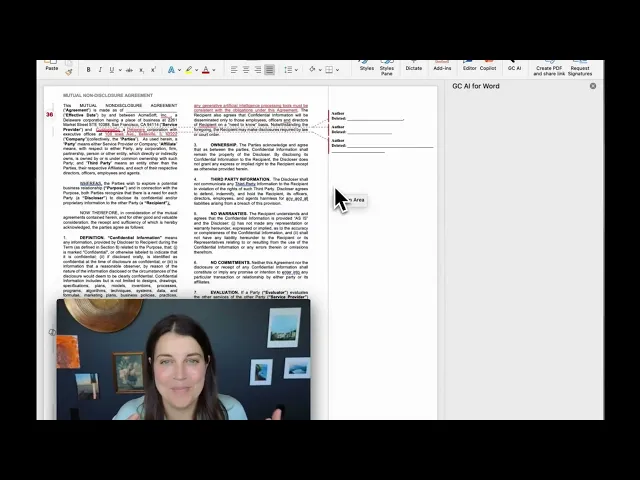
GC AI for Word puts the platform inside Microsoft Word, where most contracts already live, with Chat2 for in-Word web research and Projects for matter memory.
Files and Exact Quote turn the precedent library into citation-backed institutional memory, character-level verifiable (the third Class 308 example, scaled).
The Skill Library holds the saved prompts the team builds for invoice review, board reporting, and recurring intake patterns (the first Class 308 example, scaled). Custom Company Profile encodes the team’s voice and standards so outputs arrive calibrated to how the team writes.
GC AI is SOC 2 Type II and SOC 3 certified, GDPR compliant, with zero data retention agreements with OpenAI and Anthropic, and AES-256 encryption. CLE-eligible classes cover the prompts and workflows that compound team adoption past pilot. For a comparison against the alternatives, see GC AI vs Harvey or GC AI vs Spellbook.
Kaniah Konkoly-Thege, Chief Legal Officer at Quantinuum, summed up the compounding effect:
“I cannot tell you how much legal AI has revolutionized my law department. I’ve contracted hiring, I’ve streamlined how we use our outside counsel.”
Frequently Asked Questions
How Can AI Improve Legal Department Efficiency in 2026?
AI improves legal department efficiency by handling the work that bottlenecks in-house lawyers (first-pass contract review, “what’s market” research, intake triage, invoice analysis, matter reporting) and freeing the team to focus on judgment work. GC AI’s December 2025 ROI study of more than 100 customers reported an average of 14 hours per lawyer per week reclaimed, a 14% reduction in outside counsel spend, and 97.5% of teams seeing value before month one.
How Do I Measure Legal Department Efficiency?
Three numbers measure legal department efficiency in 2026: hours per matter, outside counsel spend, and decision-cycle time. The leading indicator most GCs aren’t tracking is the percentage of last quarter’s outside counsel emails that should never have left the building (the “what’s market” questions, clause comparisons, and regulatory summaries a legal AI platform answers in seconds). Run that audit before your next budget conversation.
What Is the Best AI for Risk Assessment in a Legal Department?
The best AI for legal department risk assessment is the platform that already runs your contract review, with encoded playbooks and document-level citation. For most lean in-house teams, GC AI’s Playbooks covers contract risk and matter triage end to end. For regulatory complexity (financial services, healthcare, multi-jurisdictional privacy), pair the reasoning layer with a dedicated change-monitoring feed (Compliance.ai, Regology, as of May 2026).
What Is the Best AI for Legal Department Expense Tracking?
The best AI for legal department expense tracking pairs an e-billing system of record (Brightflag, SimpleLegal, Onit, Thomson Reuters Legal Tracker) with a reasoning layer that reads invoices against your billing guidelines and flags variances. The reasoning layer is the source of the 14% outside counsel reduction in the December 2025 GC AI customer cohort, which works out to roughly $252,000 a year for a department at the ACC 2024 median.
What Is the Best AI for Data Analysis in a Legal Department?
The best AI for legal department data analysis depends on the data type. For document analysis (contracts, transcripts, filings), a legal AI platform with character-level citation like GC AI’s Exact Quote handles up to 1,500 pages at a time. For matter and spend analytics, pair an e-billing platform with a reasoning layer. For contract portfolio analytics at scale, pair a CLM (Ironclad, LinkSquares, ContractPodAi, Agiloft) with AI on top.
If We Adopt AI, How Do I Tell Outside Counsel Their Hours Are Getting Cut?
Reframe the conversation as a redistribution. The reduction comes from cutting the “is this term standard” calls and the first-pass research, while the bet-the-company work continues to flow to outside counsel. Use the reclaimed budget for the engagements that need partner-level expertise (disputes, M&A, regulatory crisis), and your firm relationships compound on the work that matters.
How Do I Show AI ROI Without Overpromising at the Next Board?
Run a 30-day pilot on one workload (contract review or invoice analysis are the two highest-yield). Set a baseline before the AI touches the work. Measure cycle time, outside counsel touches avoided, and prompt reuse across the team. Bring the delta, not the projection, to the board. 97.5% of GC AI customers in the December 2025 study saw measurable value inside the first month.
Does AI Replace In-House Lawyers?
AI absorbs the work that bottlenecks in-house lawyers, so the team focuses on judgment, strategy, and escalation. Headcount holds steady. Throughput compounds. Kaniah Konkoly-Thege, Chief Legal Officer at Quantinuum, described the effect on CZ and Friends as “contracted hiring” with streamlined outside counsel use, meaning capacity grows without payroll growing.
Is AI Secure Enough for a Legal Department?
GC AI is SOC 2 Type II and SOC 3 certified, GDPR compliant, with zero data retention agreements with OpenAI and Anthropic, and AES-256 encryption. This is the security baseline a legal department should require from any AI platform handling contracts, matter notes, or privileged analysis. Any vendor that cannot match this bar will struggle to clear procurement at a public company.
How Should a Legal Department Start Evaluating AI in 30 Days?
Pick one workload where friction is sharpest, usually contract review or invoice analysis. Set a real baseline before the AI touches the work. Encode the team’s playbook for the workload. Run the pilot for 30 days on real matters. Measure time saved, outside counsel touches avoided, and team adoption. Take the delta to the CFO with the calculation behind each number.