Jordan Breslow finished law school in 1980, spent two years at a small Oakland firm, built his own practice, and subsequently spent four decades doing in-house legal work at some of Silicon Valley’s most influential technology companies. Along the way, Jordan taught as an adjunct at UC Berkeley, GC AI founder Cecilia Ziniti’s alma mater, and NYU Law while still practicing in-house.
His resume includes Geoworks, Loud Cloud (which became Opsware) which was acquired by HP for $1.6 billion, Silver Spring Networks, and Etsy, where he led the 2015 IPO as the largest certified B corporation ever to go public. Jordan is also the attorney Ben Horowitz thanked publicly for keeping him out of jail.
“You’re in Silicon Valley, something crazy happens everyday,” said Jordan. “And it's not just moments where your integrity is challenged. I think it's a matter of keeping your ear open to situations that don't feel right, and following the simple saying: trust your gut.”
These days, Jordan is retired, lives in Lake Tahoe, plays in a band called Down the Rabbit Hole, and occasionally mentors young lawyers who find him on LinkedIn. In conversation with CZ, Jordan dishes on his four IPOs, a stock option scandal, and the importance of speaking truth to power.
Practicing the Art of Faking it Until You Make It
After Jordan left firm life, he started his own practice in Walnut Creek, California, focused on serving tech clients. Eventually, his clients' needs outgrew what his small firm was able to offer. He decided to merge his practice with a larger firm in Oakland, which boasted clients like Autodesk, and Software Publishers Association.
“Most of the time while I was at work, I was thinking there's got to be another way I could make a living because I don't like practicing law, " Jordan said. “I don't like time sheets. I don't like billing. It's boring and thankless.”
When Geoworks, a Berkeley startup looking for their first in-house counsel, came calling, he turned them down. Six months later, dreading every day of work at the firm, Jordan called back and said he'd be there Monday.
On his second day of work, the president walked into Jordan’s office and asked him to handle a bridge loan for the company since they were short on cash. Jordan smiled politely, said “of course!” and waited for the door to close before phoning a friend to ask what a bridge loan was.
“That kind of set the stage for how I did many things at Geoworks, “ said Jordan. “There's just no way one can be prepared for all the things that get thrown at you as a general counsel. You've got to do IP, technology, human resources, so many different things. The word general fits.”
That experience kicked off Jordan’s philosophy for operating in the unknown: surround yourself with good outside counsel, study every new area hard before touching it, build real relationships instead of relying on your title, and never copy and paste a document you don't fully understand.
This mindset, along with a keen BS detector, carried him through the bridge loan experience, the Silicon Valley backdating fiasco, and eventually, several IPOs.
The Stock Option Scandal and Day Jordan Kept Ben Horowitz Out of Jail
When Jordan was GC at Opsware, the company's new CFO arrived with an idea from a previous employer: they should set their grant option price to the lowest the stock had been in the last 30 days This stock option pricing practice had quietly been normalized across the industry, but some were already flagging it as shady.
The practice wasn't formally called “backdating” just yet. It was simply a way to arrive at a number, the finance bros said. Everybody was doing it, and prominent Silicon Valley law firms insisted that it was perfectly fine. Jordan researched it, talked to other GCs, consulted outside counsel, but he still couldn't get comfortable with the idea.
"There was something about this that didn't feel right,” Jordan recalled. “I guess what my gut was saying is just because everybody's doing something doesn't make it right."
Jordan admitted to Ben Horowitz that he wasn’t comfortable with backdating the option price and didn't think they should do it. Ben trusted his judgement and went a different direction.
Shortly after, the SEC launched a sweeping investigation into backdating across Silicon Valley. Companies paid enormous fines, a handful of people went to jail, and some general counsels lost their jobs. These unfortunate folks were, in Jordan's words, probably thrown under the bus. Ben has publicly credited Jordan with keeping him out of the whole mess, and a lot of press has been written about the incident, and the resulting fallout.
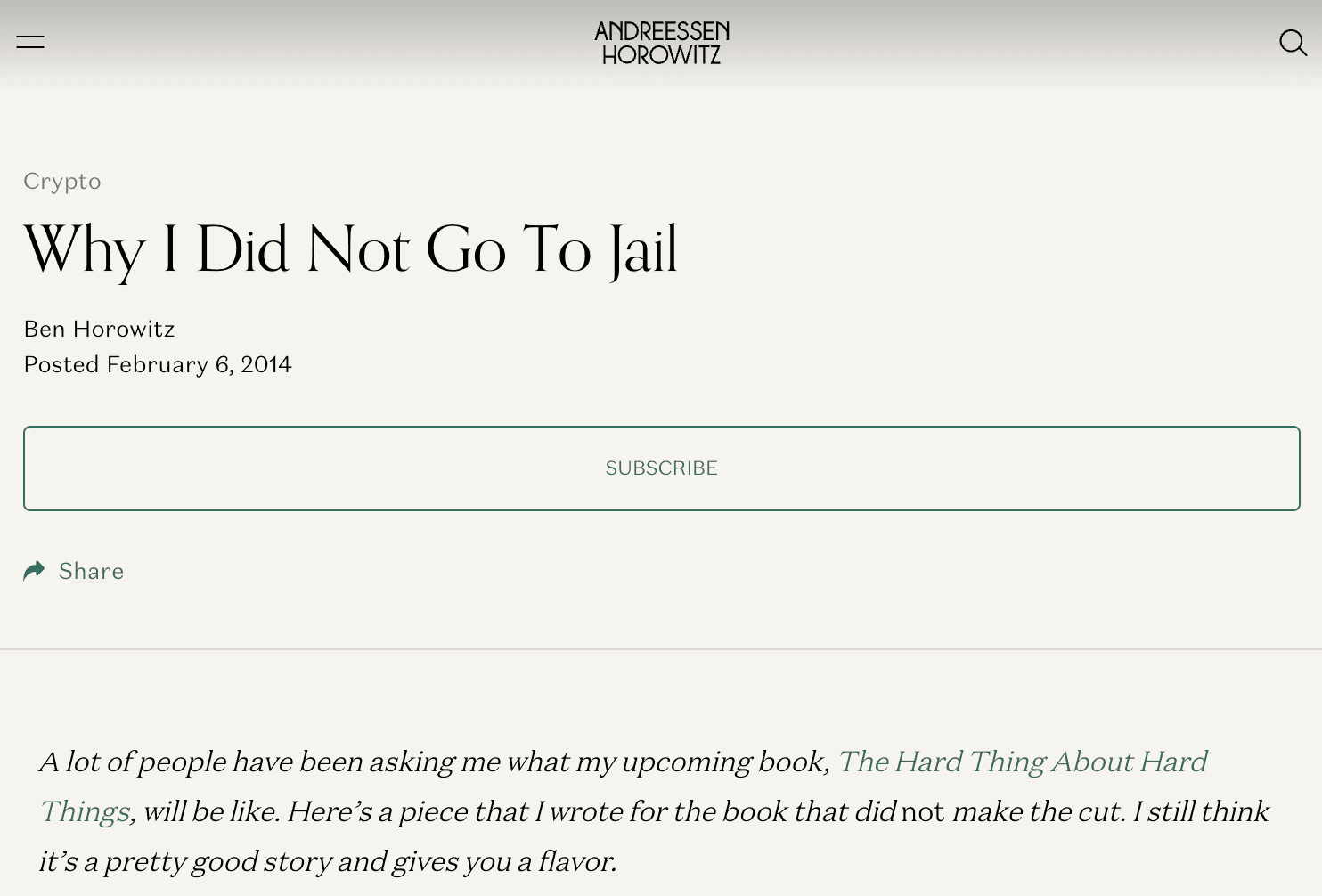
The biggest lesson Jordan learned at Opsware was to trust his gut instinct, while finding ways to say yes as much as possible.
"I was in the habit of finding a way to say yes as many times as I possibly could. So when I said no, Ben trusted me,” he said.
The Etsy IPO: Don’t Let the Bankers Run the Show
By the time Jordan got to Etsy, he had been through four IPOs. He and the CFO decided early on that they weren't going to let the outside lawyers or the bank dictate how the process went. Etsy was going to do this their way.
A good example of this mindset was Jordan's insistence that every document be sent in plain English. He sent back every draft the outside lawyers submitted with the same instruction: rewrite it in language a human can actually understand. Etsy is a company whose entire identity is built around small creators and human connection, so anything written in legalese would have been a brand contradiction.
“Whether it's the employees, the shareholders, or the customers, the merchants, I didn't want to hit them with incomprehensible documents,” Jordan said. So that was a pretty constant tug of war. I would say I won most of those battles, but not all of them.”
The ones he lost were the ones where outside counsel told him, credibly, that changing the language would create liability exposure he couldn't afford.
The other critical element of the Etsy IPO was its status as the largest public company ever certified as a B corporation. In fact, Jordan wove that into the prospectus and negotiated directly with the SEC. He even pushed to formally reincorporate Etsy as a public benefit corporation under Delaware law, a move that would have given the board explicit legal obligations to stakeholders beyond shareholders. Unfortunately, Delaware law hadn’t caught up in time. Etsy officially became a publicly traded company on April 16, 2015, hitting the market at $16 a share.
Note from CZ: Jordan’s insistence on plain English is something I feel deeply. One of the things GC AI users tell us most often is that our product gives legal advice that actually lands: bulleted, clear, translated for the business rather than the courtroom. Jordan was doing this with paper prospectuses in 2015. Great legal communication has always been a form of respect for the reader.
Copyright Law and the Ethics of Training AI Models
Jordan has followed the AI copyright debate closely, as a former lawyer but also as a musician who plays cover songs every summer on the North Shore of Lake Tahoe. When he gets on stage with his band and plays a song written by someone else, that creator gets compensated. Not much, maybe, but the mechanism exists.
ASCAP and BMI built a collective licensing system that allows venues, platforms, and performers to use copyrighted music commercially while ensuring the people who created it see something in return. It isn't perfect. But it functions. The AI industry, in Jordan’s view, is currently lacking a way to compensate the creators whose work trains new models. There isn’t a straightforward solution just yet.
"It seems technically correct that if you're using all the works of all these authors to train your AI model, you don't have to pay them,” said Jordan. “But it feels wrong. And it bothers me that they're going to profit off the labor of all of these authors."
AI companies argue that if you read a book and learn from it, you shouldn't have to pay an extra fee because it influences your later work. The courts are working through where that analogy breaks down when the learner is a commercial AI model generating billions in revenue. But the moral case, to Jordan, is already settled in the same place his gut settled on the stock option question two decades ago. Technically permissible and genuinely right are not always the same.
Ethically strong in-house lawyers who are willing to ask the hard questions surrounding copyright, governance, data privacy, and creator rights, are exactly what modern businesses need most. A great GC, says Jordan, is someone who can sit with the discomfort of an unsettled area and make good judgments along the way.
GC AI is built for that kind of lawyer: the one who studies hard, builds real relationships, finds a way to say yes, and knows when to trust their gut. Try it free at gc.ai.