Legal ops vendor selection means choosing software that fits a legal department's work, systems, risk requirements, budget, and ability to implement it. This guide covers software: contract lifecycle management (CLM), intake, matter management, e-billing, contract analysis, and legal AI. For law firm selection, see our guide to outside counsel management.
A sound comparison does three things:
Filters out vendors that miss mandatory requirements.
Tests the remaining finalists on the same representative work.
Weighs the results against total cost and implementation effort.
GC AI is an enterprise legal AI platform built for in-house legal teams, from solo GCs and smaller teams to enterprise legal departments.
More than 2,200 legal teams use it, including teams at Bass Pro Shops, Nestlé, TIME, and Tipalti. GC AI is itself the kind of software legal teams evaluate through this process.
Our CEO and co-founder, Cecilia Ziniti, served as general counsel at Anki, Bloomtech, and Replit. At Replit, she worked with early versions of GPT and saw its potential for the work she knew firsthand. She later left to build GC AI with former Replit engineer Bardia Pourvakil.
Teaching lawyers to use AI helped her see what the product needed to do. Ziniti put it this way:
"Our software needs to provide accurate citations. Our software needs to tell you where in the document it's getting the backup for this."
Ziniti said the product also needed to show where an answer came from in a document and use language suited to legal work. The same principle applies to vendor selection: define what a good answer or completed task looks like before comparing products.
This guide assumes the legal team has identified the type of software it needs. Corporate legal software covers that earlier category decision.
When legal AI is relevant to the problem, GC AI can be evaluated using the same requirements, representative testing, cost, implementation, and contract considerations discussed here.
What a Strong Vendor Evaluation Should Establish
A strong vendor evaluation makes the reasoning behind the decision visible. The format matters less than whether the team can trace the decision from the original business problem through the evidence, tradeoffs, contract, and rollout.
Six elements matter most:
Business problem and baseline: What is not working well today, and what would meaningful improvement look like?
People and decision rights: Who will use and maintain the software, who controls the budget, when the decision matters, and who has final authority?
Mandatory versus optional requirements: Which failures disqualify a vendor, and which differences make one eligible option more attractive than another?
Evidence and review: What supports each important vendor claim, and who is qualified to judge whether that evidence is sufficient?
Implementation effort: What data cleanup, integrations, internal time, vendor services, and ongoing administration will the purchase require?
Contract and rollout: Do the capabilities that drove the decision appear in the signed scope, implementation plan, and post-launch review?
For a reporting tool, the baseline might be the time spent preparing the monthly matter report, including corrections before the general counsel can use it.
A useful requirement might be: "The legal ops lead can export open matters by owner and status, with totals matching the source records." A known set of matters can then show whether the result is reliable enough for the team's actual reporting process.
Decision Rights Matter Before the Demos
Different parts of a purchase often belong to different reviewers: workflow fit, budget, systems, security, privacy, and contract terms.
Clear ownership matters because approval in one area does not resolve concerns in another. An unresolved mandatory requirement remains unresolved even if the rest of the scorecard looks strong. If the business accepts an exception, the reason, the steps taken to manage the risk, and the limits of that exception should be explicit.
Systems, Data, and Integrations Can Decide the Outcome
Software can fit the legal use case and still fail because its data, permissions, or integrations do not fit the surrounding systems. Intake depends on routing a request to the right person. Reporting depends on reliable fields. Contract analysis depends on having the right documents and amendments.
On CZ and Friends, GC AI's podcast for in-house legal leaders, Jenna Hunt, then Tipalti's head of legal operations, described a failed CLM implementation. The team spent about a year trying to make the system work before deciding it did not fit its needs.
Her lessons for the next purchase were practical:
The problem needs to be clear before the sales process begins.
Legacy data cleanup and import can require substantial work.
Other teams' workflows and technology plans can determine whether a new system duplicates, replaces, or disrupts existing tools.
Alice Davidson, Tipalti's general counsel in the same episode, described the decision to stop the failed project. The money the team had spent was no reason to keep investing in a system that did not work.
A representative workflow can expose questions that a polished demo may hide:
What enters the workflow?
Which fields move between systems, in which direction, and how often?
Who can view or change the information, and do those permissions carry across systems?
What happens when a record is incomplete, duplicated, or fails to sync?
Who is responsible when an integration fails, and who handles configuration changes?
What can the legal team export if it leaves the vendor, and in what format?
An integration that is included in the quoted product is materially different from one that requires separately priced services or depends on a future release. If launch depends on the integration, evidence that it works with the systems and setup the team plans to buy matters more than a generic demo.
Security, Privacy, and Contract Terms Need Separate Evidence
Security and privacy requirements depend on the software, data, users, and risk involved in the purchase. The National Institute of Standards and Technology's supplier-requirements guide can help teams define and communicate cybersecurity requirements, but the organization's own policies and risk assessment determine what applies.
The review usually spans several distinct questions:
Service scope: Which contracting entity, product, hosting arrangement, and services do the documents cover?
Security evidence: What reports or certifications apply, what do they cover, and what exceptions or follow-up issues remain?
Data handling: What do the data processing agreement, subprocessor terms, data locations, retention and deletion terms, and AI-training provisions establish?
Access and operations: How do sign-in, permissions, activity logs, incident notification, support access, and continuity measures work?
Commercial terms: Does the order form reflect the agreed services, integrations, usage limits, support, renewal terms, and exit assistance?
For GC AI, the security page and subprocessor list provide the starting evidence for those questions.
A vendor report or certification supports the review, but the responsible reviewer still determines whether that evidence is sufficient for the proposed use.
Representative Work Separates a Demo From Fit
A pilot is most useful when its results could change the decision. Comparable pilots put finalists through the same representative work, use the same success criteria, and make vendor assistance visible rather than treating every successful demonstration as equivalent.
A matter-reporting pilot might follow a matter from intake through reassignment, reporting, and export. A contract-analysis pilot might use documents and amendments with answers counsel has checked. Routine work matters, but so do the exceptions that create real-world friction.
Setup effort and day-to-day effort are different costs, and a pilot can expose both. A workflow that succeeds only with heavy vendor intervention may be harder for the team to operate independently after launch.
For a legal AI shortlist, how to evaluate legal AI vendors goes deeper on finalist testing and pilot design.
Scoring Helps Only After Mandatory Requirements Are Met
Mandatory requirements determine whether a vendor stays in consideration. Weighted scores are useful only for vendors that meet those requirements or have an approved exception; strong optional features should not offset a failure the team considers unacceptable.
Weights work best when they reflect the reasons for buying the software rather than the features a particular vendor happens to emphasize. The following example shows one possible model for a team buying a reporting tool:
Criterion | Illustrative Weight | Reason for the Weight |
Workflow performance | 40% | Compare how well each eligible vendor handles the reporting work. |
User and administrator effort | 20% | The team must have time to use and maintain the software. |
Implementation effort | 15% | The team needs enough time and support to move its data and launch. |
Total cost over the evaluation period | 15% | Compare the same services, expected usage, and period. |
Ongoing support and exit arrangements | 10% | The team needs support when problems arise and a way to take its data when it leaves. |
Source: GC AI editorial scorecard example, October 2026. These weights illustrate a buyer's priorities; no vendors were scored.
A simple five-point scale is enough if the ratings have observable meaning:
0: Unacceptable
1: Weak
2: Acceptable
3: Strong
4: Fully meets the defined target
For reporting, a correct export that still needs manual cleanup might earn a 2, while a report users can prepare and use without cleanup might earn a 4. The evidence and reasoning beside the rating matter more than the number alone.
The arithmetic is straightforward: weight × rating ÷ 4. A rating of 3 on a 40-point criterion earns 30 points: 40 × 3 ÷ 4 = 30.
If small, reasonable changes to the weights produce a different leader, the choice depends more on the underlying priority than the final score suggests.
A useful decision record captures the selected vendor, why it fits the team's needs, which limitations the team accepts, and what remains unresolved before signing. If no eligible option meets an essential requirement or the team lacks the capacity to launch it, delaying or narrowing the purchase may be the better decision.
Total Cost Extends Beyond the Subscription
A like-for-like cost comparison includes more than the subscription fee:
Subscription
Implementation and training
Data migration
Integrations
Internal administration
Exit or migration to another system
One-time and recurring costs should remain distinguishable, along with assumptions about growth, usage limits, renewals, and work the vendor expects the legal team to perform.
Monetary cost and internal effort are related but not identical. Keeping them visible as separate criteria helps prevent the same concern from being counted twice.
Features that materially affected the decision should appear in the proposed purchase. Counsel can then compare the agreement and statement of work with the commitments that influenced the evaluation.
Vendor Selection Does Not End at Signature
A good purchase decision anticipates what happens after signing. The commitments that helped a vendor win should carry into implementation, adoption, and renewal.
A workable rollout has clear ownership for:
Launch: Schedule, setup, data cleanup, migration, and acceptance testing
Access: User provisioning, permissions, departures, and role changes
Adoption: Training, questions, and problem reporting
Results: Comparison with the pre-purchase baseline
Contract management: Usage limits, service commitments, notice deadlines, renewals, and exit obligations
For the reporting example, post-launch evidence might include preparation time, corrections, and whether the intended readers use the report in practice.
An early review creates time to fix setup or adoption problems. A renewal review needs to happen before the contract's notice deadline, while the business still has realistic options.
GC AI Can Help With the Vendor Handoff
Tipalti uses GC AI to explain signed vendor contracts to business owners. Later in the same episode, Hunt described a team-built prompt that produces a plain-language summary of user limits, extra charges, and renewal terms.
That approach can connect the purchase decision with the obligations the business needs to manage after signature. Signed agreements, order forms, and relevant attachments can be organized in GC AI's Files, while the evaluation record remains available as the reference for what mattered during selection.
A vendor handoff can be organized around four checks:
Commercial terms: Purchased services, charges, usage limits, implementation responsibilities, and support commitments
Renewal and exit: Notice deadlines, renewal mechanics, exit obligations, and amendments that modify the original agreement
Contract match: Missing commitments, conflicting terms, or gaps between the final contract and the requirements that drove the purchase
Verification and ownership: Counsel's confirmation of the cited terms and clear ownership of the resulting tasks and deadlines
With GC AI's Exact Quote, a citation in chat can open the source document with the relevant passage highlighted. That makes it easier to check a handoff summary against the signed agreement.
See how Exact Quote opens the source passage:
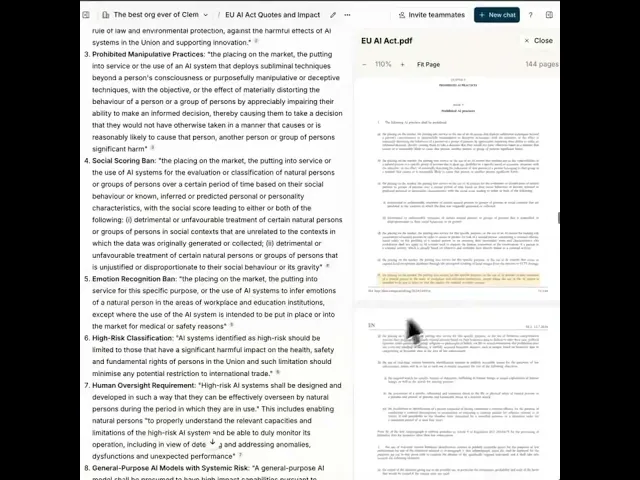
GC AI Exact Quote demo
Try This Vendor Handoff Prompt
Adapt these instructions to your contract package:
Prepare a plain-language handoff for the business owner using the attached signed vendor documents and the evaluation record.
List the purchased services, user and usage limits, charges, implementation responsibilities, support commitments, renewal and notice terms, and exit obligations.
Cite the source document and section for each item. Map material commitments back to the corresponding requirement in the evaluation.
Keep contractual obligations separate from proposed internal tasks.
Flag missing documents, conflicting terms, and unclear dates. Do not infer commitments the documents do not establish.
After counsel reviews the summary and resolves open questions, the agreed tasks and deadlines can move into the systems the team uses to manage the vendor.
A completed vendor agreement and its evaluation record make a useful test case for this workflow. The question is whether GC AI cites the right terms, surfaces missing commitments, and reduces the correction work compared with the team's current process.
From Vendor Selection to a Working System
Vendor selection works best when the original business problem stays connected to the evidence gathered during evaluation, the commitments in the contract, and the results after launch. That connection makes it easier to tell whether the software solved the problem the team set out to address rather than merely winning a comparison on paper.
For legal AI, the same standard applies. GC AI can be tested on representative legal work, with source-backed answers and signed documents, against the team's own requirements. Ziniti's point from the opening provides a useful benchmark: define what a good result looks like first, then see whether the product consistently delivers it.
Frequently Asked Questions
Does Every Legal Software Purchase Need an RFP?
No. Whether an RFP makes sense depends on the organization's procurement rules and the size and risk of the purchase. An RFP is useful when the team needs to compare detailed offers against defined requirements. An RFI can help earlier, when the team is still identifying vendors that might fit.
How Should We Evaluate an Incumbent Vendor at Renewal?
Treat the incumbent as a current candidate, not the default choice. Compare today's requirements, actual usage, support history, and renewal terms, then factor in the cost and effort of switching. Starting before the notice deadline keeps realistic alternatives open.
What If a Vendor Will Not Offer a Pilot?
You can still learn a lot, but be clear about what remains untested. A demonstration using the team's scenarios, a relevant reference customer, and written answers to the same test questions can all help. None of those substitutes shows exactly how the team's users will work with the software day to day.
What If No Vendor Meets Every Mandatory Requirement?
First determine whether the requirement is truly mandatory. If it is, a vendor that fails it should stay out of the final comparison unless the appropriate approver accepts a specific exception and the associated risk. If every candidate fails the same requirement, the better answer may be to narrow the scope, revisit the requirement, or delay the purchase rather than let optional strengths hide the gap.