On the CZ and Friends podcast, Danielle Sheer, Chief Legal and Trust Officer at Commvault, told GC AI CEO Cecilia Ziniti what she had been searching for in a legal AI chatbot. Her answer is the brief for this whole article:
“What would be really helpful is if there was an entire universe that was like ChatGPT, but built for and made for the legal world and the compliance world. GC AI.”
In-house counsel want the speed of a conversational AI, applied to the legal questions their day is built around. The chatbots they try are built for a general audience, and that breadth shows up the moment a lawyer needs the AI to redline an NDA in Word.
Why “Legal AI Chatbot” Gets the Question Half-Right
A legal AI chatbot is a conversational interface that takes a question in plain English and returns an answer informed by legal information or primary law. ChatGPT, Claude, CoCounsel, and Lexis+ AI all operate this way. They are the right shape for one question at a time.
For in-house counsel, that shape covers a small slice of the workday. Most matter work starts as a document: a vendor contract that needs redlining, a DPA that has to be checked against your standard, a draft response to a regulator, or a litigation memo that has to cite primary law. None of those are conversational. They are documents with revisions, comments, track changes, and a clock.
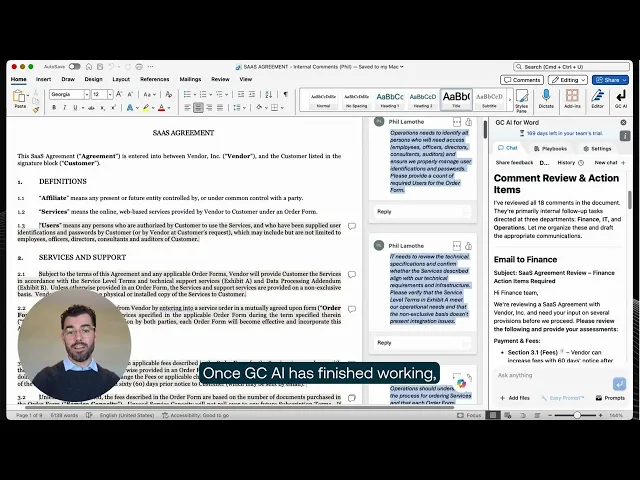
GC AI for Word does the in-house matter work directly inside Microsoft Word, with workflows tuned to NDAs, DPAs, MSAs, and the other documents in-house teams see every week. The chatbot frame is the right wedge for the conversation. The work that follows needs workflow AI built for the in-house buyer.
More capable legal AI raises a broader question beyond chat alone: Will AI Replace Lawyers? Here’s What the Experts Say.
What a Legal AI Chatbot Can and Cannot Do for In-House Work
Chatbots are well-shaped for four jobs in-house lawyers do every week:
Quick research questions. “What are the elements of promissory estoppel in California?” A general-purpose chatbot tuned with legal data will produce a usable starting answer, with the caveat that any output that touches a brief still needs a citation check.
Plain-English explanations of clauses or statutes. Useful for a business owner who needs to understand an indemnity provision before the call.
Brainstorming and drafting kickstarts. Outlines for a policy memo, a list of questions to ask a vendor, a starting structure for a board update.
First-pass intake triage. “What is this contract type, and which playbook applies?” Routing-level questions a chatbot can answer in seconds.
Chatbots fall short on four jobs in-house counsel cannot avoid:
Document-level edits. A chatbot returns a wall of text. A redline is markup inside a Word file with track changes the business can accept or reject.
Reusable workflow. A chatbot answers a question once. A matter has the same NDA, DPA, or MSA review running every week with the same standards. Playbooks belong inside the platform that runs the review, and Skills cover the non-contract workflows a team repeats every week.
Verifiable citations to your own documents. A chatbot can quote a clause it half-remembers. In-house counsel cannot send a CEO a contract summary that says “approximately Section 7.”
Multi-document context. A chatbot has a context window. A matter has a folder of documents, a playbook, a previous redline, and a counterparty’s revisions. The platform has to hold all of them at once.
Tricia Kinney, General Counsel at BlueLinx and a CZ and Friends guest, named the consumer-vs-legal-AI choice plainly on the CZ and Friends podcast:
“I am a huge fan of using legal specific AI tools as opposed to consumer specific AI tools. You want them training in the same context that we’re operating in.”
When Chatbots Try to Do Legal Work: DoNotPay and the Anthropic Filing
Two cases in 2024 and 2025 show what happens when a chatbot is asked to do legal work past its limits.
DoNotPay: $193K and a Promise to Stop Calling It a Lawyer
DoNotPay called itself “the world’s first robot lawyer” and promised consumers a chatbot that would “generate perfectly valid legal documents in no time.”
The FTC investigated. In September 2024 it announced charges.
In February 2025 it finalized an order requiring DoNotPay to pay $193,000 in monetary relief, stop claiming the chatbot is an adequate substitute for a lawyer, and notify subscribers from 2021 through 2023 about the settlement.
The FTC’s press release says DoNotPay never tested whether its AI performed at the level of a human lawyer and never hired or retained attorneys to check the quality of its outputs.
Consumer chatbots have their uses, including the casual research questions that account for a slice of in-house work.
The DoNotPay enforcement turns on substantiation: calling a chatbot “your lawyer” is a problem with the FTC, and using one as a lawyer is a problem with your CEO.
The Anthropic Filing: When the Defendant’s Own Chatbot Hallucinated
In April 2025, Anthropic’s defense attorneys at Latham and Watkins used Claude, Anthropic’s own chatbot, to format a citation in an expert declaration filed in Concord Music Group v. Anthropic, the music publishers’ copyright case against Anthropic. Claude got the title and the authors of the underlying article wrong. The underlying article was real, but the citation Claude produced was a fabrication.
A district court in California struck the relevant portion of the expert’s testimony. Ivana Dukanovic, the Latham associate who signed the declaration, called it “an embarrassing and unintentional mistake.”
The detail that should land for in-house counsel - a manual citation check did not catch it. Two trained lawyers signed off on a citation a chatbot fabricated. The error is small. The category of error is recurring across every chatbot used for legal work.
GC AI builds the verification step Concord Music exposed as missing into the platform by default.
Exact Quote™ ties every quoted clause back to character-level source language in the underlying document, so the in-house lawyer signing a filing has the source text on the same screen as the cited language.
The Four Chatbots In-House Counsel Try First
These four names show up in almost every in-house buyer conversation we have. The list below covers what each one is good at, where each one stops, and why the chatbot category as a whole is the wrong shape for matter work.
ChatGPT Business is the default first contact for most in-house lawyers and a fast option for ad-hoc research.
Claude for Work is the long-document Q&A pick, with a native Microsoft Word add-in Anthropic shipped in April 2026.
Thomson Reuters CoCounsel runs primary-law research on Westlaw with Practical Law backing.
Lexis+ AI (Protégé) runs research grounded in the LexisNexis database.
ChatGPT Business
OpenAI’s chatbot is the default first contact most in-house lawyers have with AI.
In-house lawyers reach for it because it is fast and conversational, and the Business and Enterprise tiers add SOC 2 Type II compliance, stronger retention controls, and default no-training commitments. OpenAI offers ZDR for eligible API endpoints and qualifying use cases. (For the deeper safe-and-not-safe analysis on ChatGPT in legal work, see our guide ChatGPT for Lawyers: What’s Safe, What’s Not, and What Heppner Changed.)
The limits for in-house work as of May 2026:
No native ChatGPT-brand Word add-in. Microsoft 365 Copilot uses OpenAI models in Word, but that is a separate Microsoft product with a different license structure.
No character-level citation back to user-uploaded documents. A ChatGPT summary may say “approximately Section 7” without a verifiable anchor back to the clause it came from.
No legal-specific playbook system. Custom GPTs are user-built and ship empty; no pre-loaded NDA, DPA, or MSA review standards.
General-purpose model trained on the open web. ChatGPT will produce a confident answer to a jurisdiction-specific legal question that the user has to verify against primary law.
Discovery exposure precedent from NYT v. OpenAI. The May 2025 preservation order required OpenAI to retain ChatGPT Free, Plus, Pro, and Team logs (Enterprise and zero-data-retention API accounts were carved out). That blanket obligation ended September 26, 2025, but a November 2025 order required OpenAI to produce 20 million ChatGPT conversations to the plaintiffs. The precedent for in-house counsel: consumer-tier ChatGPT chat history can be made discoverable across an entire user base by a single court order.
The full GC AI vs ChatGPT page covers the workflow-by-workflow trade-offs.
Claude for Work
Anthropic’s chatbot has a larger context window than ChatGPT and tends to write in cleaner legal English. In-house lawyers reach for it for long-document Q&A, and Anthropic shipped
Claude for Word as a native Microsoft Word add-in in public beta on April 10, 2026 (Claude Pro, Max, Team, and Enterprise tiers).
The limits for in-house work as of May 2026:
Claude for Word is positioned across categories (legal review, financial memo drafting, iterative editing), not built for in-house legal workflows specifically.
No character-level citation back to source documents. Concord Music is the verifiable demonstration: Claude fabricated the title and authors on a citation Anthropic’s own outside counsel signed. Claude writes well in legal English; the verification gap sits at the product layer.
No customer-document playbook reuse tuned to in-house contract types. Claude Skills and Projects exist but ship without pre-loaded NDA, DPA, or MSA standards.
Enterprise pricing is not publicly disclosed as of May 2026, which matters because the controls in-house legal teams need (audit log, SSO, advanced DLP) sit on the Enterprise tier rather than Team.
Privilege exposure precedent from US v. Heppner. In February 2026, Judge Rakoff (SDNY) ruled that a criminal defendant’s exchanges with Claude carried neither attorney-client privilege nor work-product protection. The court left a door open for counsel-directed use on a contractually confidential platform under the Kovel doctrine, but in-house teams running matter analysis through Claude need to think through privilege posture before sensitive work enters the chat. Detail in our Heppner ruling analysis.
The full GC AI vs Claude page covers the workflow-by-workflow trade-offs.
For a deeper look at Anthropic’s legal offering, including its pricing, capabilities, and current limitations for in-house teams, see our Claude Legal Plugin guide.
For a closer look at Claude’s Microsoft Word add-in and what it can and cannot do for legal work, see Claude for Word: What It Does and Misses for Legal Work.
Thomson Reuters CoCounsel
CoCounsel (originally Casetext) is the chatbot Thomson Reuters built on Westlaw’s primary-source database, with a CoCounsel for Microsoft Word add-in for in-document drafting backed by Practical Law standard documents and a playbook function for checking contracts against internal standards.
Litigators and research-heavy teams reach for CoCounsel because it pairs primary-law research with citation discipline grounded in Westlaw.
The limits for in-house work as of May 2026:
Bundled with the Westlaw and Practical Law stack. CoCounsel assumes an active Thomson Reuters research subscription that most in-house teams do not separately maintain.
Design point is litigation and research. Public marketing leads with deposition prep, brief drafting, and case-law summarization, not transactional in-house work like vendor contract redlining against an internal playbook.
Mid-integration product. CoCounsel began as Casetext, acquired by Thomson Reuters for $650M in June 2023, and is still being woven into the broader Westlaw stack.
Pricing is not publicly disclosed as of May 2026.
Lexis+ AI
Lexis+ AI (rebranded to Lexis+ with Protégé in 2026) is LexisNexis’s chatbot built on the LexisNexis primary-source database, with document editing and custom workflow features as of May 2026.
Microsoft Word drafting ships through a separate LexisNexis product, Lexis Create+, which puts AI drafting inside Microsoft 365. Teams already on LexisNexis reach for it for research grounded in Lexis citations.
The limits for in-house work as of May 2026:
Two-product stack to match GC AI’s one surface. Lexis+ AI for research and Lexis Create+ for Word drafting, with separate licenses, separate UIs, and an active LexisNexis subscription required for both.
Research-anchored design point. Protégé’s marketed strengths are case-law summarization, Shepard’s citation checking, and brief drafting, not multi-document NDA redlining against an in-house standard.
Pricing is not publicly disclosed as of May 2026.
Workflow AI vs Legal AI Chatbot, Side by Side
Dimension | Legal AI Chatbot | Workflow AI (GC AI) |
Shape of work | One question at a time | Full matter, end to end |
Surface | Browser chat window | Microsoft Word and web, single surface |
Citation | URL or footnote-style, user verifies | Exact Quote™, character-level back to source language |
Reuse | Conversation history | Skill Library and reusable in-house playbooks |
Context | One chat thread | Multi-document, multi-matter memory |
Verification | User supplies the check | Built into the platform |
Designed for | General audiences and ad-hoc use | In-house counsel specifically |
What In-House Counsel Need: Workflow AI
Workflow AI is what the chatbot conversation hands off to. In-house teams see the same five document types coming across their desk every week: NDAs, DPAs, MSAs, employment agreements, and vendor renewals. Each one runs against a playbook the team has built, or wishes it had built, of “what we change, what we accept, and what we kill.”
Here is what the work has to do, every time:
Open the NDA in Word.
Run the team’s NDA playbook against it.
Return the redline.
Surface anything outside the team’s standard so the lawyer can decide what to push back on.
A chatbot can answer questions about an NDA in a chat window.
A platform with native Word integration, reusable playbooks, multi-document memory, and verified citations can run all four steps itself.
Trisha Mauer, VP of Legal at Tonal, ran her own side-by-side against ChatGPT and put it this way:
“I go straight to GC AI for everything from research requests to litigation responses. I’ve compared against ChatGPT, GC AI gives more comprehensive responses appropriate for a lawyer to use. After six months of use, I’m sure I’ve saved hundreds of hours.”
What in-house counsel buy is hours back, fewer escalations to outside counsel, and a Friday afternoon where the deal closes on time.
How GC AI Works for In-House Counsel
GC AI is the legal AI platform purpose-built for in-house counsel. It runs as a web app and as a native Microsoft Word add-in. Where a chatbot ends with the answer, GC AI starts with the document.
Cecilia Ziniti built GC AI after a moment her friend Amjad Masad at Replit asked her to stand up a legal team from scratch with one week’s notice.
By that point Cecilia had been a general counsel three times (at Anki, Bloomtech, and Replit) and an in-house counsel at Amazon and Cruise.
The gap between the AI tools on the market and the AI tools an in-house lawyer would reach for every day was the gap she built the company to close.
GC AI is used today by more than 2,200+ in-house legal teams (as of September 2026), including Riot Games, Vercel, Liquid Death, Hitachi, BlueLinx, and more, across 53 countries and 200+ public companies.
The product is built around four ideas the chatbot frame does not capture.
Microsoft Word Integration, Built for In-House Workflows
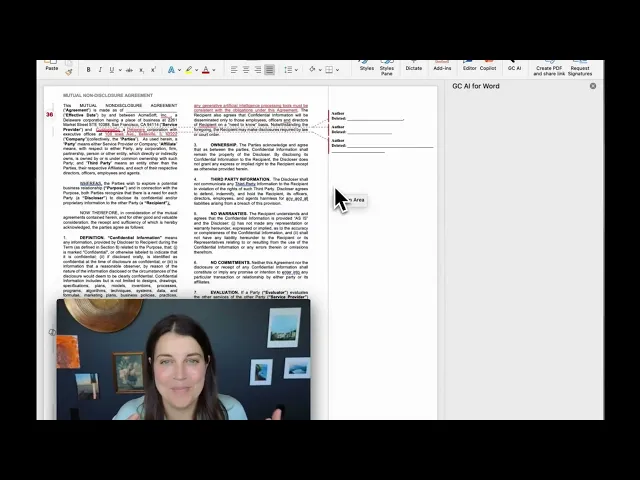
GC AI for Word puts the platform inside Word with the Skill Library and Easy Prompt already loaded with in-house workflows: NDA review, DPA negotiation, vendor MSA redlining, and board consent drafting. Word add-ins from Anthropic and Thomson Reuters also launched in 2026. For a deeper look at the platforms in-house teams use for vendor MSA review, see AI for MSA Review: 6 Platforms Compared for In-House Teams.
The differentiation here is the in-house specificity of the workflows that ship inside the add-in, the single web + Word surface, and the Skill Library tuned for the documents in-house teams see every week.
For a side-by-side comparison of the leading Word-native legal AI platforms, see The 4 Best Legal AI for Word for In-House.
Skill Library and Easy Prompt
Skill Library ships ready-to-use skills for the workflows in-house teams run every week: NDAs, DPAs, regulatory summaries, and board consents. Easy Prompt translates plain-language asks into AI-optimized legal prompts that help junior counsel produce more complete, senior-ready first drafts.
Exact Quote Citation
Exact Quote ties every quoted clause back to character-level source language in the underlying document. The verification layer the Concord Music filing did not have is the default behavior here.
GC AI Research
Research deploys multiple agents simultaneously across authoritative legal databases, government sites, and primary law, returning citations the user can verify in seconds.
GC AI’s December 2025 ROI study of more than 100 active customers found in-house lawyers saving an average of 14 hours per week and reducing outside counsel spend by 14%. For the median customer, that translates to roughly $252,000 in annual savings (math: 14% × $1.8M median outside counsel spend per the ACC Law Department Management Benchmarking Report).
GC AI is SOC 2 Type II and SOC 3 certified, GDPR compliant, with zero data retention agreements with OpenAI and Anthropic, and AES-256 encryption.
Cecilia, on the CZ and Friends podcast:
“You are a business person with a legal skill set.”
The chatbots in this list answer questions a lawyer asks. GC AI runs the matter a business needs closed.
Start This Quarter With Three Concrete Steps
Pick one workflow your team runs every week. Most teams pick NDAs, vendor MSAs, or a recurring regulatory review. Then in the next 90 days, do three things.
First, run the workflow against two chatbots and against GC AI’s free 14-day trial. Use the same document, the same set of questions, the same standard. Note how long each one takes, where the answer breaks, and what your verification step had to catch.
Second, write down the playbook your team is running in your head, even if it lives only as bullets in a Word file. The team that wins with legal AI is the team that has codified what “good” looks like before they ask the AI.
Third, in the third month, pick the platform that handled the document, the playbook, and the citation discipline best, and roll it to one more workflow. Adoption is slower than the AI hype cycle and faster than every other software rollout in your career.
Frequently Asked Questions
What Is a Legal AI Chatbot?
A legal AI chatbot is a conversational interface for legal questions, where the lawyer types a question in plain English and the chatbot returns an answer informed by legal information or primary law. ChatGPT, Claude, CoCounsel, and Lexis+ AI all operate this way. For in-house counsel, a chatbot is well-shaped for ad-hoc research and brainstorming, and poorly shaped for document-level work like contract redlining or matter workflow.
Is a Legal AI Chatbot Free?
Free legal AI chatbots exist, with the consumer-grade ChatGPT free tier the most common. For in-house work, the privacy, citation, and security disclosures most legal teams need only ship on paid enterprise tiers. The DoNotPay FTC settlement is the cautionary case for what “free legal AI chatbot” promised consumers and could not deliver.
What Is the Best Legal AI Chatbot for In-House Counsel?
GC AI is the best legal AI platform purpose-built for in-house counsel matter work, with character-level citation through Exact Quote, a Skill Library of ready-to-use in-house workflows (NDAs, DPAs, MSAs, and board consents), and a single web + Microsoft Word surface tuned for in-house teams. For law-firm research with Practical Law integration, Thomson Reuters CoCounsel is a strong research-specific option. For research grounded in the LexisNexis database, Lexis+ AI (Protégé) paired with Lexis Create+ is the natural pick for teams already on Lexis. For ad-hoc research and brainstorming, ChatGPT Business and Claude for Work both handle the conversational use case well, with Claude shipping a native Word add-in in April 2026.
What Happened in the Anthropic Claude Legal Filing Error?
In Concord Music Group v. Anthropic, Anthropic’s defense attorneys at Latham and Watkins used Claude, Anthropic’s own chatbot, to format a citation in an April 2025 expert declaration. Claude fabricated the title and the authors of the underlying article. A district court in California struck the relevant portion of the expert’s testimony. The signing attorney called it “an embarrassing and unintentional mistake.”
What Was the DoNotPay FTC Settlement?
The FTC finalized an order in February 2025 requiring DoNotPay to pay $193,000 in monetary relief, stop calling its chatbot “the world’s first robot lawyer,” and notify subscribers from 2021 through 2023 about the settlement. The FTC alleged DoNotPay never tested whether its AI performed at the level of a human lawyer and never hired or retained attorneys to validate its outputs.
Can a Legal AI Chatbot Replace an In-House Lawyer?
No, a legal AI chatbot cannot replace an in-house lawyer. The DoNotPay FTC enforcement is the legally binding version of that answer. Chatbots handle research and drafting kickstarts; matter judgment, privilege, and primary responsibility for advice stay with the lawyer. ABA Formal Opinion 512 covers attorney competence and verification duties when using AI.
What Is the Difference Between a Legal AI Chatbot and Workflow AI?
Legal AI chatbots answer a single question through a conversational interface, while workflow AI supports the matter workflow end to end: redlining a contract inside Word, applying a reusable playbook, generating a citation that ties back to the source language, and storing the result so the next matter starts from prior context. GC AI is built for workflow AI inside Microsoft Word.
Is ChatGPT Secure Enough for In-House Legal Work?
Yes, for ad-hoc research, if the team is on the Business or Enterprise tier. SOC 2 Type II compliance, stronger retention controls, and default no-training commitments; ZDR is available for eligible API endpoints and qualifying use cases. Two gaps remain: domain specialization (ChatGPT handles general-purpose work, so legal-specific output still needs lawyer verification) and Word integration.
How Do Legal AI Chatbots Handle Hallucinations?
Every chatbot can hallucinate. The question for in-house buyers is whether the verification layer is built into the platform or left to the user. Character-level citation systems such as GC AI’s Exact Quote tie every quoted clause back to source language in the document and surface confidence flags before the user signs anything.
What Features Should I Look for in a Legal AI Chatbot for In-House Work?
Six features matter for in-house teams: citation discipline (character-level if possible), privacy and zero data retention with the underlying LLM providers, domain specialization for legal output, native Microsoft Word integration, reusable workflow through playbooks and saved skills, and SOC 2 Type II compliance.