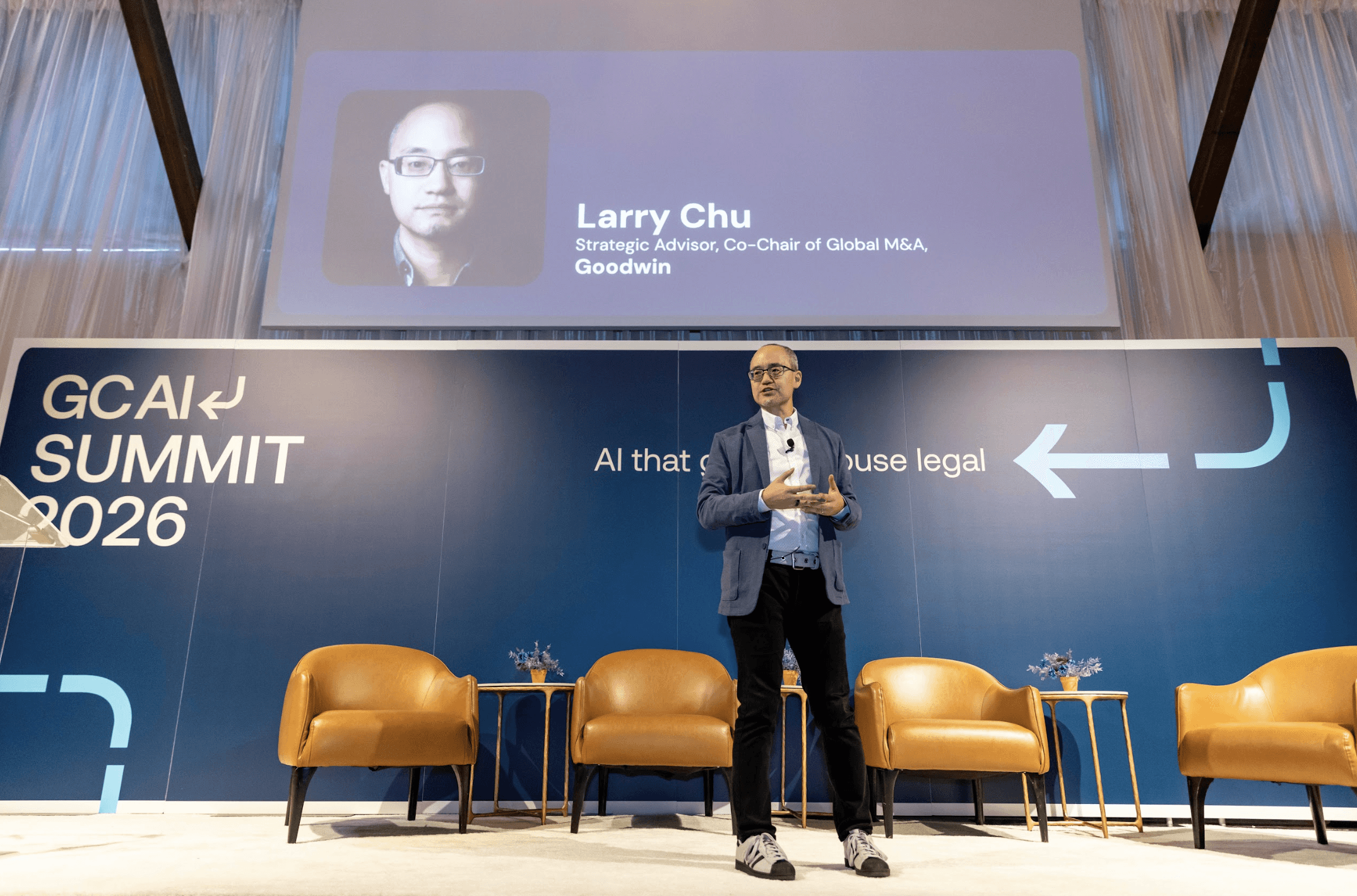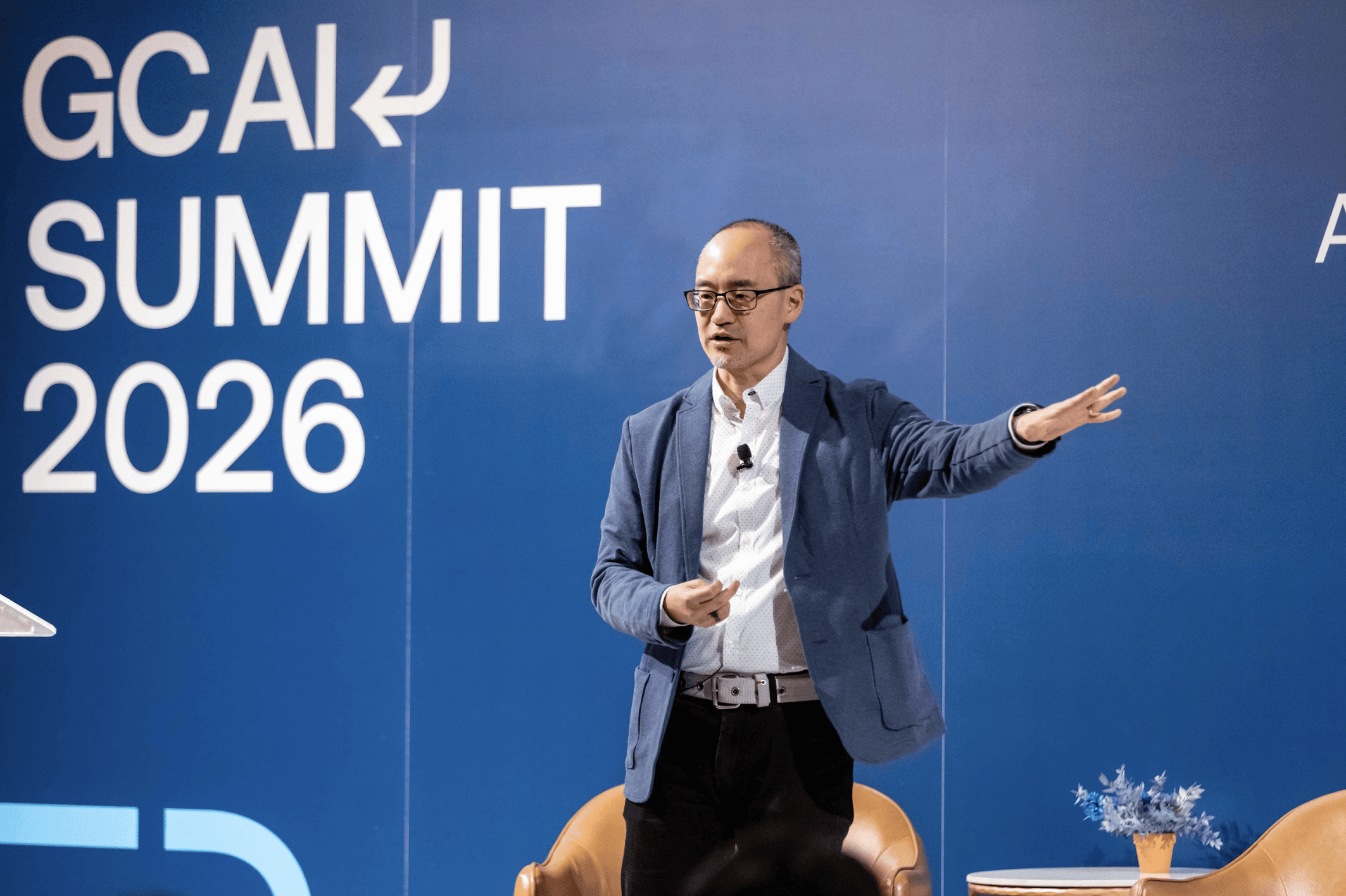
“AI is not a tool. It is a complete paradigm shift.”
Larry Chu, Partner at Goodwin, in the opening of his 2026 GC AI Summit session.
The goal of his speaking session was to give the room a set of frameworks for understanding how M&A is changing as AI reshapes companies, talent markets, and legal work itself.
Treating AI simply as another efficiency upgrade misses the shift underway.
M&A Value Is Moving Toward Talent and Time
Larry framed M&A success around three factors: strategic alignment, structural creativity, and risk management. Those ideas are familiar. What has changed is where value concentrates when AI is involved.
He described a strategic value pyramid. At the top sit people and collective know-how. Below that are product, technology, and customer deployment.
“At the highest levels in AI, there’s probably only 300 people.” Larry argues that elite AI talent is scarce.
Scarcity makes time the limiting factor. Larry emphasized that there is a real-time value that money alone cannot address. If AI capability becomes table stakes across industries, waiting a year to hire or build internally is often too slow.
This reality explains the rise of scaled acqui-hires, licensing structures, and halo transactions. These deals exist to compress timelines. They trade simplicity for speed.
For lawyers, this shows up as complexity. Consideration mechanics, fiduciary duties, retention incentives, and post-closing governance rarely resemble a standard transaction. Larry’s message was that structural creativity is now core to M&A execution.
AI and Associate Training
One of the most candid moments came during a question about junior lawyer development. Larry did not have a clear answer and his honesty resonated with the 150+ legal leaders in the room - many of whom started their own careers as junior associates.
Law firms have historically trained associates through repetitive work. Larry compared it to The Karate Kid.
"It's sort of like when Ralph Macchio is asking Mr. Miyagi, 'Why the hell do I have to paint the fence or wax the car? This is stupid.' But that's how you learn."
“You learn by managing a cap table. You learn by reading change of control clauses and building pattern recognition.”
Those tasks are also the easiest for AI to automate. Clients benefit from speed and cost savings. Associates see fewer opportunities to build judgment through repetition. Firms are left with compensation and promotion models designed for a workflow that no longer exists.
Larry was explicit about the scope of the problem.
“We have to rethink training 100%.”
Incremental fixes will not work. The open question is whether firms can design interactive, judgment-focused training that replaces manual repetition with structured learning. Simulations, AI-assisted review with feedback, and project-based work may fill part of the gap. For now, the gap is real, and junior lawyers are aware of it.
Treating AI as Software Is a Strategic Mistake
Larry returned repeatedly to the same warning: AI should not be treated as another tool layered onto existing workflows.
Law firms are already seeing pressure on pricing, turnaround time, and leverage models. Clients expect efficiency and transparency. Associates want to use AI, but doing so can push them further from billable targets. The current model strains on all sides.
Larry referenced the prediction that a venture deal could close without lawyers by 2026. Whether that happens is less important than the signal it sends. If AI drives the marginal cost of drafting and diligence down, the traditional investment model breaks.
That forces hard conversations about pricing and success-based fees. What do clients actually pay for? Larry has been pushing for outcome-based pricing in transactional work for years. In his view, the existing model serves no one well in an AI-enabled world.
Humans will remain in the loop, specialization still matters, and judgment does not disappear. What changes are the workflows and incentives that support that judgment.
Law firms that treat AI purely as an efficiency gain risk falling behind firms that treat it as an organizational shift.
Closing
What made Larry’s session land was specificity. He avoided abstract claims about disruption and focused instead on where change is already visible: deal structure, talent economics, training models, and pricing pressure.
For lawyers working in M&A, the work itself is not disappearing. Firms and legal teams that adjust early will have leverage. Those who delay will find themselves reacting to changes that are already in motion.