When we started GC AI, the bar was set high. The AI output had to meet the highest professional legal standards, or it wouldn’t be useful.
Legal teams evaluate AI on rigor, structure, and whether the reasoning holds up under scrutiny. Meanwhile, model capabilities have advanced quickly. Professional-grade legal work, however, requires more than stronger models. It requires coordinated research, systematic review, reconciliation of findings, and disciplined drafting.
Incremental upgrades were no longer enough. So we rebuilt the core chat experience from the ground up.
First, Let’s Talk About Agents
“Agent” means different things across the AI market. It can refer to autonomous systems, workflow automation layers, or standalone tools operating outside the core product.
That is not how Chat 2.0 uses agents.
In Chat 2.0, agents operate at the architectural layer within the core chat experience. They coordinate research and analysis behind the scenes while the customer remains in a single, continuous conversation.
They structure how the system thinks.
When a complex legal question is asked, specialized research and analysis processes run in parallel. Findings are reconciled before output is delivered. The result is structured work grounded in primary sources and document analysis. Multi-agent architecture here means coordinated intelligence embedded directly in the product to improve depth and reliability across legal tasks.
Parallel Research With Real-Time Transparency
Consider the question: Which states restrict the use of AI or require disclosure for the use of AI in hiring?
Solutions Attorney Taylor Robertson walks through this example in the video below.
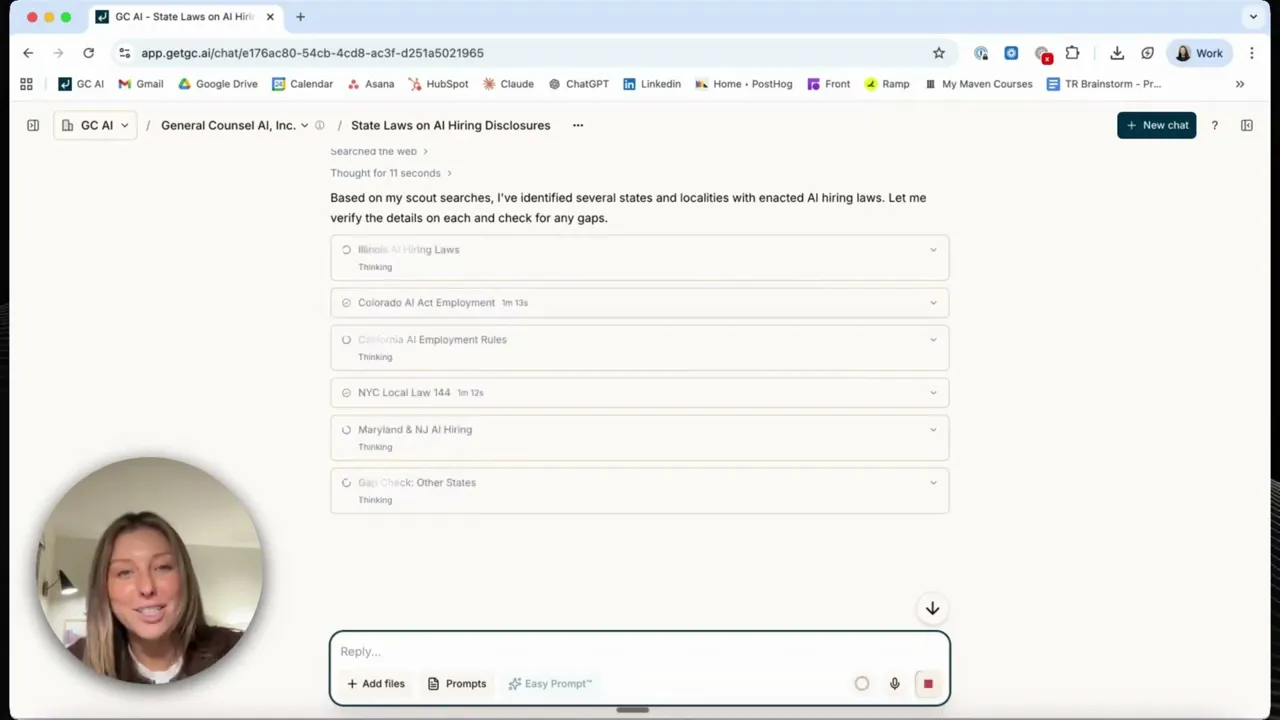
Chat 2.0 launches coordinated research that:
Search state statutes and prioritize trusted legal sources
Review agency guidance and regulatory commentary
Analyze relevant court decisions
Compare requirements across jurisdictions
Cross-check findings before synthesis
Separate processes review multiple jurisdictions simultaneously. Each extracts key statutory language. Findings are compared side by side before the final output is generated. Customers see progress in real time as the system reviews sources such as California regulations, EEOC guidance, and congressional records. The output is structured and cited. A comparison table references each state’s law. From there, the workflow continues:
The customer uploads internal hiring policies for comparison
Asks follow-up compliance questions
Is able to draft a compliant disclosure notice
Research runs in parallel without degrading performance on long documents or follow-up analysis. The conversation remains clear and usable and for multi-jurisdiction compliance work, which compresses hours of manual research into minutes.
Iterative Document Review That Mirrors Legal Practice
Chat 2.0 retrieves document content dynamically. It can read specific sections, search for defined terms or clauses, and query for semantic meaning across an agreement. Importantly, the system pulls only what it needs at each step. It can review one section, identify a risk, and pivot to related provisions elsewhere in the document. This improves:
Citation accuracy
Clause detection
Reliability in long agreements
Precision in contract comparison
Large MSAs, diligence sets, and policy audits can be reviewed in full. Relevant provisions are retrieved dynamically rather than relying on fixed excerpts. Findings are grounded in specific language and reconciled before conclusions are presented.
Structured Reasoning for Complex Legal Tasks
For contract review, regulatory research, and document comparison, Chat 2.0 follows a five-step framework:
Scope: Define what must be covered
Systematic Sweep: Review each relevant dimension methodically
Pattern Tracing: Connect findings to broader themes
Completeness Accounting: Verify no material issue is omitted
Reconcile: Ensure findings are accurately reflected in the final output
Each major issue category is accounted for before conclusions are delivered. Findings are tracked and reconciled to reduce the likelihood of missed risks, all of which produces more consistent and defensible review quality across repeated workflows.
Writing Quality Designed for Legal Stakeholders
Chat 2.0 was rebuilt to reflect professional legal communication. Output is:
Point-first
Structured
Direct
Free of filler language
Free of conversational padding
Contract reviews include severity categorization and proposed resolutions. Strategic advice begins with a clear recommendation. Regulatory summaries cite primary authority. The tone reflects how senior legal teams communicate: direct, structured, and defensible. Work product can be shared with business partners or external counsel with minimal editing.
Built-In Legal Task Patterns
Chat 2.0 includes embedded reasoning structures for eleven core workflows:
Contract Review
Contract Redlining
Strategic Advice
Document Summarization
Regulatory Research
Employment Law
Dispute Resolution
Contract Drafting
Document Editing
Document Comparison
Policy Creation
Customers do not need to over-engineer prompts. The system applies professional structure automatically based on the task.
Immediate Usability for Legal Teams
For existing customers, Chat 2.0 strengthens the workflows you already rely on with deeper research, more reliable analysis, and higher writing quality.
For prospective customers, this release reflects how GC AI approaches legal AI at the architectural level. Structured reasoning is embedded. Research transparency is visible in real time. Document analysis is iterative and precise.
Chat 2.0 powered by a multi-agent architecture delivers:
Stronger primary source grounding
Higher research accuracy
More reliable contract review
Improved document comparison logic
Better instruction following
Less need to break tasks into granular sub-prompts
This release advances GC AI’s core intelligence layer and raises the standard for AI-assisted legal work.
See Chat 2.0 in Action
If you are an existing customer, Chat 2.0 is now available in your workspace.
If you are exploring GC AI for your legal team, we'll show you how the new multi-agent architecture performs on your contracts, policies, and regulatory questions.
Book a demo to see Chat 2.0 powered by a multi-agent architecture in action.