💁🏻♀️ Built for In-House Legal Work
GC AI was built by a GC (ex-Morrison Foerster. tech transactions and litigation). The system is tuned by default to align with how in-house legal teams analyze issues and communicate advice. Outputs are structured to reflect common in-house expectations, including issue spotting, risk framing, and practical guidance. Legal tone and organization are consistent without requiring extensive prompt customization. GC AI includes an extensive library of legal-specific workflows, including:
🔒 Closed System and Data Handling
GC AI is designed to align with confidentiality expectations for legal work and applicable California Bar guidance.
Segregated databases by user and organization
No training on customer or confidential data
Data transmitted to underlying language model providers solely to generate responses, without retention by those providers
🛣️ Multi-Model Architecture
GC AI uses a multi-model strategy and selects underlying models based on the task and use case. This approach optimizes for reasoning quality, document handling, and citation reliability. Currently supported models include:
OpenAI GPT-4 and GPT-5
Anthropic Claude Opus and Sonnet 4.5
Google Gemini
✏️ Prompting and Workflow Support
Easy Prompt™
Use AI to help you use AI. Give GC AI a concept of a prompt, press the button, and the AI comes up with a perfectly-crafted AI readable prompt for you to tweak and use. In the words of GC AI users: “magic!”, “unbelievable”, “may be the greatest idea of all time”, “I just got to blow the mind of our senior leaders [with it].” General purpose tools try to get there through back and forth questions, though none are tuned for legal. See demo video.
🤝 Collaboration and Team Use
GC AI supports team-based legal work through secure collaboration features, including:
Shared prompts, workflows and playbooks
Shared files
Permissioned access controls
🌐 Web Research and Trusted Legal Sources
GC AI actively searches the web for legal authority and performs up to 30 parallel searches per query. It prioritizes trusted legal sources, including statutes, regulators, agencies, and established law firm publications.
Our system uses Google to surface primary and secondary legal sources, resulting in more complete and more reliable citations to specific laws, regulations, and official guidance. Users can also inspect the sources reviewed and relied upon for each response.
Example search on GC AI versus similar search on ChatGPT
GC AI cites the Texas AG and Davis Wright & Tremaine
ChatGPT appears to hallucinate, linking to three articles that are “not found”
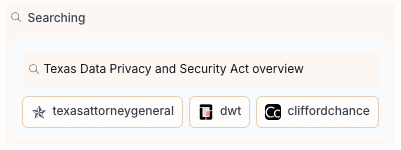
Finally, while processing, GC AI provides the user with what AI sees and is using in the search:
📚 Real Case Law a General-Purpose Tool Cannot Reach
A general-purpose chatbot summarizes the open web and can invent citations that do not exist. GC AI now searches US Case Law directly in chat: ask a question in plain English and it reads from a dedicated database of 13M+ federal and state court opinions, checks treatment data to flag whether each case is still good law, and links every citation to the full opinion you can open and verify. Coverage spans federal courts at every level plus the state supreme and appellate courts of all 50 states, D.C., and the Delaware Court of Chancery. For exhaustive litigation research, some teams keep a traditional research platform alongside GC AI.
In a general-purpose chatbot, a great prompt lives in your chat history; in a purpose-built platform, it becomes a saved workflow your whole team runs. How to build Skills in GC AI shows the difference in practice.
👀 Exact Quote and Document Fidelity
As a lawyer, paraphrasing is often insufficient. Legal analysis depends on exact language. GC AI is engineered to prioritize verbatim accuracy when users request quotations from contracts, policies, and regulatory materials. This includes:
A proprietary PDF parsing pipeline
Advanced OCR for scanned and image-based documents
Document chunking and context management to preserve clause integrity
Page and section-level citation
In side-by-side testing using identical prompts and source documents, GC AI consistently returns accurate quotations with correct section references. By contrast, we have observed that ChatGPT can hallucinate, misquote, or misleadingly paraphrase even when explicitly asked to provide exact language. In some cases, outputs are labeled as “quotes” despite the text not appearing in the underlying document.
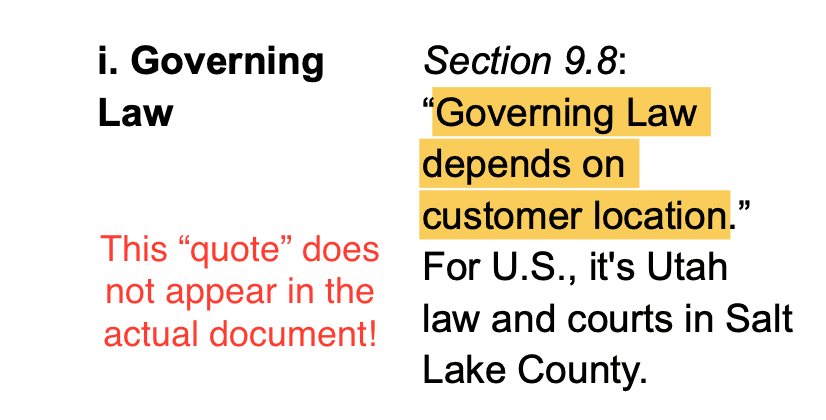
Example showing a purported quotation generated by ChatGPT that does not appear in the source document.
For legal teams, these errors are material. Dropped words, altered phrasing, or missing qualifiers can change the meaning of a provision and introduce risk.
⚖️ Why This Matters for Legal Teams
Legal work requires precision, traceability, and confidence in source material. Small inaccuracies can have outsized consequences when advice is based on contractual or statutory language. GC AI is designed to support everyday legal workflows by reducing the likelihood of misquotation, hallucination, and source ambiguity.
GC AI is enterprise-ready. It runs in production at 2,100+ legal teams, including 200+ public companies and 25 unicorns, and is SOC 2 Type II and SOC 3 certified, GDPR compliant, and built on zero data retention agreements with OpenAI and Anthropic.